What AI Search Knows About Your Business in 2026
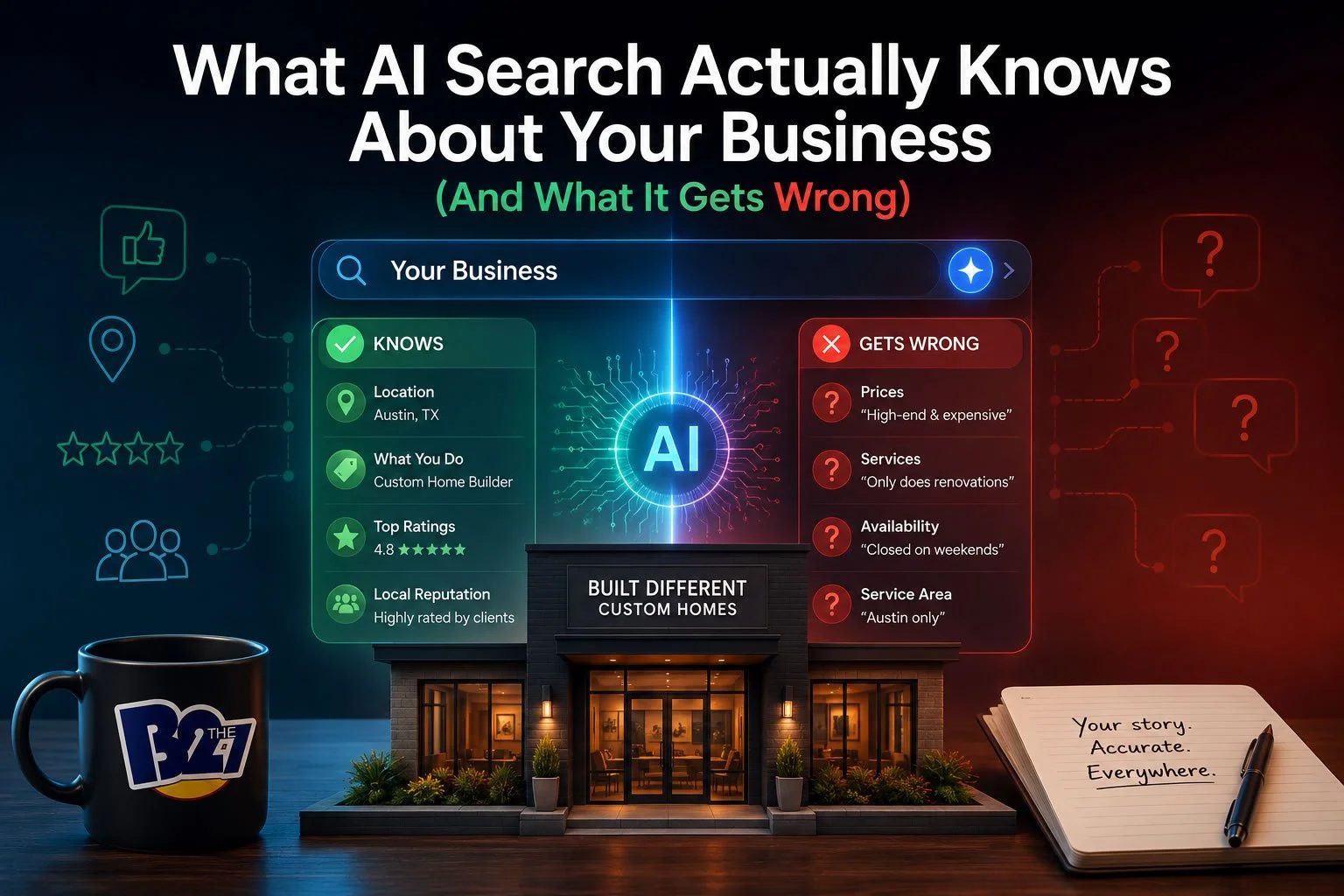
AI search tools including ChatGPT, Google AI Overviews, Gemini, and Perplexity are now how 45% of consumers find local businesses. If your business is not showing up in AI-generated answers, you are invisible to those customers. Here is what AI actually knows about your business and how to fix the gaps.
AI search tools build their picture of your business from your website, Google Business Profile, directory listings, reviews, and any external mentions across the web. Thin content, inconsistent information, or a lack of external citations causes AI to skip your business entirely or present wrong information. Auditing what AI says about you right now is the first step to fixing it.
What You Will Learn
I want you to do something right now, or at least soon. Open ChatGPT. Type in the question your ideal customer would ask. Something like "who is a good digital marketing consultant in Louisville" or "where can I find original photography on canvas in Kentucky" or "what is the best social media strategy for a small business in Louisville."
Then read what comes back.
A lot of small business owners do this for the first time, and one of two things happens. Either they get a response that does not mention them at all, even though they have been in business for years and rank reasonably well on Google. Or they get a response that mentions them but gets something wrong. Old address. Outdated service description. Or worse, it describes a competitor's positioning in the answer and attributes it to them.
Both outcomes are a problem. And both are fixable. But you cannot fix something you have not looked at.
I'm Bernie. I run B2The7, and I work with small businesses on exactly this kind of AI search visibility gap. Here is what is actually happening inside those AI systems when they decide who to mention and who to skip.
Why This Is Happening Faster Than Most People Think
ChatGPT hit 900 million weekly active users in early 2026. That is roughly one in nine people on earth interacting with it every week. And that is just one platform. Gemini, Perplexity, and Claude are growing fast alongside it, with Gemini's market share jumping from about 6% to over 25% in twelve months.
This is not a trend that is still a few years away. It is already changing how people find local businesses. When something jumps that quickly, it is no longer emerging technology. It is becoming part of everyday customer behavior.
When someone searches on Google, they get ten results. When someone asks ChatGPT who to hire, they get one answer. Two or three businesses, named directly. If you are not in that answer, you were not considered at all.
Bernie Fussenegger, Chief Cheese, B2The7That is what makes AI search different from Google. There is no page two. No second chance to catch someone scrolling back up the results. Either you are named or you are not. If you want the mechanical version of how that single answer gets assembled, and why one business makes it in while another does not, that is in how GEO actually works.
What AI Tools Actually Know About Your Business
Here is the part that surprises most people. What ChatGPT knows about your business is not what you told it. It is whatever the public web has indexed about you, filtered through the model's training data, and any live web search it runs to supplement its knowledge.
That means your website copy matters. But so do your Google Business Profile, your directory listings, your review platforms, any press mentions, any social media presence, and any third-party sites that reference you. AI tools are not reading your site the way a human does. They are building a picture of your business from every publicly available signal they can find.
If those signals are inconsistent, the AI gets confused. Different name formats in different directories. An old address still listed somewhere. A service description on Yelp that does not match what your website says. These inconsistencies cause AI tools to either skip your business entirely or present a muddled picture of who you are.
If those signals are thin, the AI has nothing to work with. A business with a basic website, no reviews, and no directory presence is essentially invisible to these systems. They cannot confidently recommend something they cannot verify from multiple sources.
The weighting shifts if you serve one market. Directory consistency and Google Business Profile accuracy carry more influence for a local business than they do for a national brand, because AI tools have fewer independent sources to cross-check against. That version is in GEO for local business and AI search visibility in Louisville.
A Real Example: What AI Says About B2The7
I regularly do this exercise for my own business because I think it is important to know what potential clients are finding when they search for me before they ever visit my site.
When I ask ChatGPT who is a good digital marketing consultant in Louisville, B2The7 does come up. The answer mentions digital marketing strategy, content, and SEO services in Louisville. It references my background in marketing for larger brands. That is a reasonably accurate picture.
But here is what is interesting. The answer does not mention the canvas photography. It does not mention GEO or AI search visibility, which is increasingly a core part of what I do. Those things are not invisible to AI because they do not exist on my site. They are invisible because the content that covers them is newer and has not yet built enough external citation signals.
That is a real and live example of how AI visibility works. It is not all-or-nothing. It is a picture built from signals, and the picture is always a few months behind what you are actually doing. Which is why building those signals consistently matters more than any single piece of content.
The Three Biggest Mistakes Brands Make Optimizing for AI Search
Inconsistent Business Information Across the Web
Your business name, address, and phone number appear in more places than you realize. Google Business Profile, Yelp, local chambers, industry directories, Facebook, and the BBB. If any of those use a slightly different version of your name or an old address, AI tools see conflicting signals and reduce confidence in your listing. Standardize everything to a single, exact format. The Google Business Profile optimization guide on this site covers exactly how to audit and lock down those signals.
Content That Exists Only on Your Own Domain
AI tools build confidence in a business by seeing it referenced across multiple credible sources, not just on your own site. If your business only exists on your website, that is a real limitation. Reviews, directory listings, press mentions, podcast appearances, guest articles, and local news coverage all matter. Every external reference adds a verification signal AI tools use when deciding who to recommend. The free local SEO checklist on this site has a full audit section for exactly this.
Generic Content That Does Not Answer Specific Questions
AI tools are not looking for impressive-sounding copy. They are looking for content that directly answers the specific question someone asked. A page that says you are passionate about helping businesses grow is not something an AI will quote. A page that says you have run paid media programs for a regional restaurant chain with 700 locations and shares what worked is the kind of specific, credible content that gets cited. This is also why SEO is not dead, just evolving, and why the businesses getting found are the ones whose content actually answers real questions rather than broadcasting a brand message.
These three problems connect directly to the broader visibility gap most Louisville small businesses face. I covered the full picture in why Louisville small businesses are invisible online, and the AI visibility layer is one more dimension of the same underlying issue.
The fixes themselves are their own subject. Crawler access, Bing indexing, content structure, and the off-site signal work all have a specific order to them, and I laid that out step by step in how to get cited in AI search. Worth reading once you know what your gaps actually are.
Frequently Asked Questions
Most small businesses have never asked AI what it knows about them. That is the first thing to fix. Not because the answer will be terrible, but because you cannot improve something you have not measured. I walk through exactly how to run that check yourself, step by step, in How to Check Your AI Search Visibility in 2026.
Forty-five percent of consumers are using AI to find local businesses right now. That number will keep growing. Meanwhile the traffic you already have is quietly moving, which is the other half of this story and the subject of why AI Overviews are killing your traffic. The businesses that understand what AI knows about them, fix the gaps, and build the signals that earn AI citations are building a real competitive advantage over those who are still only thinking about Google rankings.
If you want to understand what AI is currently saying about your specific business and what it would take to improve that picture, that is exactly what I work through with clients. You can also read more about what generative engine optimization is on this site.