What Is GEO and How Does It Work? A 2026 Guide
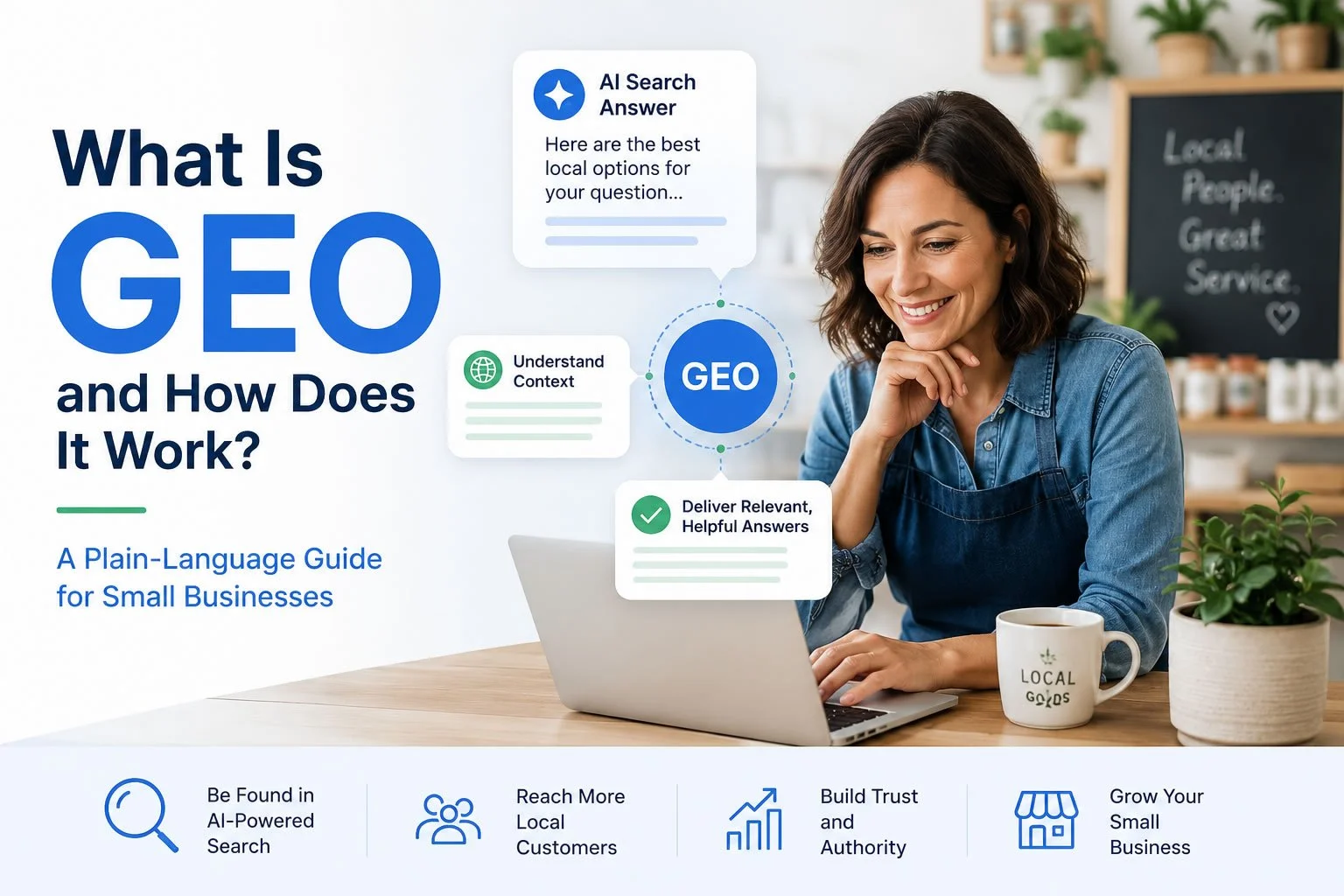
Generative Engine Optimization (GEO) is the practice of structuring content and building digital authority so AI-powered search tools like ChatGPT, Google AI Overviews, Perplexity, and Gemini cite your business in their generated answers. Unlike traditional SEO, which earns a spot in a ranked list of links, GEO earns a citation inside the answer itself. Research from Princeton, Georgia Tech, IIT Delhi, and the Allen Institute for AI found that GEO-optimized content achieves up to 40% higher visibility in AI-generated responses. Bernie Fussenegger at B2The7 in Louisville helps small businesses understand GEO and build content that earns citations across AI search platforms.
Someone asked me recently how GEO actually works. Not what it is (I broke that down in what generative engine optimization is), not why it matters, but what is literally happening inside the AI when it decides to mention one business and ignore another.
That is the right question. And most articles about GEO skip it. They tell you to write better content, add FAQ sections, and be more specific. All of that is true. But if you do not understand the mechanism, you are following instructions without knowing why they work. And when something stops working, you have no idea how to fix it.
So let me walk through what is actually happening. Not the theory. The actual process.
What You Will Learn
What query fan-out is and why it is the core mechanic behind every GEO strategy
How AI tools retrieve and evaluate content when building an answer
Why the same content can rank on Google and be ignored by ChatGPT
What GEO-optimized content looks like versus content that gets skipped
How to know if your content is set up to be cited or set up to be skipped
Step One: The Question Gets Broken Apart
When someone types a question into ChatGPT or asks Google AI Overviews something, the AI does not just paste that question into a search engine and grab the top result. That would be too simple, and the answer would be too narrow.
What actually happens is something called query fan-out. The AI breaks the original question into several smaller sub-queries and searches for each one separately. If someone asks who is a good digital marketing consultant in Louisville, the AI might generate sub-queries like what does a digital marketing consultant do, how to find a marketing consultant in Kentucky, and what makes a good marketing consultant for a small business.
It searches for each of those separately, retrieves relevant content from multiple sources, and then synthesizes them into a single answer.
This is why GEO is not a one-keyword game. You do not optimize a single page for a single term. You build a cluster of content that covers a topic from multiple angles so that when the AI fans out across several sub-queries, your content shows up on more than one of them. The more sub-queries your content answers, the more likely you are to appear in the final synthesized response.
This is exactly why the cluster strategy in GEO vs SEO for small businesses works. One article targeting one keyword is not enough. A cluster of interconnected content on the same topic is what earns consistent AI citations.
Step Two: The AI Retrieves and Evaluates Sources
After generating the sub-queries, the AI retrieves content to answer each one. This is where the selection process gets interesting, and where most small businesses lose out without realizing why.
AI tools are not selecting content the way Google does. Google ranks pages based on backlinks, technical signals, and keyword relevance. AI tools are looking for something different. They want semantically clear content that directly answers the question, is specific enough to be credible, and can be extracted and quoted without losing meaning.
A page that takes three paragraphs to get to the answer is not going to get cited. A page that opens with a direct answer in plain language and then expands on it has a much better shot.
The AI is also looking for signals of consistency. If your business name, address, and description appear consistently across multiple credible sources, directories, and review platforms, and in your Google Business Profile, the AI treats that as a verification signal. Inconsistency suppresses confidence. Consistency builds it. For a business serving one market, that consistency layer does most of the work, which is why GEO for local business and AI search visibility in Louisville looks different from GEO for a national brand.
Step Three: Synthesis and Citation
Once an AI tool gathers information from different sources, it builds a response using what it has found. It isn't copying paragraphs from one website. Instead, it pulls together the most useful information, summarizes it, and writes a new answer. When it names a business, references a website, or cites a source directly, it's usually because that information was clear, specific, and trustworthy enough to stand behind.
This is why generic content gets skipped. A page that says we are a passionate full-service marketing agency dedicated to helping your business grow is not something an AI is going to quote. There is nothing extractable. There is nothing specific. The AI cannot point to it and say, this is why I am recommending them.
A page that says Bernie Fussenegger built and ran marketing programs for Papa John's and Confluent Health, and now works with Louisville small businesses on GEO, SEO, and paid media strategy, is something the AI can work with. It has a named person, a verifiable background, a specific location, and specific disciplines. That is citation-ready content.
Why Google Rankings and AI Citations Are Two Different Things
This is the part that confuses most people and is worth a minute of your time.
You can rank on page one of Google for your main keywords and still be completely invisible in ChatGPT.
The reason is that Google and AI tools are optimizing for different outcomes. Google is optimizing for relevance and authority in a link list. AI tools are optimizing for clarity and extractability in a synthesized answer. I covered this distinction in more detail in what AI search actually knows about your business, which explains why the gap between your Google presence and your AI presence is often larger than most people expect.
The practical implication is that GEO requires different choices than SEO. Not instead of SEO. In addition to it. You need both. But the content you write for GEO looks different from the content you write to rank for a keyword.
Treating them the same is why so many businesses have strong Google rankings and almost no AI visibility.
What GEO-Optimized Content Actually Looks Like
The answer is in the first two sentences.
Not teased. Not set up with context. The actual answer to the question the page is about. AI tools pull from early content. If you bury the answer in paragraph four, you are invisible regardless of how good paragraph four is.
Clear, descriptive headings that mirror questions.
A heading that says What Does GEO Mean for a Small Business is more extractable than one that says Our Approach. The AI is parsing your structure to find answers to specific questions. Help it find them.
FAQ sections on every key page.
FAQ content is already formatted as a question and a direct answer. It requires almost no interpretation from the AI. It is the most reliable content format for AI citations and the most underused by small businesses.
Specific, verifiable claims rather than general statements.
Named clients. Specific results. Verifiable locations. Actual numbers. The more specific and verifiable your content is, the more an AI can use it as a credible source. Generic expertise claims get skipped. Specific ones get cited.
Understanding the mechanism is one thing. Doing the work is another. The step-by-step version, including the crawler access and Bing indexing checks that have to happen before any of this content advice matters, is in how to get cited in AI search.
Frequently Asked Questions
GEO stands for Generative Engine Optimization. It is the practice of structuring your content and building your digital presence so AI tools like ChatGPT, Google AI Overviews, Perplexity, and Gemini cite your business when generating answers. The goal is not just to rank in a list of links but to be named inside the answer itself. Research from Princeton, Georgia Tech, IIT Delhi, and the Allen Institute for AI, published at KDD 2024, found that GEO-optimized content achieves up to 40% higher visibility in AI-generated responses than unoptimized content.
When someone asks an AI a question, the system breaks that question into several smaller sub-queries using a process called query fan-out. It searches for each sub-query separately, retrieves relevant content from multiple sources, evaluates that content for clarity and credibility, and then synthesizes everything into a single answer. Businesses whose content shows up on multiple sub-queries, and whose content is specific and clearly structured, are more likely to appear in the final answer.
Not exactly. They build on many of the same fundamentals, but they're trying to accomplish different things. SEO is about helping your website rank higher in search results. GEO is about giving AI tools enough confidence to mention your business when they generate an answer. That means your content has to be easy to understand and easy to quote. Put the answer near the top of the page, use headings that match the questions people actually ask, and back up your points with clear, specific information. In 2026, the businesses seeing the best results aren't choosing between SEO and GEO. They're building content that works well for both. The full comparison is in GEO vs SEO for small businesses.
Google and AI tools use different selection criteria. Fewer than 40% of AI-cited sources come from Google's top 10 results. AI tools are looking for content that is clearly structured, directly answers specific questions, and is consistent across multiple credible sources. A business with strong Google rankings but generic website copy, no FAQ sections, and inconsistent directory listings can rank well on Google and be completely invisible to ChatGPT and Perplexity at the same time.
Rewrite the opening paragraph of your most important service pages so the main answer is in the first two sentences. Then add a FAQ section to each of those pages with four to six questions your customers actually ask, answered directly and specifically. Those two changes address the most common reasons AI tools skip content and can show early citation results within a few weeks of implementation. The complete checklist is in getting cited in ChatGPT and AI search.
The Bottom Line
GEO is not complicated once you understand what the AI is actually doing. It is breaking your topic into multiple sub-questions, retrieving the clearest and most specific answers it can find, and synthesizing them into a response. The businesses that show up consistently are the ones that made their content easy to find, easy to extract, and specific enough to attribute.
Most of your competitors have not thought about this yet. That is the window. It is not going to stay open indefinitely.
If you want to understand where your specific business stands in AI search and which fixes are highest priority, that is the kind of GEO work I do directly with small businesses. You can also check your own AI search visibility with the free 20-minute walkthrough on this site.
GEO Strategy
B2The7 helps small businesses build content that earns citations in ChatGPT, Google AI Overviews, and Perplexity. One senior strategist. No agency overhead.
Work With BernieThe Newsletter
Marketing news and practical strategy for small business owners. No filler. Straight to your inbox.
Get the NewsletterBernie Fussenegger is a Louisville-based digital marketing strategist who helps small businesses get found on Google and inside AI search results. He has built marketing programs for companies including Papa John's and Confluent Health and now works with small businesses that need enterprise-level thinking at a scale that actually fits them. Find him at b2the7.com.