How to Get More Local Customers With Google Business Profile + SEO
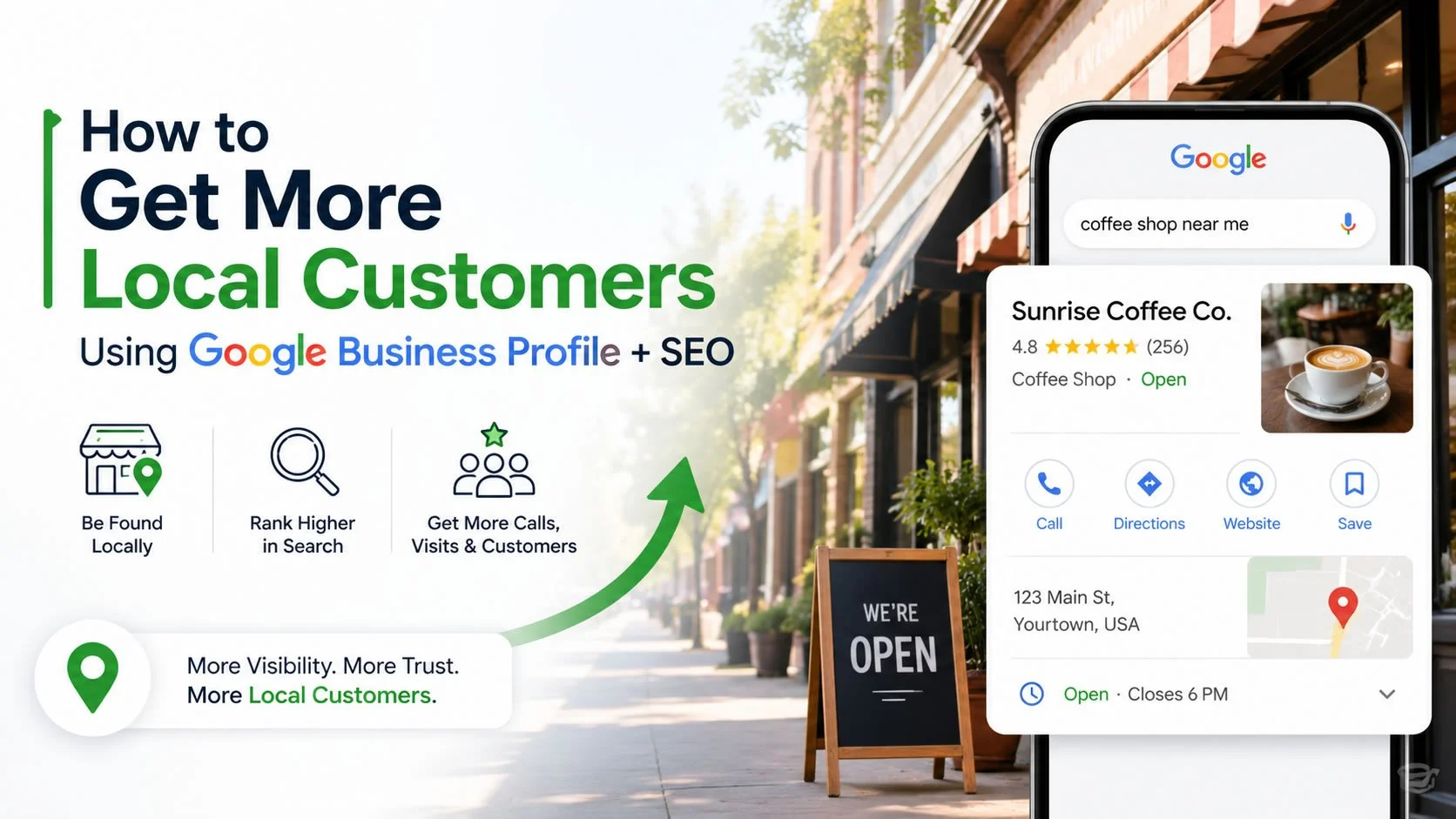
Google Business Profile optimization is the most direct path a local business has to showing up in front of buyers who are actively searching nearby. When someone types "best plumber near me" or "coffee shop open now," Google's local pack pulls from verified, active, well-maintained profiles. Businesses that treat their profile as a living asset, not a one-time setup, consistently outrank competitors with bigger budgets. This guide covers the exact steps to optimize your profile, build a review process that runs consistently, put the right content on your website, and track the numbers that actually predict revenue. Local SEO for small business is not complicated. It rewards consistency, and most of your competitors are not doing it consistently.
- Why Google Business Profile optimization moves the needle faster than most other local marketing tactics
- Which profile fields actually affect your Maps ranking, and which ones most businesses skip
- Why reviews, posts, and photos are ranking signals, not just ways to look credible
- How to build a local content strategy that captures "near me" searches
- What to measure so you stop guessing and start making decisions with real data
- How long it takes to rank on Google Maps and what determines the timeline
- The five local SEO mistakes that keep small businesses invisible in local search
Someone in your city is searching for what you sell right now. They are ready to buy. The question is whether your business shows up first or your competitor does.
For most small businesses, the answer is no. It is not about budget or how long you have been around. It comes down to whether your Google Business Profile is set up and being managed the right way.
This guide breaks down the steps to fix it, starting with your profile, then reviews, content, and tracking, so you can see what is actually making a difference.
Your Google Business Profile is the single most direct lever a local business has for showing up in Google Search and Google Maps. This article focuses on five areas that make a real difference: getting your profile verified and fully completed, setting up a steady flow of reviews, staying active with posts and photos, adding location-based content to your website, and checking your GBP performance each month. Businesses that do all five appear 18 times more often in local results and pull in up to 70% more profile visits than those with gaps or no activity.
Start with verification. Fill in every field on your Google Business Profile. Make sure your business name, address, and phone number appear the same across all platforms. Ask for reviews regularly. Post something at least twice a week. Publish content on your website that speaks to your specific location and services. Do those things consistently, and your visibility in local search starts compounding.
Why Your Biggest Local Marketing Problem Is Not Budget. It Is Visibility.
Google handles over 8.5 billion searches every day. A large share of those carry local intent, meaning someone nearby is looking for a specific product or service and wants it soon. Data shows that 46% of all Google searches have local intent, and 76% of people who run a local search visit a business within 24 hours. That is not a passive audience browsing content. That is a buying audience looking for somewhere to go.
Your Google Business Profile determines whether you appear in the local pack, the map-based results that appear above regular organic listings. It is the most visible real estate on Google for local searches, and it is free to claim and manage. The businesses ranking there are not necessarily larger or older. They are the ones keeping their profiles active and up to date.
Google has been building AI features into local search throughout 2026, and the ranking signals that matter have shifted with it. Profiles that stay active, collect fresh reviews, and publish current content are pulling ahead. Stale listings are getting passed over, even ones that used to rank well.
The businesses winning local search right now are not spending more. They are staying consistent. Every week the profile stays active, every review that comes in, every post that goes up adds to a foundation that compounds over time. The gap between brands that keep at it and those that fade out becomes very hard to close after six months.
Claim, Verify, and Fill In Everything
Go to business.google.com and either claim your existing listing or create a new one. Verification tells Google this is a real business at a real address. In 2026, you can verify through a postcard, phone, email, or video. Until your profile is verified, none of the optimization you do matters. Google will not surface an unverified listing in the local pack.
Once verified, fill in every available field. Not most of them. All of them. Here is what carries the most weight:
- Business name: Use the name on your signage and legal filings, nothing more. Stuffing keywords into your business name violates Google's guidelines, and the company enforces them with suspensions.
- Primary and secondary categories: The primary category is the most consequential choice in your entire profile setup. Get it wrong, and you will not show up for the searches that matter. Secondary categories extend your reach to related services. Look at what your top local competitors are using before you lock yours in.
- Business description: You have 750 characters. Put your primary keyword near the top. Be specific about what you do and what makes you different from the competitors a block away.
- Hours: Keep them accurate. Update for holidays before they happen. Businesses with incorrect hours get negative reviews from people who show up to find a locked door, and Google factors that into its ranking.
- Phone, website, and address: These three pieces of information have to match exactly across your website, Yelp, Facebook, and every other directory listing. Mismatches confuse Google and hurt your ranking. This is called NAP consistency, short for Name, Address, Phone.
- Services and products: List every service with a short description that includes relevant local and service terms. Google now cross-references your GBP services tab against your website to confirm expertise.
Build a Review Process That Runs Every Week
Reviews are one of the top Google Maps ranking factors. Not just the count. The recency, response rate, and language used in both the review and your reply all factor into how Google reads your profile. Businesses that manage reviews actively build 1.7 times more consumer trust than those that ignore the feedback section.
The most effective approach is straightforward:
- Ask right after a good experience. Text, email, or in person, ask while the customer is still in a positive headspace. Waiting days or weeks sharply drops response rates.
- Cut the friction. Use the review request link from your GBP dashboard or generate a QR code. The fewer clicks a customer has to make, the more reviews you get.
- Reply to every review, good or bad. Your response tells the next potential customer how you operate. Use real language and work a service name or location in where it fits naturally.
- Do not buy reviews or ask for bulk submissions. Google flags patterns. Five-star reviews from accounts with no history posted in the same week will trigger a review removal, not a ranking boost.
No specific number of reviews will get you into the local pack. What Google is weighing is how recent your reviews are and whether you are responding to them. Forty reviews from the last few months, all answered, will outperform 200 reviews from two years ago that nobody replied to. Build the habit of asking regularly and responding every time.
Post Consistently and Keep Your Photos Current
Plenty of businesses add a logo and a few photos during setup and never come back. Competitors who post two or three times a week are quietly taking ground because of it. Posting consistency became a real ranking factor in 2026, and the numbers back it up. Profiles that publish regularly see 34% higher engagement than those that post once a month or go dark entirely.
What to publish:
- "What's New" updates: a new service, a team addition, a seasonal change, or updated hours
- A time-limited offer that gives someone a reason to pick up the phone today
- Local events you are involved in or running
- A straight answer to something customers ask you constantly
Each post needs a call to action and a link you can track. That way you know which posts are driving actual traffic and which ones are just filler.
Professional images get 35% more clicks than stock or low-quality shots. Upload pictures of your actual space, your actual team, and your actual work. Aim for at least one new photo per week. Google measures engagement with your images, including views and clicks, and uses those signals in ranking decisions.
Put Local Content on Your Website
Your Google Business Profile and your website work together. Google constantly checks one against the other. If your profile lists a service and your website has nothing about it, that gap registers as a credibility problem. Here is how to close it:
- Build a page for each area you serve. If it is one city, your homepage should say so directly. If you cover multiple areas, each one deserves its own page with content that is actually about that place, not a template with a different city name dropped in.
- Write locally focused blog posts. A plumber in Dallas writing about water pressure problems in older homes in Oak Cliff will rank for searches that a generic article about plumbing will never touch. Location-specific content is a moat that is hard to compete against.
- Add local schema markup. This is code on your website that tells Google exactly who you are, where you operate, and what you offer. It reinforces every signal your GBP sends and helps your site appear in AI-generated search summaries.
- Embed a Google Map on your contact page. A small step that confirms your location to Google's crawlers and improves geographic relevance signals.
- Put your city and primary service in your title tags. Your homepage and top service pages should include location terms in the title tag, right up front where Google reads first, not buried in paragraph text.
Track Your Numbers and Act on Them
Running a profile without looking at the data is the same as running ads without checking conversions. Your GBP dashboard tracks how people found you, whether they clicked for directions, whether they called, and whether they came through to your website. Look at these at least once a month.
If any metric drops, something changed. Either the profile went quiet, a competitor ramped up, or a Google update shifted ranking signal weighting. The businesses that hold their positions long-term check this data regularly and adjust.
The Local SEO Mistakes That Are Costing You Customers
The same errors keep appearing across small business profiles. Most of them are fixable in an afternoon:
- NAP inconsistencies: "Suite 100" on Google and "Ste. 100" on Yelp looks minor. To Google's algorithm it reads as ambiguous. Audit every directory and make them match exactly.
- No activity on the profile: A listing with no posts, photos, or review replies reads as abandoned. Google surfaces it less and less over time as a result.
- Wrong primary category: If your main category does not match what people are actually searching for, you can miss the results entirely. Check the top-ranking competitors and see what they use before you lock yours in.
- Ignoring negative reviews: A one-star review with no response does more damage than the review itself. A simple, professional reply that acknowledges the issue and offers to fix it goes a long way with the next person reading it.
- Mismatch between your website and profile: If your Google Business Profile says one thing and your website says another, it creates doubt on both sides. Keep your services, messaging, and contact details aligned so each one reinforces the other.
How Long Before You See Results on Google Maps?
The honest answer is 60 to 90 days in most markets, assuming the profile is complete, reviews are coming in, and you are posting a couple of times each week. Smaller markets can move faster. More competitive areas take longer. Either way, progress builds when you stay consistent.
The businesses that rank and hold their position do not stop after setup. They keep posting. They keep asking for reviews. They keep adding new photos. That steady activity signals that the business is active and reliable, which helps it stay visible in search results.
Common Questions About Google Business Profile and Local SEO
Google Business Profile optimization is the ongoing process of improving and maintaining your listing so it appears more often in local search results and on Google Maps. That includes completing every field, choosing the right categories, earning reviews, posting updates, adding photos, and keeping your business details accurate everywhere they appear online.
Google looks at three core factors: relevance, distance, and prominence. Relevance is how well your profile matches what someone is searching for, which comes down to your categories, services, and how clearly your business is described. Distance is based on the searcher's location and is outside your control. Prominence is your reputation and activity: reviews, updates, engagement, and the strength of your website all play a role. Focus on relevance and prominence. Get those right and you give your business the best chance to show up when it matters.
No specific number will get you there. What Google is actually weighing is how recent your reviews are and whether you are responding to them. Forty reviews from the last few months, all answered, will outperform 200 reviews from two years ago that nobody replied to. Build the habit of asking regularly and responding every time.
It does, directly. Google cross-references your profile with your website to confirm your services, verify where you operate, and gauge how credible your business is. If your website backs up what your profile says, that reinforces your ranking. If it does not, you are working against yourself on both sides. Local content, consistent contact information, and schema markup on your site all support what your GBP is trying to do.
Yes, and it is not even close compared to most paid channels. More than 60% of local searches lead to action within a day. Local SEO costs less over time than paid search and keeps working even when you are not actively spending. The businesses pulling ahead right now are not doing anything exotic. They are just consistent. Each week the profile stays active, reviews keep coming in, and posts go up. It all adds up and builds over time.
Plan on 60 to 90 days in most markets, assuming the profile is complete, reviews are coming in regularly, and you are posting at least twice a week. Smaller markets with less competition can move faster. Cities with a lot of established players take longer. Either way, the results build consistently as long as you keep the fundamentals in place.
Stop Renting Attention. Start Owning Local Visibility.
Getting more local customers is not a paid media problem. It is a visibility problem, and Google Business Profile is where you fix it. Get verified. Fill in every field. Ask for reviews every week. Post a couple of times each week. Add local content to your website. Check your performance numbers monthly and make small adjustments.
None of this is difficult. The difference is consistency. Most businesses start, then fade out. The ones that stick with it keep gaining ground while their competitors stand still.
That gap is the opportunity. The brands showing up in local search right now are not outspending anyone. They are out-executing on the basics, repeatedly, over time. You don't need a massive budget to pull this off. You need a plan and the consistency to follow through.
Ready to Build a Local SEO Strategy That Brings in Customers?
B2The7 will review your current Google Business Profile, identify where you are leaving visibility on the table, and map out the exact steps to turn local search into a reliable customer-acquisition channel. Not theory. A plan with real accountability.