Why Louisville Small Businesses Are Invisible Online
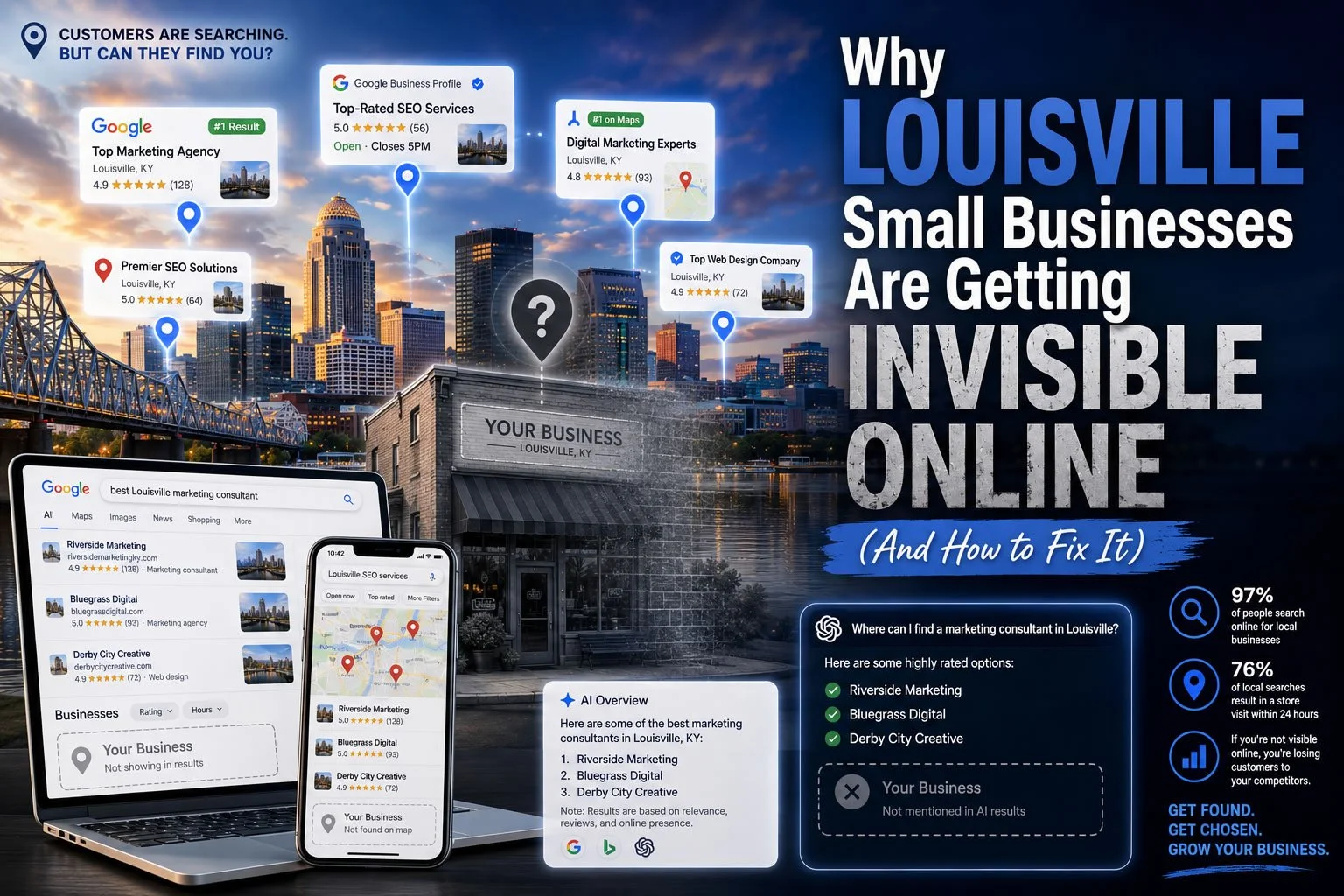
Louisville small businesses with a website but no search visibility share a common problem: their content does not tell Google, ChatGPT, or customers what they actually do, who they serve, or where they operate. Completing your Google Business Profile, writing location-specific service pages, and building consistent directory listings are the highest-impact fixes. In 2026, visibility requires showing up in both traditional Google results and AI-generated answers.
Why are Louisville small businesses invisible online?
Most Louisville small businesses struggle with online visibility because their websites use generic language, their Google Business Profiles are incomplete, and their content does not answer the specific questions customers are searching for. In 2026, this also means being absent from AI tools like ChatGPT and Google AI Overviews, which pull from a different set of signals than standard Google search.
I talked to a Louisville business owner last month who had been running her company for eleven years. Good reputation, strong word of mouth, solid client base. She asked me why her website was getting almost no traffic.
We looked at it together. The site was fine. Clean, professional, mobile-friendly. And it ranked on page four for every keyword that mattered to her business. Her competitors, two of whom she knew personally and considered less experienced than her, were on page one.
The website was not the problem. The problem was visibility. And that is a different thing entirely.
I'm Bernie. I run B2The7, and I work with Louisville small businesses on digital marketing and content strategy. Visibility problems are the most common thing I see. And in 2026, it is getting more complicated because it is no longer just about Google.
What You Will Learn
- Why having a website is not the same as being visible, and what the difference actually costs you
- The five most common reasons Louisville small businesses are buried in search results
- Why AI search tools like ChatGPT and Google AI Overviews make the problem worse if you ignore them
- What a Google Business Profile problem looks like and why most businesses have one without knowing it
- What to actually do about it, in priority order, without hiring a team or rebuilding your site
Having a Website Is Not the Same as Being Visible
This is the thing most small business owners do not realize until someone says it directly. A website is infrastructure. Visibility is what happens when the right people can actually find it.
Over 60% of small businesses in the US have a website. Most of them are invisible. Not because the sites are bad. Because the sites were never set up to be found by anyone who was not already looking for them by name.
Think about how your customers actually find new businesses. They type a problem or a service into Google. Sometimes they ask ChatGPT or Perplexity. They look at the results on the first page, maybe the first three results, and they click. If you are not there, you do not exist to that person. Your website, your reviews, your eleven years of experience, none of it matters if they never see you.
That is the visibility problem. And it is fixable. But you have to understand what is actually causing it before you can fix it.
A website tells your story. Visibility is what happens when the right people can actually find it. In most cases, the site is fine. The signals are broken.
Five Reasons Louisville Small Businesses Are Invisible Online
Generic content that could belong to any business in any city
A website that says you are a passionate, full-service professional dedicated to exceeding client expectations tells Google and AI tools absolutely nothing specific. They cannot tell who you serve, where you serve them, or why you are different from anyone else. In 2026, being specific matters. Google and AI search tools are getting better at understanding exactly what a business does and who it serves. If your website talks about helping Louisville healthcare companies, regional restaurant groups, or businesses in Kentucky's bourbon and hospitality industries, that's useful information. Compare that to a page filled with broad claims that could apply to almost any company.
An incomplete or ignored Google Business Profile
Your Google Business Profile is often the first thing someone sees when they search for your business or your category in Louisville. It shows up in the map pack. It shows in the knowledge panel. It pulls your reviews, hours, photos, and services. Most small businesses set it up once and never touch it again. Wrong category. Missing services. No photos. No recent posts. Old hours that have not been updated. Google treats an inactive Business Profile as a signal that the business is either inactive or not worth featuring prominently. Both interpretations hurt you.
No content that answers the questions your customers are actually asking
When someone searches for a service in Louisville, they are often asking a specific question. Best accountant for small business in Louisville. How to choose a commercial contractor in Louisville, KY. What does a digital marketing consultant in Louisville actually do? If your site does not have a page that answers those specific questions, you do not rank for them. Your competitors who have even one well-written article addressing those questions will outrank you every time. Content is how Google decides you are relevant to a specific search. No relevant content means no ranking for that search.
Inconsistent business information across the web
Your business name, address, and phone number appear in a lot of places beyond your own website. Yelp. The Better Business Bureau. Industry directories. The Louisville Chamber. Local news articles. If that information is inconsistent across those sources, it creates what search engines treat as conflicting signals about who you are and where you are located. AI tools are especially sensitive to this. They build confidence in a business by seeing consistent, specific information across multiple sources. Inconsistency reads as unreliability. It suppresses your visibility in AI-generated answers even when your website is otherwise solid.
Missing from AI search entirely
This one is newer, and most Louisville small businesses have no idea it is happening. When someone asks ChatGPT, Perplexity, or Google AI Overviews for a recommendation in Louisville, those tools are not pulling from the same source as Google search. They are synthesizing answers from content they consider credible and specific. If your content is generic, structured poorly, or only lives on your own domain with no mentions anywhere else, you are invisible in AI search. A competitor with one well-structured article and a few local directory listings may be getting mentioned regularly, while your business never comes up. I covered this in the GEO vs SEO article on this site if you want to go deeper.
The businesses showing up in Louisville AI search results right now are not always the best at what they do. They are the ones who made it easy for AI tools to understand exactly what they do, where they do it, and why they are credible.
What to Do About It, In Priority Order
You do not need to redo your entire website or hire a marketing team. You need to fix the highest-impact problems first.
Fix your Google Business Profile this week
Log in and go through it section by section. Make sure your primary category is correct, your hours are accurate, your services are listed, and your photos are current. Publish a post. Respond to any reviews that are still sitting there unanswered. In a couple of hours, you can clean up things that have a real impact on how easily people find your business online.
Rewrite your homepage and main service pages to be specific
Get rid of every sentence that could apply to any business anywhere. Replace it with sentences that are specific to what you do, who you serve, and where you do it. Louisville. Kentucky. The specific types of clients you work with. The specific problems you solve. That specificity is what search engines and AI tools use to match you to relevant searches.
Write at least one piece of content that answers a real question
Pick the question you answer most often on every sales call or in every new client conversation. Write a clear, specific answer to it on your site. Structure it with a direct answer in the first paragraph, a few sections that go deeper, and an FAQ at the bottom. That single piece of content will do more for your search visibility than a dozen generic blog posts.
Get your business mentioned in more places
Local directories. Your industry association. The Louisville Chamber. Review platforms. Any local media or blog that covers your space. AI search tools build trust in a business by seeing it referenced across multiple credible sources. If your business exists only on your own site, that significantly limits your AI visibility.
The Louisville Angle That Most Advice Misses
Most of the SEO content you find about small business visibility is written for a national audience or for a different market entirely. Louisville has specific characteristics that matter.
It is a mid-size city with real local competition in most service categories, but without the extreme saturation you see in Chicago or Atlanta. That means local SEO is actually very winnable here for a small business that does the basics right. A business with a complete Google Business Profile, a few well-written local pages, and some genuine content about serving Louisville clients can rank on page one within 60 to 90 days for most local keywords.
The businesses I see struggling online in Louisville usually aren't losing because the competition is unbeatable. More often, they're missing some of the basics. Their Google Business Profile hasn't been fully completed. Their website barely mentions the areas they serve. The content could belong to almost any business in any city. On top of that, their business information doesn't always match from one directory to the next. None of those problems are unusual, but together they make it a lot harder for customers to find them.
Those are all fixable problems. None of them require a large budget or a major rebuild. They require attention and specificity.
Frequently Asked Questions
Usually it's a handful of fairly common issues. The Google Business Profile isn't fully filled out, the website uses broad marketing language instead of talking about specific services, or the business information isn't consistent across directories and listings. Another big one is not having content that answers the questions customers are actually typing into Google. The good news is that most of these problems can be fixed without rebuilding your website. A good place to start is your Google Business Profile, then take a hard look at your main service pages and ask whether they match the way real customers search.
Start with the highest-impact fixes in order. Complete and optimize your Google Business Profile. Rewrite your homepage and service pages to include specific language about what you do, who you serve, and where you do it. Write at least one piece of content that answers a common customer question directly. Make sure your business name, address, and phone number are consistent across all directories and listings. Those four things will move your visibility faster than anything else.
A website by itself doesn't make you visible online. Most small businesses already have a website, but plenty of them are still hard to find when potential customers search. The problem is usually not the website itself. It's that the content is too generic, the business isn't sending strong local signals, or the Google Business Profile hasn't been fully built out. You can have a great-looking website and still struggle to show up if Google can't clearly connect your business to the searches people are making in your area.
Google and AI search don't work exactly the same way. Google decides which websites show up in its search results. AI tools like ChatGPT, Perplexity, and Google's AI Overviews decide which businesses, websites, and sources to mention when they generate an answer. Those decisions often come from a different set of signals. We've seen businesses rank pretty well on Google and still never get mentioned in AI-generated answers. In 2026, showing up in Google is still important, but it's no longer the whole game. You need to be visible in both places.
Most businesses don't need to rebuild their entire website to get better visibility. Start with what's already there. Clean up your Google Business Profile, update outdated pages, answer common customer questions clearly, and make sure your information is consistent across the web. Those changes can improve Google visibility in a matter of months, and sometimes AI tools start picking up the content even sooner. The businesses that see results fastest are usually the ones that fix existing problems first.
The Bottom Line
The visibility problem is not mysterious. It is a set of fixable issues that most Louisville small businesses have not yet addressed. Generic content. Incomplete profiles. Inconsistent information. No strategy for AI search.
The businesses showing up on page one in Louisville right now are not always the best at what they do. They are the ones who have made it easy for Google and AI tools to understand exactly what they do, where they do it, and why they are credible. That is achievable for almost any small business willing to put in the work.
If you want to understand exactly what is holding your specific business back, reach out. I work directly with Louisville small businesses on this, and I can tell you in a single conversation what the biggest levers are for your situation.