GEO vs SEO: What Small Businesses Need to Know
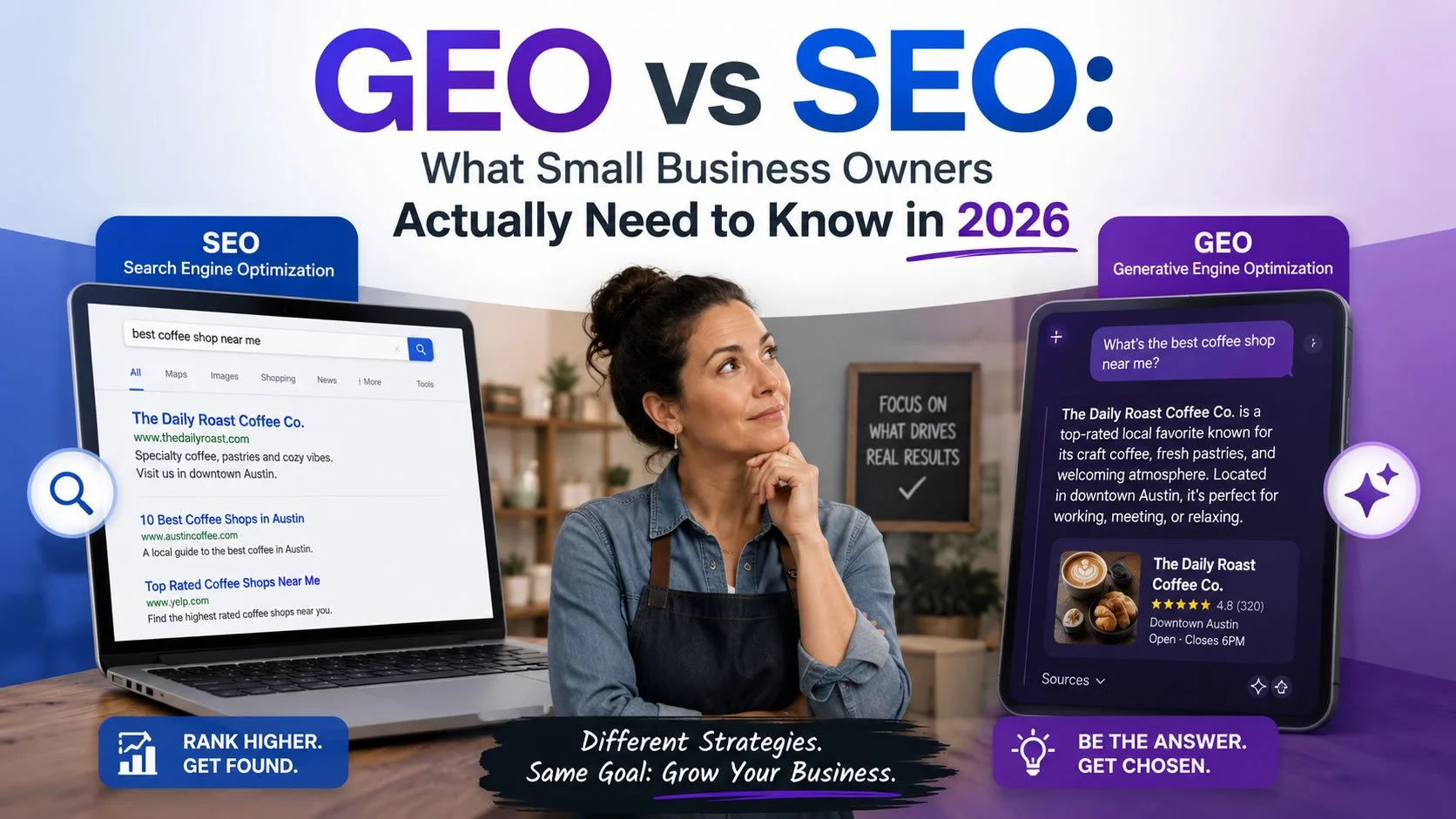
GEO (Generative Engine Optimization) and SEO (Search Engine Optimization) are both methods for getting your business found online, but they work differently. SEO gets you ranked on Google. GEO gets you cited inside AI-generated answers from tools like ChatGPT, Google AI Overviews, and Perplexity. In 2026, small businesses need both. The good news is that most of the work overlaps. Bernie Fussenegger at B2The7 in Louisville helps small businesses build content strategies that cover both traditional and AI search visibility at the same time.
A small business owner called me a few weeks ago. She had heard the term GEO somewhere, probably LinkedIn or a podcast, and was not sure if it was something she needed to worry about or just another marketing thing that did not apply to her.
That is a fair question. The answer depends on how your customers are finding you now and how they will find you a year from now.
So let me break this down in plain language. No jargon where I can avoid it. Just what is actually happening and what a small business owner should do about it.
What You Will Learn
- What SEO actually is and why it still matters in 2026, despite what some people are saying
- What GEO is and why the term is showing up everywhere right now
- How the two are different and where they overlap, because they overlap more than most guides admit
- What small businesses are getting wrong about both right now
- What a real Louisville small business example looks like when you apply both strategies at once
- What to actually do if you are starting from scratch or trying to fix a visibility problem
SEO Is Not Dead. Let Us Get That Out of the Way.
Every year, someone writes a piece about how SEO is dying. And every year, businesses that do SEO well keep getting traffic from Google, while the people who declared it dead wonder why their website is invisible.
SEO is still the process of making your content visible to people who search on Google and other traditional search engines. You write content around the things your customers are looking for, structure it so Google can read it, build some authority behind it, and over time you show up when people search for what you sell.
That still works. It works really well for local businesses especially, because local search is one area where a small company can genuinely compete with bigger ones. Someone searching for a digital marketing consultant in Louisville is not going to get a result for a national agency that serves every city from a template page. They are going to find people who are actually here.
So if anyone tells you SEO is irrelevant in 2026, that is not accurate. What IS changing is that SEO is no longer the only game in town for search visibility. And that brings us to GEO.
So What Is GEO?
GEO stands for Generative Engine Optimization. Which is a mouthful, so let me explain what it means.
When someone types a question into ChatGPT, or uses Google AI Overview at the top of a search result, or asks Perplexity to summarize something, those AI tools pull from content across the web to build their answer. They do not send the person to ten blue links. They synthesize an answer, and sometimes they cite the sources they pulled from.
GEO is the practice of making your content one of the sources that AI tools pull from.
Think about that for a second. If someone asks ChatGPT who is a good digital marketing consultant in Louisville, and your name comes up in that answer, you did not need to rank on Google for that to happen. You just needed to have content that the AI found trustworthy and relevant enough to cite.
That is a genuinely new opportunity. And right now the playing field is more level than it has been in traditional SEO for years, because most small businesses are not doing anything specific for GEO yet. I go deeper into what this actually means for a small business in What Is Generative Engine Optimization in 2026?, if you want the full breakdown. And if you want the layer underneath that, the actual retrieval and synthesis process the AI runs when it picks a source, that is in how GEO actually works.
SEO
Gets you found in Google search results. Someone sees your link and clicks through to your site. The goal is traffic from people actively searching for what you offer.
GEO
Gets your content mentioned inside AI-generated answers on ChatGPT, Gemini, and Perplexity. The goal is visibility inside the answer, not just in the results list.
The Play
Content written from real experience, structured clearly, and built around actual customer questions serves both channels at once. One approach, two outputs.
The Real Difference Between SEO and GEO
Here is the honest version. SEO is built around getting people to your website. You show up in search results, someone clicks your link, they land on your page. More traffic is the goal.
GEO works a little differently. Instead of focusing only on rankings, it focuses on whether your business or content gets mentioned when tools like ChatGPT, Gemini, or Perplexity generate an answer. Sometimes people click through to learn more. Sometimes they get what they need right there. The goal is making sure your business is part of the conversation when those answers are created.
Here is how the three terms actually stack up.
| Strategy | What It Stands For | The Goal | Where It Shows Up |
|---|---|---|---|
| SEO | Search Engine Optimization | Rank in a list of links | Google, Bing organic results |
| GEO | Generative Engine Optimization | Get cited inside an AI-generated answer | ChatGPT, Perplexity, Gemini responses |
| AEO | Answer Engine Optimization | Get pulled into quick-answer features | Google AI Overviews, featured snippets |
These are not competing strategies. They are layered. Strong SEO creates the foundation. GEO and AEO build on that foundation with specific adjustments to how AI systems actually process and select content. SEO gets you ranked. GEO gets you cited. You need both working.
What Small Businesses Are Getting Wrong Right Now
Most small businesses I talk to are doing one of two things. Either they are ignoring GEO entirely because they have not heard of it, or they do not think it applies to them. Or they are panicking about GEO and thinking they need to throw out everything they know about SEO and start over.
Neither is right.
The businesses getting hurt the most right now are the ones whose traffic is dropping and they do not know why. Their rankings look fine on Google. But AI Overviews are answering the questions their content used to answer, so fewer people are clicking through to their site even when they rank. Worth reading if that sounds like your situation.
Before you assume you know which camp you are in, go find out. Most owners have never asked ChatGPT about their own company, and what AI search knows about your business is usually either nothing or something confidently wrong.
The fix is not to abandon SEO. It is to make your content better for both. More direct. More specific. More structured. More grounded in real expertise rather than keyword targeting alone.
What This Actually Looks Like for a Real Louisville Small Business
Let me make this concrete because the SEO versus GEO conversation gets too abstract too fast and small business owners tune out.
Say you run a Louisville restaurant supply company selling commercial kitchen equipment to restaurant owners, caterers, and food trucks across Kentucky.
The SEO play: Write pages around the specific things your customers search for on Google. Commercial refrigeration in Louisville, KY. Restaurant equipment supplier in Kentucky. Used commercial ovens in Louisville. Build pages around those terms, structure them properly, get your Google Business Profile dialed in. It is not glamorous but it compounds over time and local search for a specific product category is very winnable.
The GEO play: Write a page called something like "What to Look for When Buying Commercial Kitchen Equipment in Louisville." Answer it the way a person who has sold this equipment for fifteen years would. Not bullet points about features. Real talk about what breaks, what lasts, what questions to ask a supplier. Specific. Opinionated. Based on actual experience.
The result: One page that ranks on Google for long-tail searches because it is genuinely useful, and gets cited by AI tools because it sounds like someone who actually knows the subject. Not two strategies. Not two content plans. One piece of content that serves both.
The local angle changes the weighting more than most GEO advice admits. Directory consistency, Google Business Profile accuracy, and reviews that name specific services carry more influence for a one-market business than they do for a national brand, because AI tools have fewer independent sources to cross-check against. That version is in GEO for local business and AI search visibility in Louisville.
That is the whole game in 2026. Not SEO or GEO. One piece of content that serves both, written from real experience, structured for both humans and machines to use.
I work with small businesses in Louisville on exactly this. If you want to see what it looks like applied to your specific situation, reach out at b2the7.com/contact.
Five Things to Do Right Now
You do not need to overhaul everything, and you do not need to redo your marketing strategy. But you do need to stop assuming that strong Google rankings automatically translate into visibility everywhere else. Start here. The full implementation checklist, including the crawler access and Bing indexing steps that have to happen before any of the content work counts, is in how to get cited in AI search.
Run your own visibility check
Open ChatGPT, Gemini, and Perplexity. Search the same queries your customers would use. See who comes up and who does not. Some businesses will realize they are basically invisible outside of Google. This takes 20 minutes and gives you a real baseline. The step-by-step process is in how to check your AI search visibility.
Restructure your top pages
Look at the pages that used to get traffic but are not getting as much now. Do those pages answer the question directly, in the first few paragraphs, with real specificity? AI tools are impatient. They pull from content that gives them the answer fast. If your best content buries the answer in paragraph four, move it to the top. Tighten your headings while you are in there, and add schema markup if you have not already.
Add FAQ sections to every key page
AI Overviews and ChatGPT pull from FAQ-formatted content consistently because it is already structured as a question and answer. The AI does not have to interpret the relationship. It is explicit. If your pages do not have them, add them. Base the questions on what customers actually ask, not what keywords look good.
Be specific about who you are and what you do
Generic content does not get cited. If your About page says you are a full-service marketing agency, that is not something an AI is going to quote. If your content says you have built and run paid media programs for a regional restaurant chain with 700 locations, that is specific and credible. AI systems are looking for content that sounds authoritative and particular, not like a brochure.
Build your presence beyond your own site, and keep doing SEO
AI tools pull from industry sites, local listings, interviews, podcasts, review platforms, and news mentions. If your business only exists on its own domain, that is a real problem for AI visibility. Meanwhile, none of the SEO fundamentals go away. Build local content. Get your Google Business Profile right. Keep your site technically clean. Then start tracking how often your brand appears in AI responses alongside your rankings and traffic. That is a real metric in 2026.
Frequently Asked Questions
The Takeaway
You can rank well in Google and still be invisible in AI search. That is the part most small businesses are missing right now. Traditional SEO still matters, but AI tools are making their own decisions about which sources to pull from, cite, and trust.
The businesses that figure this out in 2026 will have a real edge. Those who wait until the gap is impossible to ignore will be doing a lot more catching up.
If you want to talk through where your content stands and what a GEO strategy actually looks like for your specific situation, I am here for that conversation.