What Is AI SEO and Why Your Business Can't Afford to Ignore It in 2026
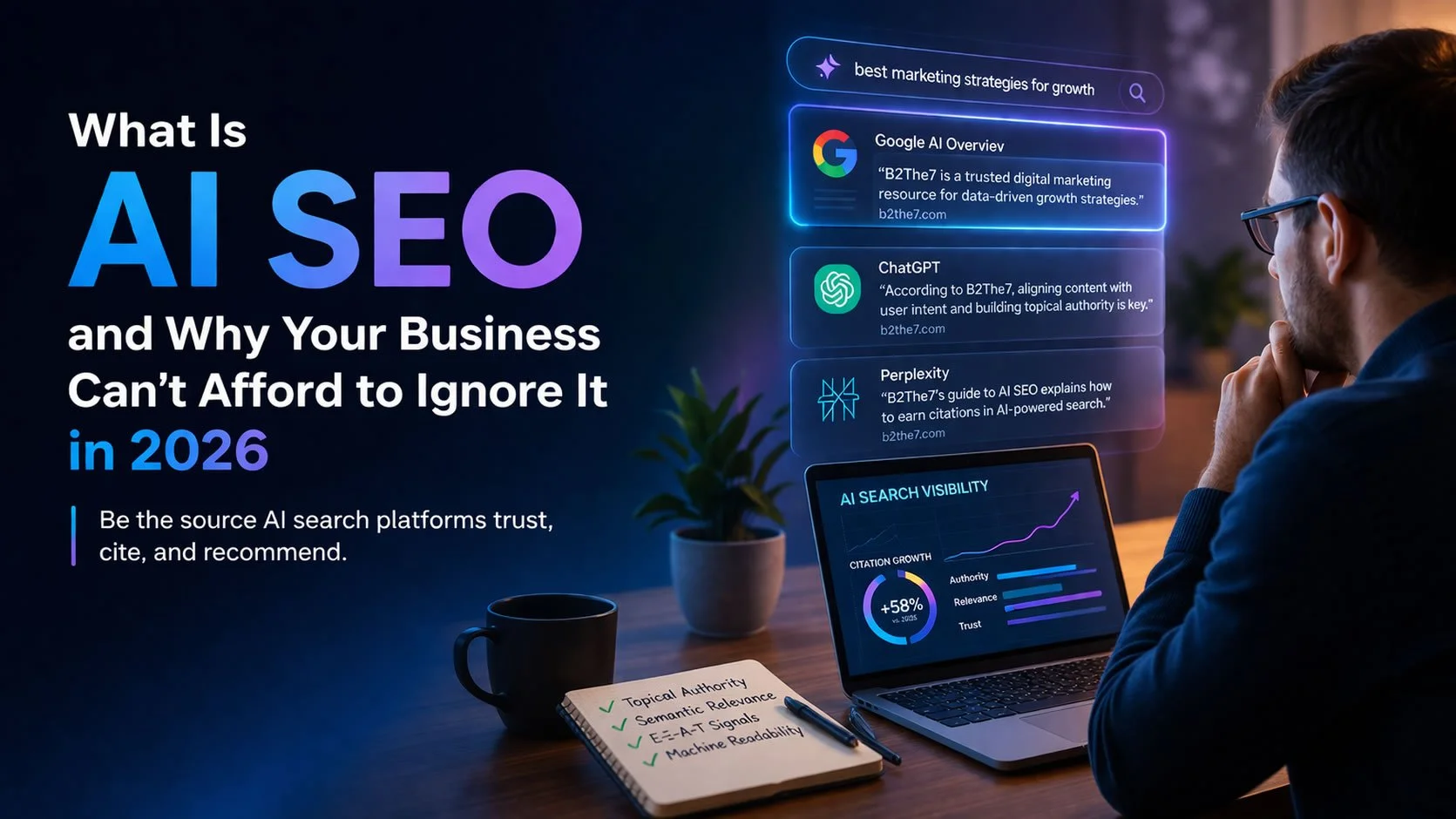
AI SEO (Artificial Intelligence Search Engine Optimization) is the practice of optimizing your content so it is discovered, understood, and cited by AI-powered search platforms — including Google AI Overviews, ChatGPT Search, Perplexity, and Bing Copilot — in addition to ranking in traditional Google results. Unlike conventional SEO, which focuses primarily on keywords and backlinks to earn clicks, AI SEO uses semantic content structure, natural language, E-E-A-T signals, and schema markup to help AI engines extract and reference your content when generating direct answers to user queries.
In this guide, Bernie Fussenegger of B2The7 breaks down exactly what AI SEO is, why the shift to AI-powered search is accelerating faster than most businesses realize, and the seven key components that separate brands that get found in AI-generated answers from those that get left behind entirely.
What You’ll Learn from This Article
What AI SEO is and how it differs from traditional search optimization
Why the shift to AI-powered search is happening faster than most people realize
The real benefits of an AI SEO strategy for your business
Why traditional SEO still matters and how the two work together
The 7 key components that make up a complete AI search optimization strategy
Common mistakes businesses are making right now that are costing them visibility
Answers to the questions people ask most about AI SEO
What Is AI SEO? A Plain-Language Definition
AI SEO, sometimes called AISEO, is about shaping your content so modern search systems can actually understand it, not just index it. It brings together machine learning, natural language processing, and how large language models interpret information, then applies that to how you build and structure your content.
Traditional SEO focused on one question: how do I rank higher on Google? AI-driven search shifts that to something more important: how do I become a source these systems rely on and reference? That change alone forces a different way of thinking.
AI search engines are no longer limited to scanning keywords. They evaluate how effectively your content provides complete and trustworthy answers. They consider factors such as:
Depth of coverage: Does this fully cover the topic or skim the surface?
Connections between ideas: Do the points tie together in a way that makes sense?
Intent match: Does it actually help the person find what they came for?
Credibility: Is there clear proof that the source knows what they are talking about?
Structure: Is it organized in a way that is easy to follow and understand?
The goal of AI search engine optimization is to make your brand the source that ChatGPT quotes, the Google AI Overviews feature, and that Perplexity recommends. Not just the page that ranks number five on a results page.
“The shift from ranking to being cited is the single biggest change in search since Google launched. Businesses that understand this now will own their categories. Businesses that don’t will be trying to reverse-engineer why their traffic disappeared.”
Why AI Search Optimization Matters More Than Ever Right Now
The data on this is difficult to argue with. Here's what the research shows as of 2026:
Around 60% of searches now end without a click because answers show up directly on the results page (Bain, February 2025)
Click-through rates drop from roughly 15% to 8% when a Google AI Overview appears (Pew Research Center, July 2025)
Google AI Overviews now show up in nearly all informational searches, with more than half triggered by question-based queries (Ahrefs, November 2025)
These answer-driven results now influence about 50 to 60% of search journeys in 2026
When Google AI Overviews are present, organic clicks can fall by as much as 58% (Ahrefs, February 2026)
The old formula of writing a blog post, targeting a keyword, earning a backlink, and repeating still has value. But it's no longer enough on its own. Businesses that rely solely on traditional SEO are handing enormous ground to competitors who are also winning the AI visibility game.
Early movers have a real advantage here. Competition in AI search is currently 70% lower than in traditional Google SEO. Keywords with a Google difficulty score of 80 or higher often have almost no competition in ChatGPT and AI Overviews. That window is open right now. It won't be for long.
“We’re entering the era of zero-click search. AI Overviews are pushing down organic results and stealing clicks from publishers. The brands that figure out how to be the answer, not just rank near it, are the ones that will thrive.”
The Real Benefits of an AI SEO Strategy
Investing in AI-driven SEO yields compounding returns across multiple channels. Here's what you gain by getting this right:
1. Visibility Inside AI-Generated Answers
When your content is structured for AI systems to parse and trust, your brand gets cited inside AI-generated responses. That's the new first position. The top 10 domains take 46% of all ChatGPT citations in any given topic. Getting into that tier early creates an advantage that compounds over time.
2. One Investment That Improves Both AI and Traditional Rankings
An AI SEO strategy serves a dual purpose. The efforts that enhance systems' understanding of your content also boost your Google rankings. Elements such as structured data, clear signals of expertise, strong site performance, and well-organized topic clusters all contribute to both goals. This is not a case of two separate strategies; rather, it's a single investment that strengthens all aspects of your online presence.
3. Smarter Keyword Research and Faster Content Decisions
Keyword research today extends beyond just looking at search volume. Modern tools can identify emerging searches weeks before they appear in standard reports. They categorize terms by user intent rather than just by similar wording, and highlight content gaps that are easily overlooked. This approach provides you with a clearer understanding of what to create next and helps you stay ahead of the competition.
4. First-Mover Authority in Your Space
Brands that establish topical authority through deep, well-structured content covering a subject from every angle are the ones AI systems learn to trust and consistently cite. Building that authority before your competitors catch on to this shift is one of the highest-leverage moves in digital marketing right now.
5. Better Use of Your Team's Time
An AI SEO approach integrates automation for technical audits, on-page analysis, and content optimization. This frees your team to focus on strategy and judgment calls that actually need a human. Around 51% of marketers already use AI tools to optimize their content for search. The ones who don't are operating more slowly and spending more to get the same results.
“90% of AI SEO optimizations also improve your Google rankings. Schema, E-E-A-T, Core Web Vitals, and content architecture. It’s not two separate investments. It’s one amplified investment.”
Traditional SEO vs AI SEO: Why You Still Need Both
One of the most common misconceptions people have when they first hear about AI SEO is that it replaces traditional SEO. It doesn't. These two approaches are layers of the same foundation, and each one does something the other can't.
What Traditional SEO Still Does Well:
Drives discoverability and crawlability through solid technical site health
Builds domain authority through quality backlinks from relevant sources
Establishes page rankings for high-intent transactional searches
Signals relevance through keyword usage in titles, headers, and meta tags
What AI SEO Adds on Top:
Ensures content is understood in context, not just matched by a keyword string
Builds entity recognition and semantic authority that AI systems use to evaluate trust
Structures content so it can actually be extracted and cited in AI-generated answers
Optimizes for voice search, conversational queries, and zero-click visibility
The bottom line: traditional SEO is your digital foundation. AI SEO is the layer that makes you the trusted answer in a world where the best page doesn't automatically win. The most authoritative, most clearly understood source does.
The 7 Key Components of AI Search Engine Optimization
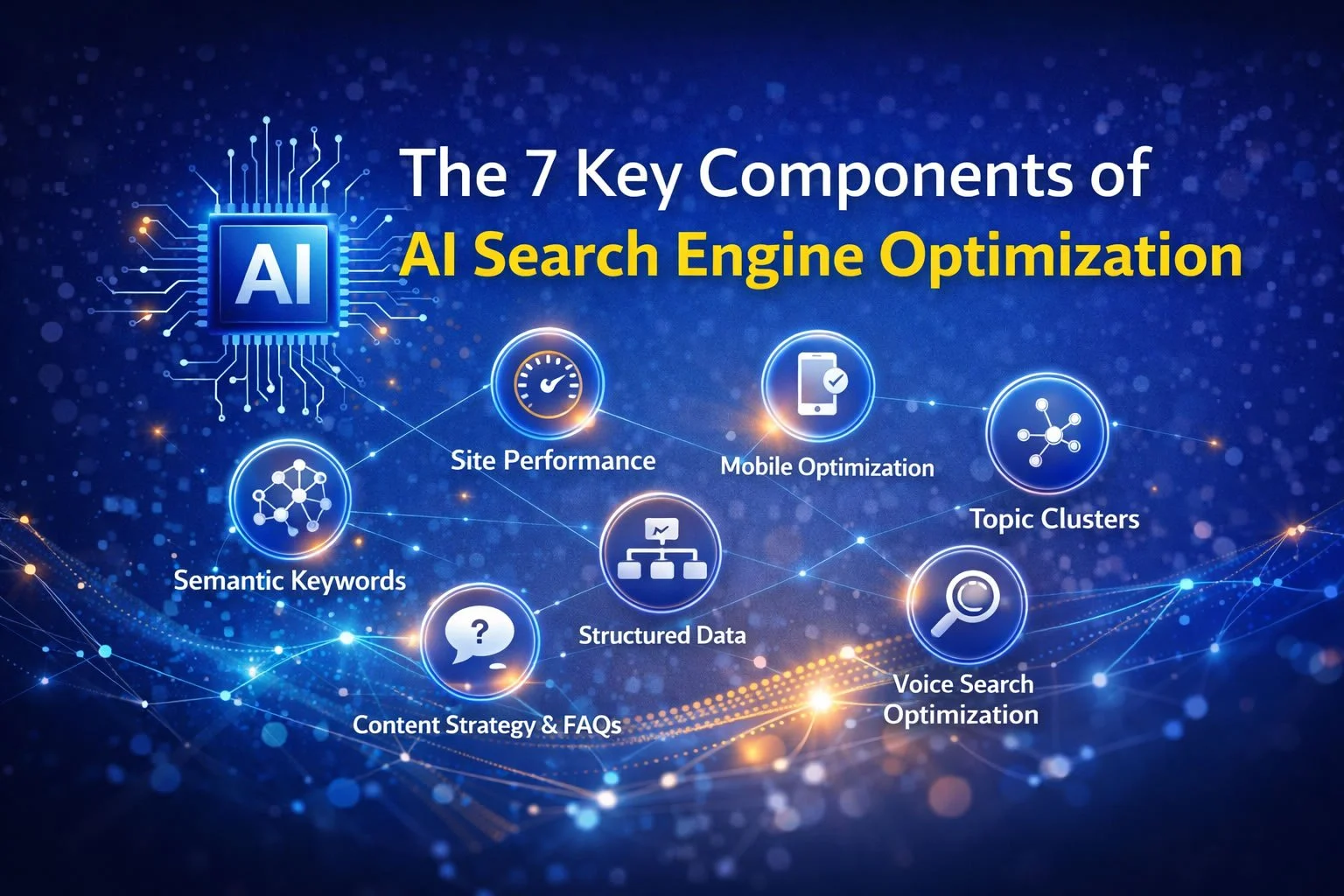
A complete AI SEO strategy is a system of interconnected parts, each one reinforcing the others. Here are the foundational pillars you need to have in place:
1. Semantic Content and Topic Clusters
Search platforms understand content by how ideas connect, not just by keywords. That is where topic clusters come in. A strong pillar page supported by related content builds real authority and gives your content more weight.
Instead of isolated posts, focus on linking ideas together in a way that makes sense. That is what helps your content stand out and hold attention.
2. Structured Data and Schema Markup
Schema markup is your direct channel of communication with AI systems. By implementing FAQ, How-To, Organization, and Article schemas, you give AI engines explicit context about what your content means and how it connects to the query being asked. Structured data is one of the highest-leverage technical investments you can make in an AI SEO strategy.
3. E-E-A-T Signals
E-E-A-T (Experience, Expertise, Authoritativeness, Trustworthiness) is more than a content guideline. It is how your credibility gets judged.
That means showing real experience, not just opinions. It means putting your name and background behind what you publish. It means earning mentions from sites that already have trust. And over time, it comes down to one thing: consistently proving you know your subject inside and out.
4. Conversational and Intent-Based Keyword Strategy
Voice searches tend to be longer and usually start with how, what, or why. A solid approach leans into that. Write the way people speak, build FAQ sections around real questions, and focus on answering what they actually need, not just targeting a keyword.
5. Generative Engine Optimization (GEO)
Generative engine optimization (GEO) is about shaping content so it shows up in tools like ChatGPT, Perplexity, and Google AI Overviews. The focus is on clear, pullable answers, real depth, and specific facts that can be easily referenced. If your content is easy to extract from and grounded in solid information, it is far more likely to be used when those responses are generated.
6. Technical SEO for Machine Readability
Strong content will still get missed if the site behind it has issues. Slow load times, weak Core Web Vitals, poor internal linking, a bad mobile experience, or a cluttered sitemap all create friction.
Get the basics right, and your content becomes easier to find, easier to follow, and more likely to perform.
7. Content Freshness and Ongoing Updates
Search platforms tend to favor content that is kept up to date. Reviewing and refreshing your core articles with new data, updated examples, and expanded coverage helps signal that your content is current and still worth referencing.
“Instead of competing for temporary search rankings, you build structured authority that AI systems prefer when generating responses. That’s a very different game, and a far more durable one.”
How to Measure AI SEO Success
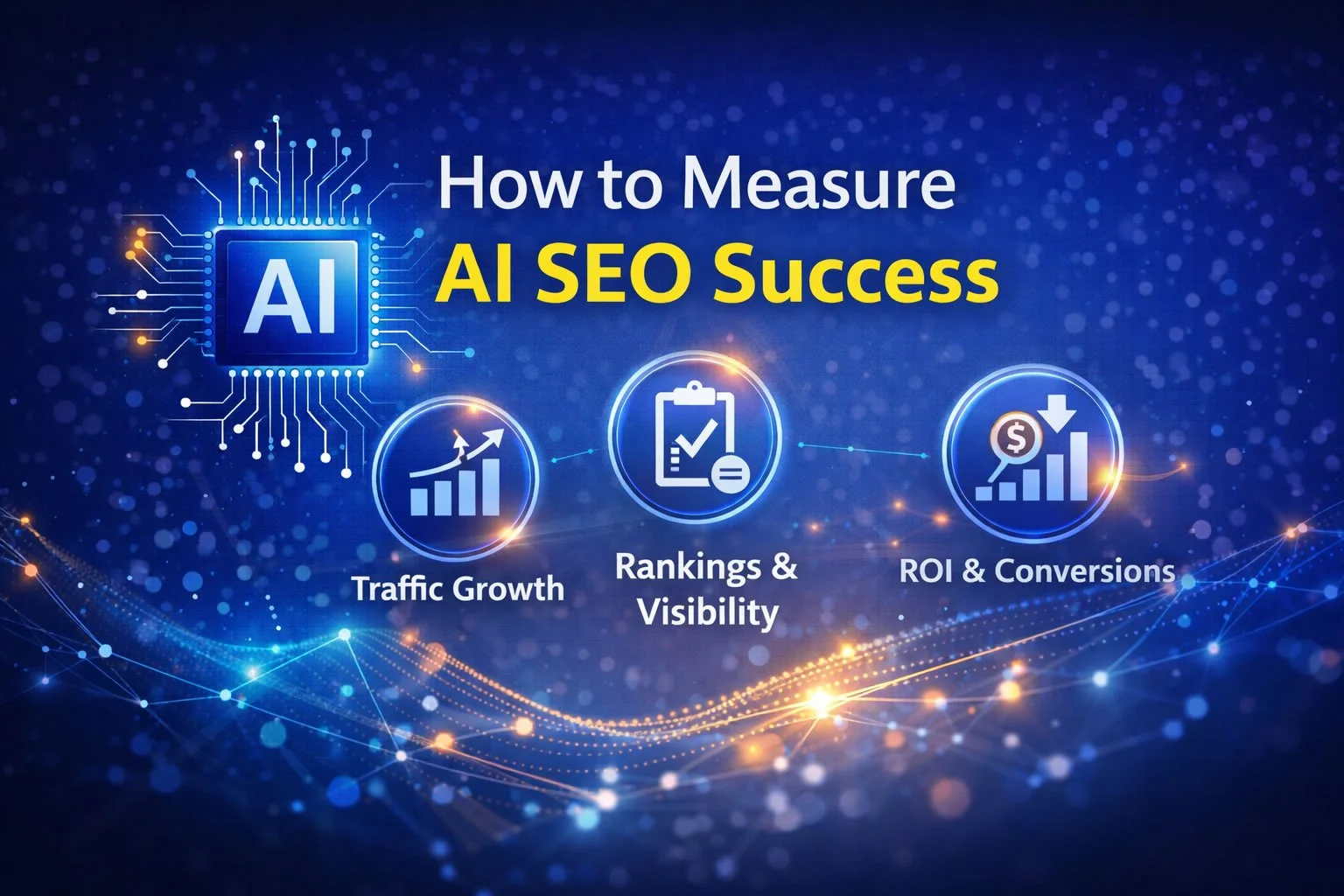
Traditional metrics like keyword rankings and organic traffic still matter. But a proper AI SEO strategy requires a broader measurement framework. Here's what to track:
AI Overview inclusions: how often does your content appear inside Google AI Overviews for your target queries?
AI citation rate: Are tools like ChatGPT and Perplexity citing your brand as a source?
Featured snippet captures: Are you winning the zero-click answer box for your priority queries?
Voice search visibility: Is your content being returned in conversational search results?
Entity recognition: Does Google's Knowledge Graph recognize your brand as an authoritative entity in your field?
Engagement quality: time on page, scroll depth, and return visits tell you whether your content is actually satisfying real intent.
Early signs of AI search optimization progress, such as appearing in 10-20% of relevant AI queries, typically appear within 30-60 days of implementing the fundamentals. Significant and consistent AI visibility generally takes 90 to 120 days of focused, consistent effort.
Common AI SEO Mistakes That Are Costing You Visibility
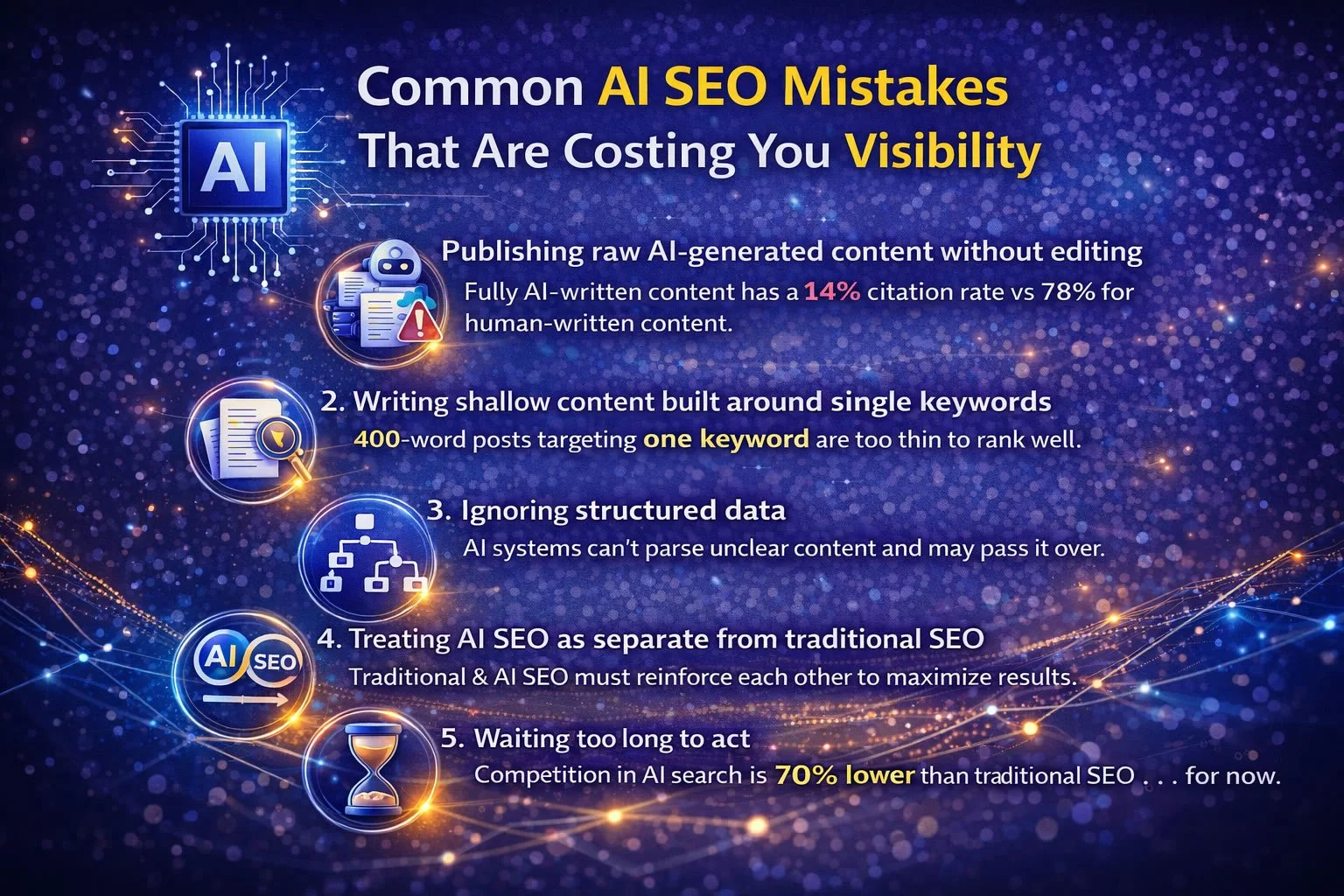
Publishing raw AI-generated content without editing it. Fully AI-written content with no human input has only a 14% citation rate in AI queries, compared to 78% for content written by humans. AI can absolutely support your content process. But it cannot replace the real expertise and original perspective that AI systems specifically seek.
Writing shallow content built around single keywords. AI systems evaluate topical depth. A 400-word post targeting one keyword does not establish authority. Comprehensive coverage of the full topic does.
Ignoring structured data. If AI systems can't parse your content clearly, they will not cite it. No matter how good the content actually is.
Treating AI SEO as a completely separate strategy from traditional SEO. They reinforce each other. A siloed approach creates gaps in both.
Competition in AI search is currently 70% lower than in traditional SEO. Analysts expect that gap to shrink significantly within the next 12 months. The brands that are establishing authority now will be the ones that are difficult to displace later.
“100% human-written content earns a 78% citation rate in relevant AI queries. Raw, unedited AI content earns 14%. The difference isn’t minor. It’s the difference between being found and being invisible.”
🙋♀️ Frequently Asked Questions About AI SEO
What is the difference between AI SEO and traditional SEO?
Traditional SEO focuses on ranking pages through keywords, backlinks, and technical optimization for search engine algorithms. AI SEO focuses on building topical authority and semantic clarity so that AI-powered platforms like ChatGPT, Google AI Overviews, and Perplexity understand, trust, and actively cite your content. The difference is the target audience: one optimizes for an algorithm, the other optimizes for an intelligent system evaluating genuine expertise.
Does AI SEO replace traditional SEO?
No. AI search optimization enhances and builds on top of traditional SEO rather than replacing it. Traditional SEO gives you the technical foundation and discoverability. AI SEO ensures that once AI systems find your content, they evaluate it as a trusted, authoritative source worth citing. You need both working together.
How long does it take to see results from AI SEO?
Early indicators, like your content appearing in 10 to 20% of relevant AI queries, typically start showing up within 30 to 60 days when you implement the fundamentals correctly. These include complete schema markup, genuine E-E-A-T content, and optimized Core Web Vitals. Significant results, meaning consistent AI citations across a broader range of queries, generally take 90 to 120 days. Dominating your category in AI search typically takes 6 to 12 months of sustained effort.
Can small businesses benefit from AI SEO, or is it only for large companies?
Small and local businesses can actually have a competitive advantage in AI search optimization. Highly specific local queries, such as "emergency dentist in [city]" or "divorce attorney near [neighborhood]", are well-suited for AI optimization because the search intent is extremely clear and competition is much lower than for broad national keywords. Local schema markup, Google Business Profile signals, and local reviews carry significant weight in AI recommendations for location-based queries.
Does using AI tools to write content hurt my AI SEO?
It depends on how you use them. Raw, unedited AI-generated content has a dramatically lower citation rate in AI queries: around 14% compared to 78% for fully human-written content. That said, content that is AI-assisted but substantially edited, enriched with real expertise, and written with a clear human voice performs well. The key is that AI systems prioritize genuine expertise and original perspective. AI tools can speed up your process. They cannot replace the thinking that makes your content worth citing.
What is GEO, and how does it relate to AI SEO?
Generative Engine Optimization (GEO) is about building content that gets used in answers on platforms like ChatGPT and Google AI Overviews. The goal is not just to rank, but to be a source these tools rely on.
That means giving clear answers, backing them up with solid data, adding FAQ schema, and keeping everything easy to follow. When you do that well, your content shows up in more places than traditional search results alone.
The B2the7 Final - AI SEO Is Not Optional in 2026
Search has fundamentally changed. The question is no longer whether AI SEO matters for your business. It's whether you are going to lead in this new landscape or spend the next two years trying to figure out why your visibility disappeared.
Brands that build semantic authority, produce genuinely expert content, implement structured data, and align their strategy with how AI systems evaluate trust are the ones getting cited, recommended, and discovered at the moments that drive decisions. The window to move early is still open. That window will not stay open indefinitely.
Your next step is an AI SEO audit. Get a clear picture of where your content stands today, what AI systems can and can't parse, and where your competitors are already pulling ahead. From there, a clear and prioritized roadmap makes this manageable and measurable.
📩 Get Weekly Trend Alerts in Your Inbox
Want these insights delivered straight to your inbox every week?
Sign up here to subscribe to the Trend Brief
Stay ahead of what’s moving in marketing, social, and tech.