Why AI Overviews Are Killing Your Traffic (And How to Fix It)
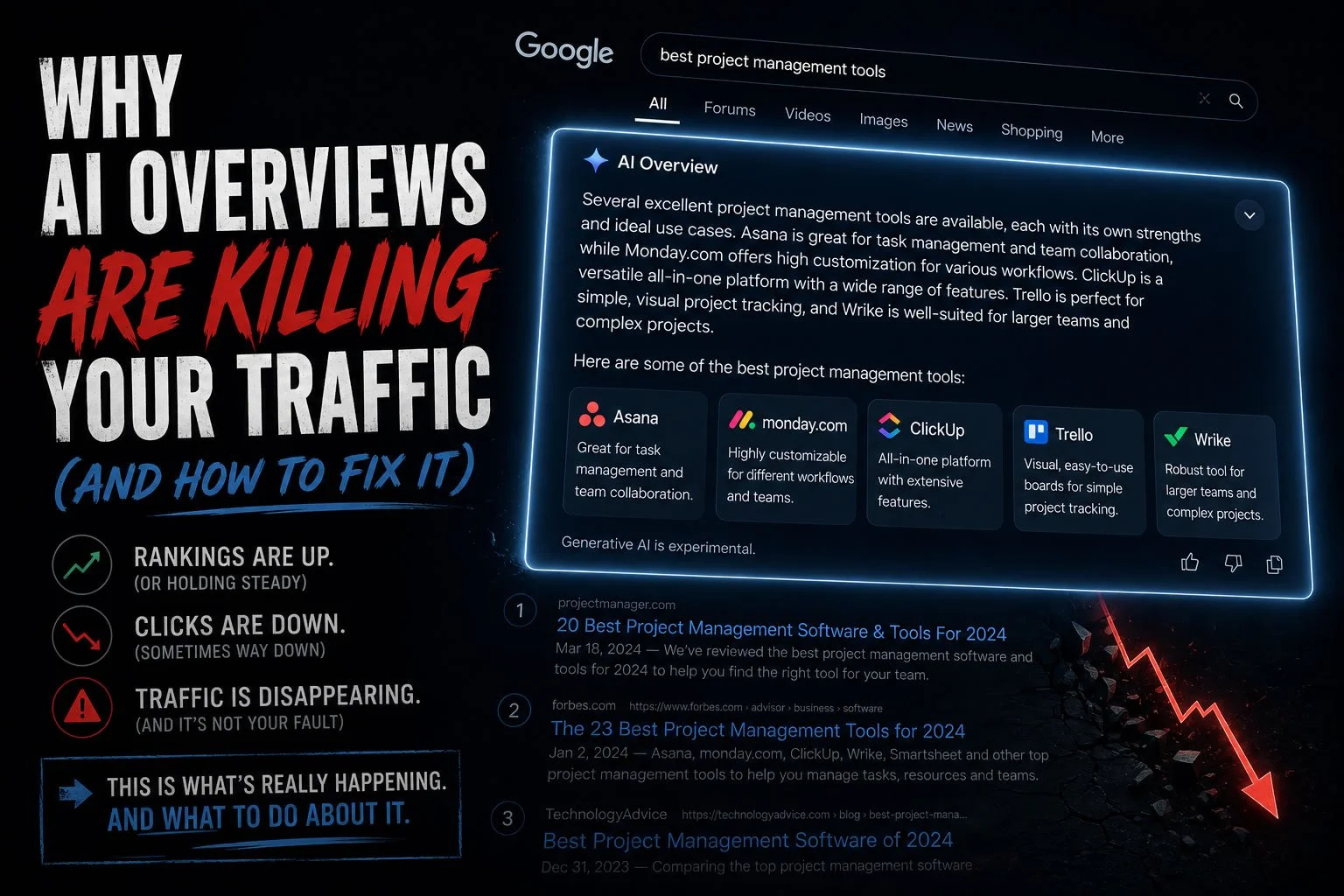
Open your Search Console right now. Go ahead.
Your rankings are probably fine. Maybe even up a little. But the clicks? Down. Maybe way down. And if you've asked your team why, you've probably gotten a lot of shrugging.
Here's the part most businesses are just now figuring out. People are still searching, but fewer of them are actually leaving Google. They type in a question, Google gives them a full answer right there on the page, and the search ends. No click. No visit. No chance for your site to do its job. Meanwhile, your article might still be ranking near the top and bringing in a fraction of the traffic it used to.
That's the problem. And no, waiting it out isn't a strategy.
Google AI Overviews now appear in more than 13% of all searches, and that number is climbing fast. They answer questions directly on the results page before anyone clicks anywhere. For businesses that built their traffic on blog content, how-to guides, and informational pages, that's not a future problem. It's happening right now in your analytics. Organic CTR drops as much as 61% when an AI Overview appears for a query your page ranks for. Your position doesn't change. Your clicks vanish. What most brands don't yet know is that businesses cited in those AI Overviews earn 35% more organic clicks and 91% more paid clicks than those that aren't. There's a path through this. It just isn't the one most people are taking.
A lot of site owners are seeing the same thing right now. Traffic drops, but rankings barely move. At first, it doesn't make sense. Then you look at the search results themselves. Google is giving people a full answer before they ever need to visit another site. So even if your page is sitting there in the top few spots, a good chunk of searchers never make it past the summary at the top. That's why clicks are falling off in so many industries. The content may still rank fine. People just are not browsing search results the way they used to.
What Google AI Overviews Actually Are
For most of Google's existence, the whole product was essentially a really good index. You type something, it finds the best pages, and you click. That was the deal. What's changed over the last couple of years is that Google decided the index isn't enough anymore. Now it wants to tell you the answer directly, which sounds like a convenience feature until you realize your website is on the other side of that equation.
These AI Overviews are the summary boxes that appear above everything else on the results page. Google pulls from multiple sources, generates a synthesized response, and surfaces it before the user ever sees a traditional link. Some of them are a sentence or two. Some are quite long with expandable sections and cited sources. Either way, the user's question is answered before they go anywhere.
A few years ago, most people barely noticed these summaries because they didn't show up very often. Now they're everywhere. Back in 2024, they appeared on less than 5% of searches. By 2026, that number had climbed past 13% overall, and in B2B or tech-related searches, some reports were putting it closer to 70%. That's why so many companies are scratching their heads right now. Rankings look mostly fine, but traffic keeps slipping because more people are getting what they need straight from the search page and never clicking through.
If you want the mechanical version of what is happening inside that summary box when Google decides which sources to pull from, I broke that down in what GEO is and how it actually works.
Why Your Rankings Look Fine, but Your Traffic Is Down
I've had this conversation with a lot of people lately, and it always goes the same way. They pull up their Search Console, show me that their rankings are holding, and then ask why their clicks are down 35%. And the answer, once you see it, is maddening.
For a long time, SEO was pretty straightforward. If a page moved up in rankings, traffic usually followed. That's what's changing now. A page can still rank well and lose visits at the same time because more people are getting what they need without ever leaving Google.
The numbers behind this shift are confusing a lot of people because they don't line up the way they used to. Seer Interactive reviewed 25 million impressions across 42 companies and found clicks dropped pretty hard once those summaries started appearing in search results. One site in the study picked up 28% more impressions but still lost 36% of its clicks over the same period. So you can look more visible in Search Console and still end up with less traffic coming to the site.
Another thing people are noticing is that ranking well doesn't automatically mean you'll get pulled into those summaries anymore. A while back, there was usually a pretty strong connection between the two. Lately, not so much. By early 2026, some studies were showing the overlap had dropped into the 17% to 38% range depending on the search. So a page can rank near the top and still not get much visibility in the part of the page people are actually paying attention to first.
One more number worth sitting with: 60% of Google searches now end with zero clicks. On mobile, it's 77%. And in Google's newer AI Mode, the zero-click rate is sitting at 93%.
Who Is Getting Hit the Hardest
Not everything is affected the same way, and it's worth being specific here because the answer changes what you should actually do about it.
The content taking the most damage is anything built to answer a question. How-to posts, explainer articles, definition pages, comparison guides, anything where someone types a question and expects an informational response. That category of query is exactly what AI Overviews were designed for, and informational traffic is down 30-40% across the board as a result. If most of your blog is built around helping people understand something, that's where you're bleeding.
Local searches are a different story. So is anything news-related or time-sensitive. AI Overviews only appear for about 15% of news queries because Google can't summarize something that happened an hour ago. Transactional content, where someone is actively trying to buy or contact someone, is also much less exposed. If you serve one market, the local angle changes the math enough that it's worth reading on its own, which is what GEO for local business and AI search visibility in Louisville covers.
A lot of the sites I look at have years of educational content sitting on them. Basic guides, FAQs, definitions, beginner explainers, all the stuff that used to pull in steady search traffic. That's the content getting squeezed the most right now. What makes it frustrating is the pages themselves often didn't really lose rankings. They're still showing up. People just are not clicking through the way they were a couple years ago.
Real Brands. Real Numbers.
HubSpot is the example I keep coming back to because it's impossible to dismiss. Between late 2024 and mid-2025, they lost 70-80% of their organic traffic. Their CEO addressed it directly on a Q1 2025 earnings call, not in vague terms but specifically attributing part of the decline to AI Overviews. This is a company with thousands of well-optimized pages, a massive content operation, and more SEO investment behind it than most companies will ever have. And they still lost the majority of their organic traffic in under a year.
Business Insider lost 55% of its organic traffic over roughly three years. They responded with a 21% staff reduction in 2025. Whatever you think about their content strategy, they weren't a small operation with thin content. Decades of publishing, massive audience, serious investment in SEO.
The category-level data is telling too. Headphones: organic click share dropped from 73% to 50%. Greeting cards went from 88% to 75%. Online game usage dropped from 95% to 84%. These shifts occurred across verticals that have nothing to do with each other, which suggests it's not an industry-specific problem.
If you only look at the big-picture numbers, it doesn't seem that bad. U.S. organic search traffic was down roughly 2.5% year over year going into 2026. That sounds manageable. Then you talk to publishers and site owners actually living through it, and some of them are seeing referral traffic from Google down closer to 38%. Big averages have a way of hiding the ugly stuff happening underneath them.
The Part Nobody Is Talking About
All the coverage of this has been about what's being lost, and yeah, the losses are real. But there's a flip side that keeps getting ignored.
Brands that are getting cited inside AI Overviews aren't just breaking even. They're actually doing better than before on a per-visitor basis. Seer Interactive found that being cited in an AI Overview results in 35% more organic clicks and 91% more paid clicks than brands that aren't cited for the same queries. And the conversion data is even more striking. Semrush put AI-referred traffic conversion rates at 4.4 times higher than standard organic. Ahrefs found a 23x lift in their own case study. I'd take any single number there with some skepticism. Still, the direction is consistent across every piece of research I've seen: the people who come through AI citations are much further along in their decision-making. They've already read the summary. They already know what they're looking for. They're not browsing.
The goal isn't recovering 2022 traffic numbers. The goal is being the source AI cites, because that's where the buyers who are actually ready to do something are going.
Bernie Fussenegger, Chief Cheese, B2The7At this point, trying to get search traffic back to what it looked like a few years ago is probably the wrong target. Search behavior changed. People are getting more answers without leaving Google, and that's not going backwards. The better question now is whether your business is still showing up when potential customers are looking for information in your space.
7 Things You Can Do Right Now
Find Out Which Pages Are Already Affected
Go find the pages where traffic dropped the most and start there. Don't overcomplicate it. Pull up Search Console, compare it against last year, and see which pages are getting seen but not clicked like they used to. In a lot of cases, the ranking didn't really change much. The search page around it did.
There's also a Search Appearance filter in Search Console that most teams have never used. Google added specific AI Overview data in mid-2025. Find it. It'll show you the actual query-level picture of where AI is intercepting traffic before it gets to you.
Stop Burying the Answer
This is the quickest fix you can make. Look at one of your informational blog posts right now. How far down the page do you have to scroll before you hit the actual answer to the question the title promises? It's not in the first paragraph, probably not even the second.
A lot of companies still write pages like every visitor is going to sit there and read from top to bottom. Most people don't do that, and search engines definitely don't. If the main answer is buried five paragraphs down, there's a good chance it gets missed. Putting the clear answer near the top of the page just makes the content easier to understand faster. Then you can use the rest of the article to add the detail, examples, and context underneath it.
Add FAQs and Schema to Every Key Page
A FAQ section provides AI with a ready-made set of questions and answers to draw from. The FAQPage schema tells crawlers exactly how to read it. Both together make your content significantly easier to cite. And this isn't just for blog posts. Service pages, resource pages, anywhere someone might land with a question.
The answers in your FAQ should be direct. Not "great question, there are many factors to consider." Just the answer. Two to four sentences. Done.
One Post Isn't Enough Anymore
A single well-written article used to be enough to establish authority on a topic. That's changed. AI systems now evaluate how thoroughly a domain covers a subject, not just how good any one page is. If you have one post about local SEO and a competitor has a dozen interconnected pages covering local search from ten different angles, they're going to get cited, and you're not.
The sites doing well right now usually are not relying on one random article anymore. They build out a main page around the bigger topic, then create supporting pieces that answer the smaller questions tied to it. Everything links together naturally, so it's obvious how the topics connect. It takes more effort than cranking out standalone blog posts, but it builds real depth around the subject instead of just scratching the surface.
Your Citations Have to Come From Off Your Site Too
This is the piece most people skip because it doesn't show up in standard SEO dashboards. AI doesn't just evaluate your website. It reads forum threads, podcast transcripts, trade publication mentions, LinkedIn posts, directories, review platforms. All of it. A mention of your brand in a relevant industry article or a podcast episode that gets transcribed online actually contributes to whether AI considers you a credible source worth citing.
Earned media, guest posts, podcast appearances. These aren't just nice brand-building activities anymore. They're part of how you build the off-site citation signal that GEO requires. If nobody outside your own site is talking about you, that matters now in a way it didn't used to.
Check Your robots.txt File
A lot of times, it's not some huge strategy mistake. It's something dumb and easy to miss. Somebody updates the site, changes a setting in robots.txt, and nobody thinks twice about it. Then a few months later traffic starts dipping and everyone's trying to figure out what changed. Sometimes the answer is sitting in a tiny line of code nobody looked at again. The major AI crawlers, GPTBot, PerplexityBot, ClaudeBot, and Google-Extended, all need access to your pages. If any are blocked, you've quietly opted out of AI visibility.
The JavaScript piece is another one people miss. A page can work perfectly fine for visitors and still be difficult for some crawlers to read properly. If most of the content loads after the page renders, there's a chance parts of it never get picked up the way you expect.
Mix in Some Timely Content
Evergreen content is where the damage is concentrated. News-related and timely content is mostly untouched because AI can't summarize something that happened yesterday. AI Overviews appear for only about 15% of news queries right now.
Start publishing regular takes on things happening in your industry. Not just evergreen guides. React to a platform update. Break down a new piece of research. Answer the question your clients are all asking this month. This type of content competes in a part of search that AI hasn't absorbed yet, and it also builds a habit of currency that helps your brand look like an active source rather than an archive.
You're Probably Tracking the Wrong Things
Sessions and keyword rankings will still tell you what you need to know. But if that's all you're looking at, you're going to keep misreading what's happening. The core issue is that the metrics most teams report on were designed for a traffic model that no longer exists.
A few things worth adding to what you track:
- Citation share. Go manually run your most important queries in ChatGPT, Perplexity, and Gemini. Does your brand show up in the answers? You won't find this in Search Console. You actually have to look, and the full walkthrough is in how to check your AI search visibility.
- Conversion rate per session. If your traffic is shrinking but the visitors who do come are higher intent, your per-session conversion rate should be going up. That movement shows you the GEO work is doing something.
- Branded search volume. When AI mentions your brand, some people go to Google you directly afterward. A slow climb in branded search is one of the downstream signals that your AI visibility is building, even before you see it in other numbers.
- Direct traffic. Some users who see you cited somewhere type your URL directly. Worth watching alongside everything else.
- AI Overview data in Search Console. Buried under the Search Appearance filter, and most teams have never opened it. It shows which queries are generating AI Overviews and gives you a starting point for understanding where your content sits in that landscape.
None of this replaces what you're already tracking. It just fills in the picture that sessions and rankings alone can't give you anymore.
Frequently Asked Questions
Why is my traffic dropping when my rankings haven't changed?
What's throwing a lot of people off right now is that rankings can look completely normal while traffic drops anyway. Someone searches for something, reads the summary Google puts at the top of the page, and leaves without clicking anything else. Your page may still be sitting there in a strong position, but fewer people are reaching it. Seer Interactive saw this across millions of searches and found clicks dropped sharply once those summaries started appearing.
Is every website being affected by this?
Not equally, no. The sites feeling it most are ones built around informational content, the kind designed to answer questions: how-to posts, explainers, definition articles. Transactional content and local search are much less affected. News content is largely untouched for now. So whether this is hitting you hard depends a lot on what your content was built to do.
Can I get that traffic back?
Not the old version of it, realistically. The behavioral shift in how people interact with search results isn't going to reverse. But that's maybe not the right framing anyway. Brands that are cited inside AI Overviews earn 35% more organic clicks than brands that aren't cited for the same queries. The opportunity isn't restoration, it's repositioning to be the source that gets cited. That outcome is actually better than what the old traffic model produced because the people who click through are already informed and further along in their decision.
What's the difference between SEO and GEO?
SEO is about ranking. GEO is about being cited. They're related, but they're no longer the same thing, and the gap between them is widening. I broke down exactly how they compare in GEO vs. SEO: What Small Businesses Need to Know, and if you want the deeper explainer on GEO itself, that's in What Is Generative Engine Optimization in 2026?. Traditional SEO gets your pages to appear in search results. Generative Engine Optimization is about making your content the source AI systems trust enough to pull from when they build their summaries. That involves structured answers, off-site mentions, technical crawler access, and content architecture that's readable by machines, not just humans. You need both, but most businesses are only doing one.
How do I know if AI Overviews are hurting my specific pages?
A quick way to check is to open Search Console and look at the pages where clicks have dropped the most compared to last year. If impressions are staying steady but traffic is falling off, there's a good chance the search results changed for those terms. Honestly, just Google some of your main keywords yourself too. You'll probably notice the answer box or summary showing up before the normal listings. Once you see it a few times, the traffic drop starts making a lot more sense. It is also worth checking what AI search actually knows about your business while you are in there, because a lot of companies find the answer is either nothing or something wrong about a competitor.
What about ChatGPT and Perplexity? Should I care about them too?
Yes, and the numbers are big enough that this isn't a secondary concern. ChatGPT is handling over a billion searches a week at this point. Perplexity has grown significantly. These platforms are absorbing search intent that previously flowed through Google, and they have their own citation logic. The good news is that the fundamentals of what makes content citable are mostly consistent across platforms: clear, direct answers, structured content, off-site credibility, and making sure your site is accessible to AI crawlers. The platform-by-platform version is in how to get cited in AI search.
How long before I see any results from this work?
Some fixes can help pretty quickly. Cleaning up technical issues, improving page structure, and making content easier to scan can start making a difference within a few weeks, while building authority through mentions and citations usually takes longer and grows over time. I'd be careful with anyone promising exact timelines, though. Search changes too fast for that. The bigger thing is getting started now instead of waiting around for a perfect plan.
The Bottom Line
Traffic declining while rankings hold is a disorienting problem because none of the old frameworks explain it. You've been told that if you rank, you get the visit. That used to be true. It's just not true anymore for a growing category of queries, and the brands still optimizing as if it is are going to keep getting frustrated.
None of this means search is dead. It just means the playbook changed faster than most companies expected. The businesses that adapt early are probably going to come out ahead over the next couple years.
Start by finding out where you actually stand. Ask ChatGPT and Perplexity about your own company and see what comes back. Most owners have never done this, and the answer is usually either nothing at all or something confidently wrong. That diagnostic is the whole point of what AI search knows about your business, and it takes about twenty minutes.
Then work the fixes in order. Make sure Google and the AI crawlers can actually reach your site. Clean up the technical issues. Write content that gets to the point faster and answers real questions clearly. Build depth around the topics you want to be known for instead of chasing random keywords. That sequence, including the crawler access and Bing indexing steps that have to happen before any of the content work counts, is laid out step by step in how to get cited in AI search.
And honestly, stop looking at rankings alone as the scoreboard. A page can rank well and still do very little for the business now. Pay attention to what actually turns into leads, calls, emails, booked demos, or sales. That's the part that matters.
This is work we do with clients at B2The7. We take the SEO foundation you've already built and layer a GEO strategy on top of it, built around how AI systems actually evaluate and cite content. If your traffic numbers have moved in a direction that your rankings don't explain, we should probably look at what's actually going on together.
Not Sure If AI Overviews Are Behind Your Traffic Drop?
Let's find out together. A free GEO and SEO visibility audit is a good place to start that conversation.
Request Your Free Visibility Audit