
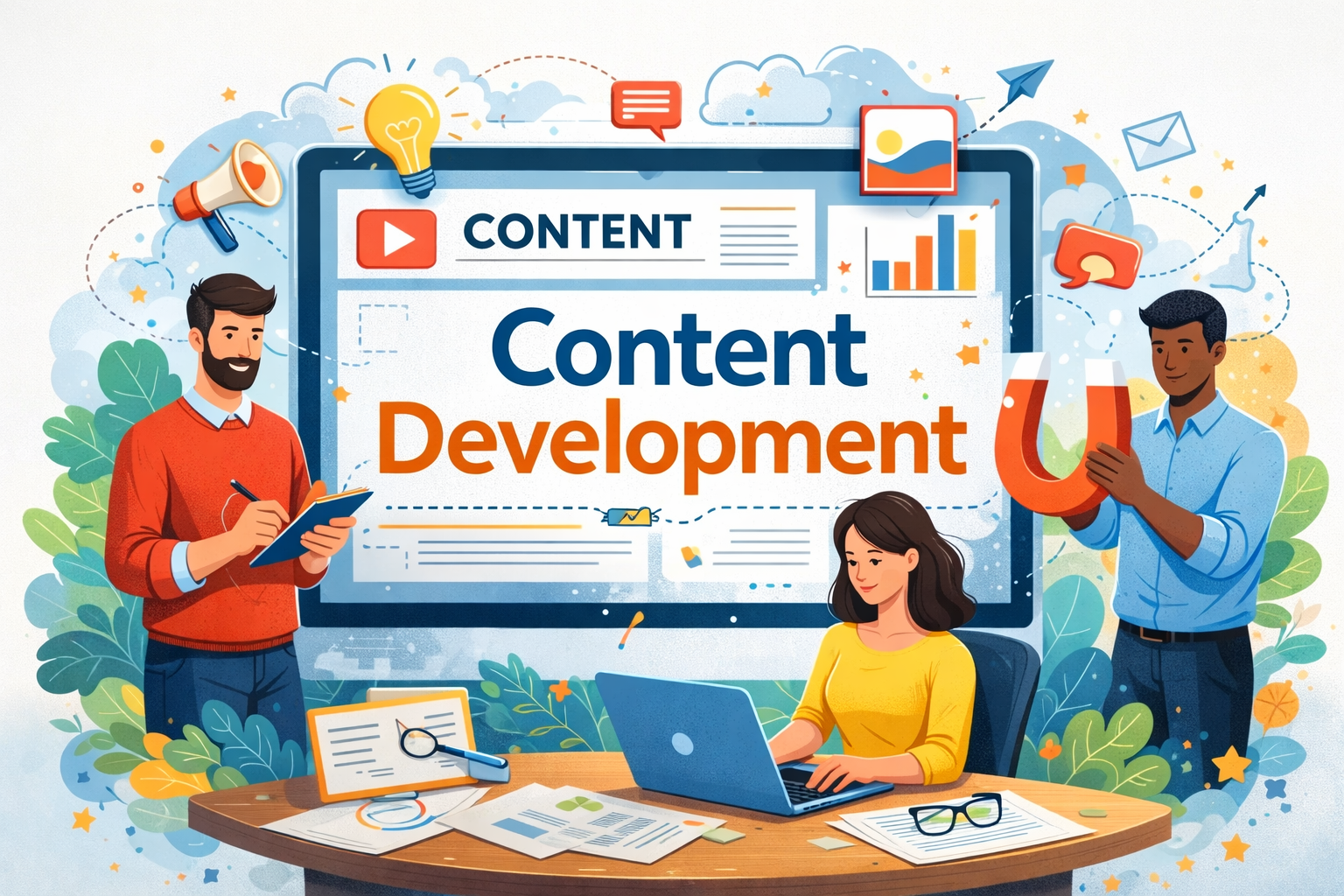
Content Development Strategy Services | B2The7
Content development is the strategic process of planning, creating, and optimizing content — including blogs, web copy, guides, and thought leadership — to support business goals and drive visibility in both traditional search and AI-powered discovery. B2The7 builds content systems for B2B, B2D, and D2C brands that align with real audience questions, SEO intent, and Generative Engine Optimization (GEO) signals to drive sustainable organic growth.
What You'll Learn in This Guide
- What content development actually includes today
- Real-world examples of content that performs
- Why content plays a critical role in SEO, GEO, and AI-driven discovery
- How B2The7 approaches content with strategy first
- How strategic content supports every stage of the customer journey
What Is Content Development?
Content development is the process of planning, creating, optimizing, and distributing content that aligns with business goals, customer needs, and discovery channels.
It goes far beyond writing blog posts. Modern content development includes:
Why Content Development Matters More Than Ever
The way people discover brands has changed.
Search engines, AI tools, and social platforms increasingly surface answers, not just links. That means your content has to do more than rank — it has to explain, clarify, and earn trust.
Strong content development helps brands:
- ✓ Show up in traditional search results
- ✓ Appear in AI-generated summaries and answers (GEO)
- ✓ Educate buyers before they ever talk to sales
- ✓ Create consistency across channels and campaigns
- ✓ Build authority over time instead of chasing trends
Why Content Development Is Important for Brands
Content is often the first interaction someone has with your brand — long before a form fill, call, or purchase.
Strategic content helps brands:
- ✓ Communicate value clearly and consistently
- ✓ Shorten the sales cycle through education
- ✓ Support trust and credibility in competitive markets
- ✓ Reduce dependency on paid media over time
- ✓ Turn insights and expertise into long-term assets
Where Content Development Shows Up Across the Journey
Content plays a role at every stage of the customer lifecycle:
Awareness
- Blog posts, articles, and social content that answer real questions
- Educational resources that align with search intent
Consideration
- Comparison content, use cases, and explainers
- Website copy that clearly articulates differentiation
Decision
- Case studies, testimonials, and proof-driven content
- Landing pages designed to convert, not just inform
Retention & Growth
- Ongoing thought leadership and insights
- Content that reinforces value post-purchase
Examples of Effective Content Development
Effective content isn't about volume — it's about relevance and clarity.
Examples include:
- A pillar blog that anchors multiple SEO and GEO topic clusters
- Website copy refreshed to align with real customer language
- Thought-leadership articles that position executives as industry voices
- Educational guides that support sales conversations
- Content frameworks built to fuel email, social, and paid campaigns
How Content Supports SEO and GEO
Search is no longer just about keywords — it's about context, structure, and usefulness.
Strategic content development supports:
How B2The7 Approaches Content Development
At B2The7, content development starts with strategy — not templates or trends.
Our approach connects:
- Digital Strategy & Planning to define what content matters most
- Content Development rooted in real audience questions
- Search Engine Optimization (SEO) for discoverability
- Generative Engine Optimization (GEO) for AI-driven search
- Website Copy & Content Refresh for clarity and conversion
- Thought Leadership & Article Creation to build authority over time
Ready to Build Content That Actually Drives Growth?
B2The7 builds content systems for B2B, B2D, and D2C brands that align with real audience questions, SEO intent, and GEO signals. Contact Bernie to get started.
Contact Bernie to Get StartedHow B2The7 Approaches Content Development
At B2The7, content development starts with strategy — not templates or trends.
Our approach connects:
Digital Strategy & Planning to define what content matters most
Content Development rooted in real audience questions
Search Engine Optimization (SEO) for discoverability
Generative Engine Optimization (GEO) for AI-driven search
Website Copy & Content Refresh for clarity and conversion
Thought Leadership & Article Creation to build authority over time
Every piece of content is designed to work across channels, support business goals, and stay relevant as search continues to evolve
Content Development Strategy FAQs
-
Content development is the strategic process of planning, creating, structuring, and optimizing content to support business goals, customer needs, and discovery across search, AI engines, and digital channels. It includes blogs, website copy, guides, articles, visuals, and thought leadership — all built with intent, structure, and performance in mind.
-
Content development focuses on what is created and why — the strategy, messaging, structure, and clarity of the content itself. Content marketing focuses on how that content is distributed, promoted, and measured. Effective content marketing depends on strong content development as its foundation.
-
Search engines reward content that is helpful, well-structured, and aligned with user intent. Strategic content development ensures your pages answer real questions, use clear language, support internal linking, and build topic authority — all critical factors for long-term SEO performance.
-
AI-driven search tools pull from authoritative, clearly written content to generate answers. Content development optimized for GEO emphasizes clarity, context, structured sections, and direct explanations — increasing the likelihood your brand is referenced or summarized by generative search engines.
-
High-value content should be reviewed and refreshed regularly — typically every 3–6 months. Updates may include improving clarity, adding new examples, aligning with current search behavior, or optimizing for evolving SEO and GEO signals.
-
Yes. Content development is especially effective for B2B, service-based, and local brands because it builds trust, educates buyers, and supports decision-making before direct sales conversations happen. Clear, informative content often shortens the sales cycle.