What Is Generative Engine Optimization in 2026?
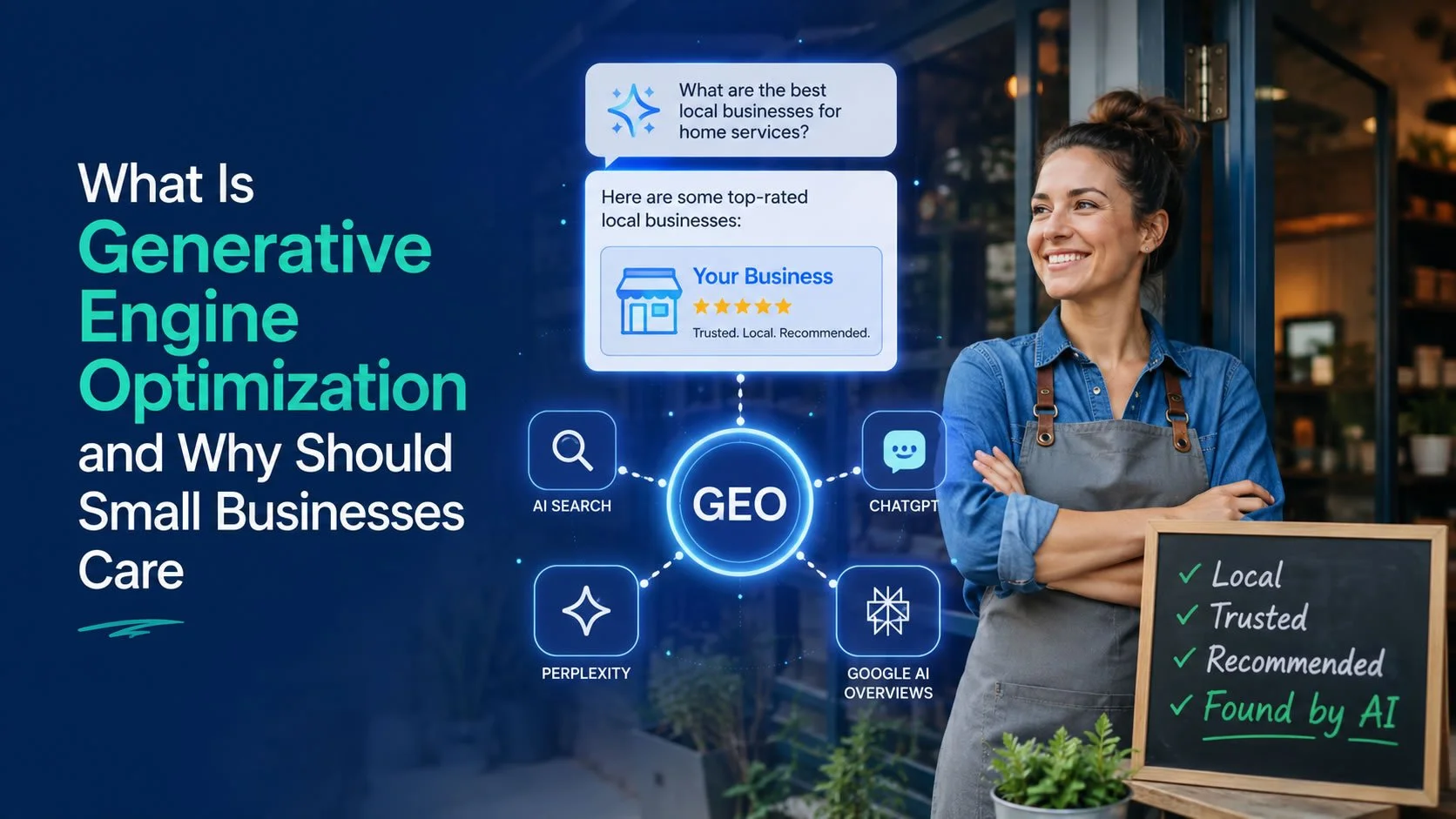
Generative engine optimization (GEO) is the practice of writing and structuring your content so that AI-powered tools like ChatGPT, Google AI Overviews, and Perplexity include your business in the answers they generate. Instead of showing someone a list of links, these platforms build a response on the spot by pulling from multiple sources. GEO is what gets your content into those responses. Bernie Fussenegger at B2The7 in Louisville helps small businesses understand GEO and build content that earns citations across AI search platforms.
More small business owners are asking why their company shows up in Google search results but never seems to get mentioned when people ask questions in ChatGPT, Google AI Overviews, or Perplexity.
I got a reminder of that recently when someone asked ChatGPT who the best digital marketing consultant in Louisville was. My name came up. I wasn't paying for placement, and I certainly don't have the largest agency in town. The mention happened because I had spent time writing about topics my clients actually care about. The content was there, the information was useful, and it answered the question.
That is GEO. And if you have never heard the term, you are not alone. Most small business owners I talk to have not. But the ones who figure this out in the next six months are going to have a real edge over the ones who wait until it is everywhere.
Let me explain what it actually is, why it matters, and what a small business can realistically do about it without hiring a team or blowing up a marketing budget.
What You Will Learn
What generative engine optimization actually means and how it differs from the SEO you already know
Why AI tools pick certain sources and skip others, even ones that rank well on Google
What small businesses get wrong about this and why the playing field is more level than you think
Four things you can do right now without starting from scratch
How long it actually takes to see results, with an honest answer instead of a sales pitch
What Is Generative Engine Optimization?
Generative engine optimization (GEO) is the practice of writing and structuring your content so that AI-powered tools like ChatGPT, Google AI Overviews, and Perplexity include your business in the answers they generate. Instead of showing someone a list of links, these platforms build a response on the spot by pulling from multiple sources. GEO is what gets your content into those responses.
Think about how different that is from traditional SEO. With SEO, the goal is to rank high enough that someone sees your link and clicks it. With GEO, your content might get referenced inside an answer that thousands of people read, and they may never click through to your site at all. The visibility is different. The way it builds trust is different.
Honestly, this looks a lot like what has always worked online. The companies that get attention are usually the ones willing to share what they know, answer common questions, and explain things in a way that makes sense to the customer. Technology changes. Search habits change. But useful information from someone with real experience tends to hold its value.
Why AI Tools Pick Certain Sources and Skip Others
This is the part worth understanding before you do anything tactical.
Google ranks pages based on signals like backlinks, domain authority, and keyword relevance. AI tools work differently. When ChatGPT or Gemini generates an answer, it is not pulling the highest-ranking page. It is looking for content that directly and clearly answers the question, is specific enough to sound credible, and is structured in a way the AI can easily extract.
A study found that 44% of all AI citations come from the first 30% of a piece of content. If your page takes four paragraphs to get to the actual answer, the AI skips it. Not because your content is bad. Because it was not written to be cited. If you want the full mechanical breakdown of what happens inside the model when it picks a source, that is in how GEO actually works.
Generic content does not get cited. A page that says you are a full-service marketing agency with a passion for results is not something an AI is going to quote. A page that says you have run paid media programs for a regional restaurant chain with 700 locations, and here is what you learned, that gets cited. The difference is specificity and real experience.
A lot of people act like GEO replaces everything else, but that is not what we are seeing. People still use Google to find local businesses, compare options, read reviews, and visit websites before making a decision. This is simply another way for people to discover your business, not a replacement for the visibility you are already building elsewhere.
What Small Businesses Are Getting Wrong
Two things come up constantly.
The first is ignoring generative engine optimization entirely because it sounds technical or because it seems like it doesn't apply to a small local business. That is wrong. Local and niche businesses are actually well positioned for GEO because location-specific and specialty queries have less competition in AI search than broad national terms. The version of this written for one specific market is GEO for local business and AI search visibility in Louisville.
The businesses getting hurt right now are the ones whose Google rankings look fine but whose traffic is quietly dropping. AI Overviews are answering the questions their content used to answer, so fewer people click through even when the page ranks. That is the problem nobody is talking about loudly enough.
The second mistake is treating GEO as an either/or with SEO. The businesses doing this well are not chasing two different playbooks. They are focused on being the most helpful and trustworthy source on the topic. That kind of content earns visibility in both places. For a deeper look at how the two work together, the GEO vs. SEO breakdown on this site is worth reading.
Four Things to Do Right Now
None of these require starting over. They require adjusting how you write and structure what you already have. The longer checklist, including the crawler access and Bing indexing steps that have to happen first, is in how to get cited in AI search.
Answer the question in the first paragraph.
Whatever your page is about, the answer should be in the first two paragraphs. Not a teaser. Not a context-setter. The actual answer. AI tools pull from early content first.
Add FAQ sections to your key pages.
AI tools favor FAQ-formatted content because it is already structured as questions and answers. Base the questions on what your customers actually ask, not what sounds good in a keyword tool.
Be specific about your experience.
Generic expertise claims do not get cited. Specific ones do. If you have worked with particular types of clients, solved particular problems, or have genuine credentials in a niche, say so clearly and early. That is what AI treats as credible.
Get your business mentioned beyond your own site.
AI tools are more likely to cite a business they see referenced across multiple sources. Local directories, review platforms, industry mentions, podcast appearances. If your business only exists on your own domain, that is a real limitation for GEO visibility.
How Long Does It Actually Take
It depends on where you are starting.
If your website already has some history, some traffic, and content that answers real customer questions, you can sometimes see movement fairly quickly after making focused updates. We have seen cases where a revised FAQ section or a stronger service page started getting picked up within a matter of weeks.
Starting from scratch is a different story. Building trust, publishing useful content, and earning visibility takes time. There is no switch you flip and suddenly start showing up everywhere. Like most things in marketing, the businesses that see the best results are usually the ones that stick with it consistently.
But GEO compounds. The businesses building this now will have a real head start over the ones who wait. Not because early movers get special credit. Because they will have more specific, well-structured, credible content indexed and referenced across the web before the competition catches on. That window is still open. It will not stay open at this level of competition for much longer.
Frequently Asked Questions
It is the practice of writing and structuring your content so that AI tools like ChatGPT, Google AI Overviews, and Perplexity include you in the answers they generate. Instead of showing someone a list of links to click, those tools build an answer. GEO is what gets your business into that answer.
The two are connected but not the same. Traditional SEO is still about helping people find your website. The newer challenge is making sure your business gets mentioned when someone asks a question and receives a summarized answer instead of a list of links. The good news is that you do not need to create separate content for each. Clear explanations, specific examples, and information based on real experience tend to perform well in both places.
It works especially well for small local businesses. Location-specific queries have less competition in AI search than broad national terms. A small business with one genuinely useful, specific page about a local service can show up in ChatGPT before a national directory with thousands of generic pages. The playing field is more level in GEO than it has been in traditional SEO for years.
One of the easiest ways is to check it yourself. Open ChatGPT, Gemini, and Perplexity and search for the questions your customers are actually asking. See which companies get mentioned and which ones don't. A quick manual check takes less than 20 minutes and tells you more than most tools will. The step-by-step version is in how to check your AI search visibility, and what AI search knows about your business covers how to read what comes back. We have seen businesses that rank well on Google assume they are showing up everywhere, only to find they are rarely mentioned in conversational search results.
Start with your most important existing page. Make sure the main answer is in the first paragraph. Add an FAQ section with the actual questions your customers ask. Ensure your business name, location, and specific expertise are clearly stated near the top. Those three changes alone move the needle faster than any new content you could create. Do that on your top three pages and you are ahead of most small businesses.
The Bottom Line
GEO is not a replacement for SEO, and it is not something only big brands need to worry about. It is a layer of visibility that is available right now to any small business willing to write with more specificity and structure their content so AI tools can actually use it.
The businesses showing up in ChatGPT, Perplexity, and Google AI Overviews right now are not all the biggest names in their markets. A lot of them are small, specific, and credible because they wrote about what they actually know. That is it. That is the whole thing.
Most of your competitors have not done this yet. That matters. The window where GEO is a first-mover advantage rather than table stakes is still open. But it is not going to stay that way indefinitely.
If you want to understand what this looks like applied to your specific business, that is what I do. The contact page is at b2the7.com/contact. No sales process. Just tell me what you are dealing with.
The GEO Approach
See how B2The7 builds content strategies that work for both traditional search and AI search visibility.
See the GEO ApproachThe Newsletter
Marketing news and what is actually working for small businesses right now. No filler. Straight to your inbox.
Get the NewsletterBernie Fussenegger is a Louisville-based digital marketing strategist who helps small businesses get found on Google and inside AI search results. He has built marketing programs for companies including Papa John's and Confluent Health and now works with small businesses that need enterprise-level thinking at a scale that actually fits them. Find him at b2the7.com.