
Social Media Strategy & Planning Services
Social strategy & planning is a documented process that aligns social media activity with business goals, audience behavior, and measurable outcomes. Social media strategy and planning is the process of defining which platforms your brand should be on, what content to post, how often to post, and how to measure whether your social efforts are achieving business goals. B2The7 develops platform-specific social media strategies and content calendars for brands that want a clear, actionable roadmap for their social presence. Contact Bernie to build your social strategy.
What You'll Learn in This Guide
- How to build a social strategy that aligns with real business goals — not just engagement
- How social strategy supports SEO, GEO, and AI-driven discovery
- How to choose the right social platforms based on audience behavior and intent
- How to connect organic social, paid social, and community engagement into one system
- How to define clear content pillars that support brand, demand, and retention
- How to measure social success beyond vanity metrics like likes and followers
Why Social Strategy Matters More Than Ever
Social platforms are no longer just awareness tools. They now influence:
- ▸ Search and discovery (human + AI-driven)
- ▸ Trust and brand credibility
- ▸ Purchase decisions
- ▸ Retention and advocacy
Without a clear strategy, brands end up:
- ✕ Posting content that doesn't compound
- ✕ Chasing engagement that doesn't convert
- ✕ Measuring vanity metrics instead of impact
Why Social Strategy Is Critical for Brands
A well-built social strategy helps brands:
Create Consistent Brand Signals
Messaging, visuals, and tone stay aligned across platforms, improving recognition and trust.
Support SEO + GEO Performance
Social content reinforces topical authority, brand mentions, and discoverability in generative search environments.
Guide Smarter Content Creation
Instead of guessing what to post, strategy informs themes, formats, and cadence.
Improve Performance Efficiency
Paid and organic social work together instead of competing for attention.
Scale Without Losing the Human Touch
Clear planning allows teams to move faster without sacrificing quality or authenticity.
What Goes Into a Strong Social Strategy & Plan
Audience & Platform Mapping
Understanding who your audience is — and how they behave differently on each platform.
Content Pillars & Messaging Frameworks
Defined themes that balance brand, education, proof, and conversion.
Channel Roles & Responsibilities
Each platform has a job — not every channel needs the same content.
Campaign & Always-On Planning
Blending long-term consistency with short-term moments that matter.
Measurement & Optimization Frameworks
Tracking what actually drives engagement, traffic, leads, and conversions — not just likes.
Real-World Examples of Social Strategy in Action
Using LinkedIn thought leadership and short-form video to support long sales cycles and build trust before the first conversation.
Combining Instagram and TikTok content pillars with paid amplification to drive both discovery and repeat purchases.
Using social proof, educational posts, and community engagement to influence search visibility and inbound leads.
How Social Strategy Connects to Other Social Services
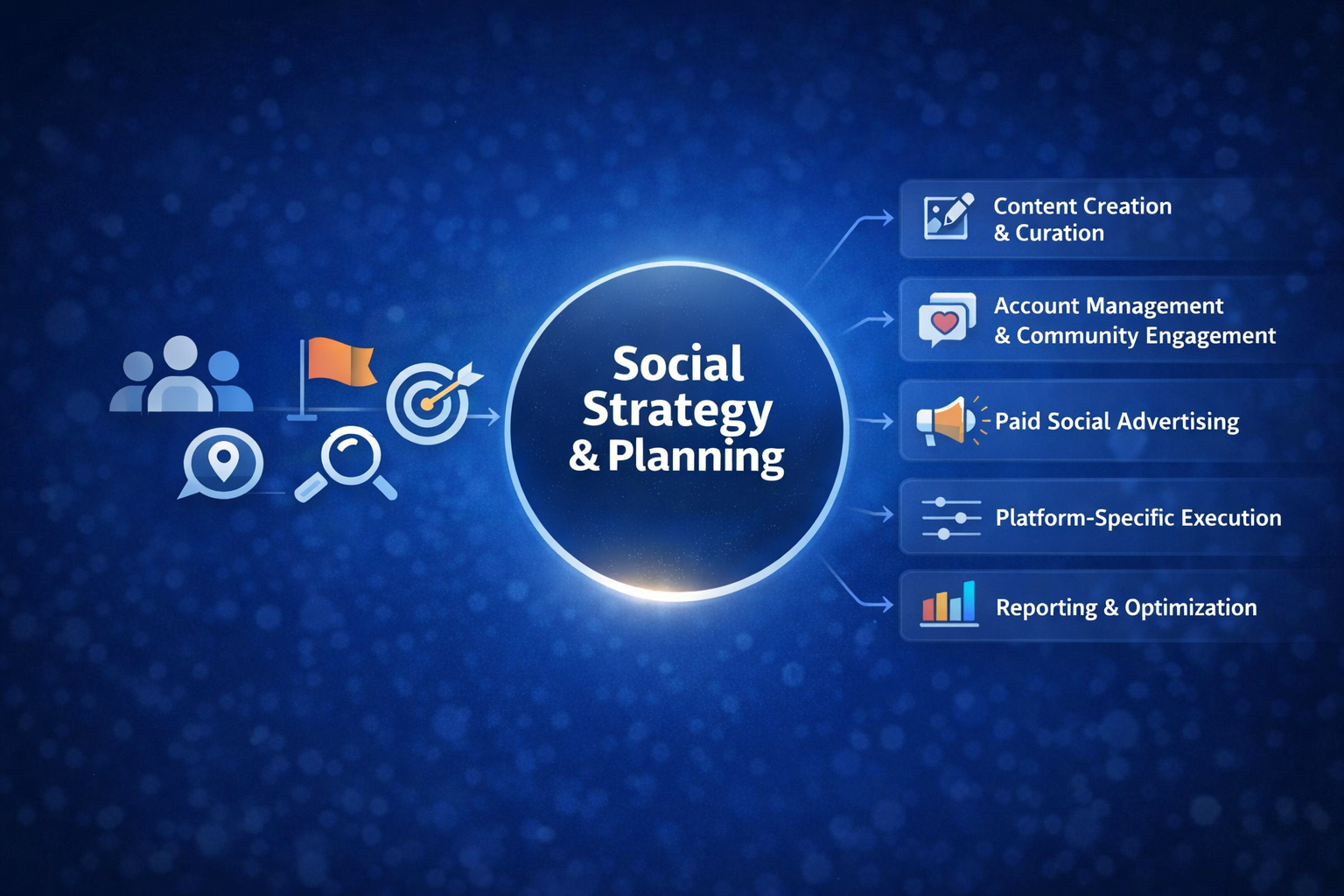
Social strategy is the anchor that makes every other service more effective:
- Social Strategy & Planning defines direction and goals
- Social Content Creation & Curation executes against clear themes
- Social Account Management & Community Engagement builds relationships consistently
- Paid Social Advertising amplifies what's already working
- Reporting & Optimization closes the loop and improves performance
Ready to Build a Social Strategy That Actually Works?
B2The7 develops platform-specific social media strategies and content calendars for brands that want a clear, actionable roadmap. Contact Bernie to get started.
Contact Bernie to Get StartedHow B2The7 Approaches Social Strategy & Planning
Social media doesn’t fail because brands don’t post enough—it fails because there’s no plan behind the posting.
A strong social strategy gives your brand direction, discipline, and momentum—so every piece of content works harder and lasts longer.
Social Strategy & Planning FAQs
-
Social strategy defines why you’re on social, who you’re trying to reach, and what role each platform plays. Social media management is the execution—posting, responding, and engaging based on that strategy. Without strategy, management becomes reactive and inconsistent.
-
The fundamentals are the same, but execution changes. B2B strategies often focus on thought leadership, education, and long-term trust. B2C and DTC brands lean more into storytelling, social proof, and conversion-driven content. Strategy ensures the right mix for your audience and buying cycle.
-
Strong social strategies reinforce brand authority, topical relevance, and consistent messaging—signals that matter for both traditional search and AI-driven discovery. Social content also increases branded search, citations, and engagement signals that support GEO visibility.
-
No—and most brands shouldn’t be. A good social strategy prioritizes platforms based on audience behavior, content fit, and resources. It’s better to show up consistently on fewer channels than to spread thin across all of them.
-
Most brands revisit their core social strategy annually, with quarterly check-ins to adjust content themes, platform focus, and performance benchmarks. Strategy should evolve as platforms, audiences, and business goals change.
-
It depends on objectives, but strong strategies look beyond surface-level engagement. Metrics often include engagement quality, traffic behavior, assisted conversions, audience growth relevance, and how social supports broader marketing goals—not just likes or impressions.