How to Build a GEO Content Cluster for AI Citations
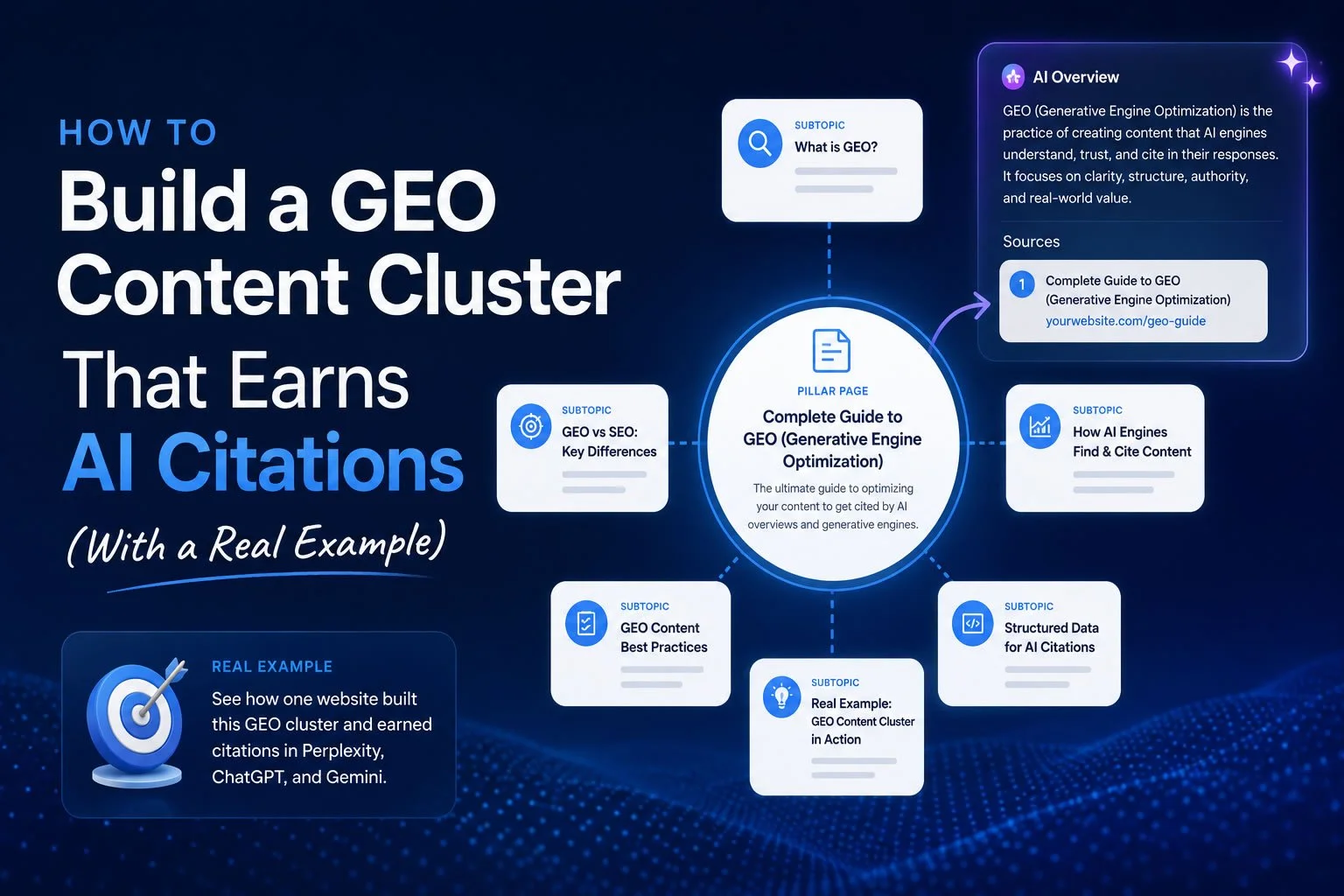
A GEO content cluster is a group of interconnected articles covering a single topic from multiple angles, each optimized for AI citation, and all cross-linked to each other. The cluster works because AI tools like ChatGPT, Perplexity, and Google AI Overviews use a process called query fan-out to break a question into sub-queries and retrieve the best answer for each one. A cluster that covers the same topic across eight articles gives AI tools multiple chances to find and cite your content across several sub-queries at once. B2The7 built an eight-article GEO content cluster over twelve weeks that now holds position 1 for "how does geo work" with confirmed AI Overview capture. This article explains exactly how that cluster was built and how a small business can copy the process.
I want to show you something real before explaining the theory.
The keyword "how does geo work" currently ranks at position 1.0 on Google for this site. In the past four weeks, that keyword generated 516 impressions and zero clicks. Not low clicks. Zero.
That is not a failure. That is a Google AI Overview answering the question directly in the search results by pulling from this site's content. The site is being cited as the source. The information is being used. The click does not happen because the reader gets what they need before they need to click.
That is what a GEO content cluster is designed to produce. And the cluster that produced it was built from scratch over twelve weeks, with eight articles, zero paid promotion, and a specific process any small business can follow.
Here is exactly how it works.
What You Will Learn
Why a Cluster Works When a Single Article Does Not
Most content advice says write a great article on a topic and it will rank. That is true as far as it goes. But AI search works differently from traditional search in one important way.
When someone asks an AI tool a question, the AI does not search for the single best article on that topic. It uses something called query fan-out. It breaks the question into several sub-questions and searches for the best answer to each one separately. Then it synthesizes everything into a single response.
So if someone asks "how do I get my small business cited in AI search," the AI might break that into sub-queries like what is GEO, how do AI tools select content to cite, what makes content AI-citable, and what do I do first to improve my AI visibility. It searches each of those separately.
A business with one article about GEO answers one of those sub-queries. A business with eight articles covering all of those angles answers most of them. And the more sub-queries your content answers, the more likely you are to appear in the final synthesized response.
That is why a cluster outperforms a single article in AI search. It is not about having more content. It is about covering more of the sub-queries AI uses to build an answer.
I covered this mechanic in detail in the what is GEO and how does it work article on this site. The query fan-out section is the part that changes how most people think about content strategy once they read it.
The Eight Articles in the B2The7 GEO Cluster
Here is the full cluster. Eight articles, each covering a distinct angle of the same topic, all cross-linked to each other. This is the cluster that produced the position 1 ranking and AI Overview capture.
1GEO vs SEO Small Business
The foundational distinction article. Why GEO and SEO are different disciplines and what a small business needs to understand about both.
2What Is Generative Engine Optimization
The definitional article. What GEO is from the ground up, written for someone who has never heard the term.
3AI Overviews Killing Your Traffic
The why-it-matters article. What AI Overviews are doing to organic traffic and why the response is not less content but differently structured content.
4What AI Search Knows About Your Business
The diagnostic article. What ChatGPT, Gemini, and Perplexity actually know about your business and why the picture is often wrong.
5How to Check Your AI Search Visibility
The practical audit article. A step-by-step process for checking what AI tools currently say about your business.
6GEO and Local Business Discovery in Louisville
The local application article. What GEO means for a Louisville small business and how local AI search works differently from national AI search.
7How to Get Cited in AI Search
The action article. The specific technical and content steps that move the needle fastest for getting cited by ChatGPT, Perplexity, and Google AI Overviews.
8What Is GEO and How Does It Work
The mechanism article. What actually happens inside the AI when it decides who to cite, including the query fan-out mechanic most small business articles never explain.
Eight articles covering eight distinct angles. None of them repeat each other's core argument. All of them are cross-linked to at least two others in the cluster. The result is a topical authority signal that tells Google and AI tools this site has comprehensive, specific coverage of GEO as a subject rather than one article that touches on it.
How to Build the Cluster: The Process
Step 1: Choose one topic you can genuinely cover from eight angles
Not eight ways to say the same thing. Eight genuinely distinct angles. For the GEO cluster, each article covers a different question a reader might have at a different stage of understanding. The definitional question, the distinction question, the diagnostic question, the audit question, the action question, the mechanism question, the local application question, and the comparison question. If you cannot identify eight genuinely distinct angles on your topic, the topic is too narrow for a cluster.
Step 2: Write the foundational article first
The foundational article is the one that makes the case for why the topic matters. For GEO, that was the GEO vs SEO article. It does not need to be the longest article. It needs to be the clearest statement of what the topic is and why a reader should care. This article becomes the hub that everything else links to first.
Step 3: Write one article per week, each covering a different angle
One article per week is the right pace for two reasons. It gives each article time to index before the next one publishes. And it gives you time to see what is working before committing to the remaining articles. If one article generates strong early signals, that tells you something about which angle the audience is most interested in.
Step 4: Cross-link every article to at least two others as you publish
This is the step most people skip and it is the most important one. Internal links between cluster articles signal to Google that these articles are related and collectively authoritative on the same topic. Each article should link to the foundational article and to at least one other article in the cluster that is a natural next step for the reader.
Step 5: Add a hub article after the cluster is complete
This article. A hub article is the one that links to all the others and explains the full cluster. It is the article someone reads when they want the full picture rather than one angle of it. It also strengthens the cluster's internal link architecture by giving every other article one more inbound link.
The Cross-Linking Architecture
Here is the specific cross-linking pattern that worked for the B2The7 GEO cluster. Every article links to the foundational article (GEO vs SEO). Every article links to at least one article that is a natural next step for the reader. The hub article, this one, links to all eight.
The pattern creates a web rather than a chain. A chain breaks if one link is missing. A web distributes authority across the whole cluster regardless of which article a reader enters through. Someone who finds the diagnostic article through a search on AI search visibility can navigate to the foundational article, the action article, the mechanism article, or the audit article without ever leaving the cluster.
That navigation behavior, readers moving between multiple articles in a single session, is one of the engagement signals that reinforces topical authority in Google's eyes. The cluster is not just linked. It is structured for a reader who wants to go deeper, and that structure produces the navigation behavior that signals genuine expertise.
The cross-linking discipline also connects directly to the zero-click search problem I covered in the zero-click search article on this site. When a Google AI Overview cites the cluster content and delivers the answer without a click, the internal links within the cluster become the path readers use when they want more than the AI Overview summary gives them.
What the Data Looks Like When It Is Working
The GEO cluster started generating gap zone signals around week four. By week eight, the first GEO keywords entered the gap zone. By week twelve, the cluster had two queries at once in the top 5 with AI Overview capture confirmed on the position 1 keyword.
Position 1 ranking with confirmed AI Overview capture, plus two queries in the top 5 at the same time
Here is specifically what to watch for in your Search Console data as a cluster builds.
New keyword variants you did not target directly
The cluster generates topical authority that pulls in related queries you never wrote specific content for. That is how you know the authority signal is compounding.
Position movement on the foundational article weeks after the others publish
The foundational article often climbs faster once the cluster articles are cross-linking to it than it did in isolation. That is the internal link authority signal showing up in the data.
The AI Overview zero-click pattern
A keyword at position 1 with high impressions and near-zero CTR is not a failure. It is the clearest signal that AI is citing the content. That is the GEO goal achieved.
Frequently Asked Questions
A GEO content cluster is a group of interconnected articles covering a single topic from multiple angles, each written to be AI-citable, and all cross-linked to each other. The cluster works because AI tools use query fan-out to break a question into sub-queries and retrieve the best answer for each one separately. A cluster that covers eight angles of the same topic gives AI tools multiple chances to find and cite your content across several sub-queries, which produces more consistent AI citations than any single article can generate on its own.
Eight is a practical target for a well-developed cluster, but the right number depends on how many genuinely distinct angles exist on your topic. A cluster of five strong articles covering five genuinely distinct angles outperforms a cluster of ten articles where four of them repeat the same core argument with different phrasing. The test is whether each article answers a different question a reader might have at a different stage of understanding the topic. If two articles answer the same question, merge them.
The B2The7 GEO cluster started showing early gap zone signals around week four and reached a position 1 ranking with AI Overview capture by week twelve. This timeline varies based on domain authority, competition, and publishing consistency. A new site in a competitive category will take longer. An established site in a less competitive category may see results faster. The consistent signal across most cluster builds is that results compound rather than arrive linearly. Slow progress in weeks one through six, then accelerating movement in weeks seven through twelve as the internal link architecture and topical authority signals accumulate.
Three things. First, every article is written to be AI-citable, meaning the answer is in the first paragraph, FAQ sections are included on every piece, and the writing is specific enough to be attributed to a credible source. Second, every article is cross-linked to at least two other articles in the cluster, creating a web of internal links that builds topical authority faster than isolated articles. Third, the cluster is designed around query fan-out, meaning each article answers a different sub-query AI tools use when building an answer to a question about the topic.
Yes. The B2The7 cluster was built by one person, one article per week, over twelve weeks. The key is topic selection and pace. Choose a topic you can cover from eight genuinely distinct angles without running out of things to say. Publish one article per week rather than trying to publish all eight at once, because indexing time between articles is part of what makes the cluster work. Cross-link every article to at least two others as you publish. And add a hub article at the end that links to all of them.
The Bottom Line
The GEO content cluster on this site is not a theory. It is a live example with Search Console data showing position 1 with AI Overview capture and two queries in the top 5 at the same time after twelve weeks of consistent publishing.
The process is not complicated. Choose a topic. Cover it from eight angles. Write each article to be AI-citable. Cross-link everything. Add a hub article. Wait twelve weeks.
The businesses doing this right now are building an AI search advantage that will be a lot harder to close once they have established topical authority. The window is still open because most small businesses have not started yet.
Want help building a GEO content cluster for your business?
B2The7 builds GEO content clusters for small businesses that earn AI citations in ChatGPT, Google AI Overviews, and Perplexity. One strategist. Real data. No theory.
Bernie Fussenegger is a Louisville-based digital marketing strategist who helps small businesses get found on Google and inside AI search results. He has built marketing programs for companies including Papa John's and Confluent Health and now works with small businesses that need enterprise-level thinking at a scale that actually fits them. Find him at b2the7.com.