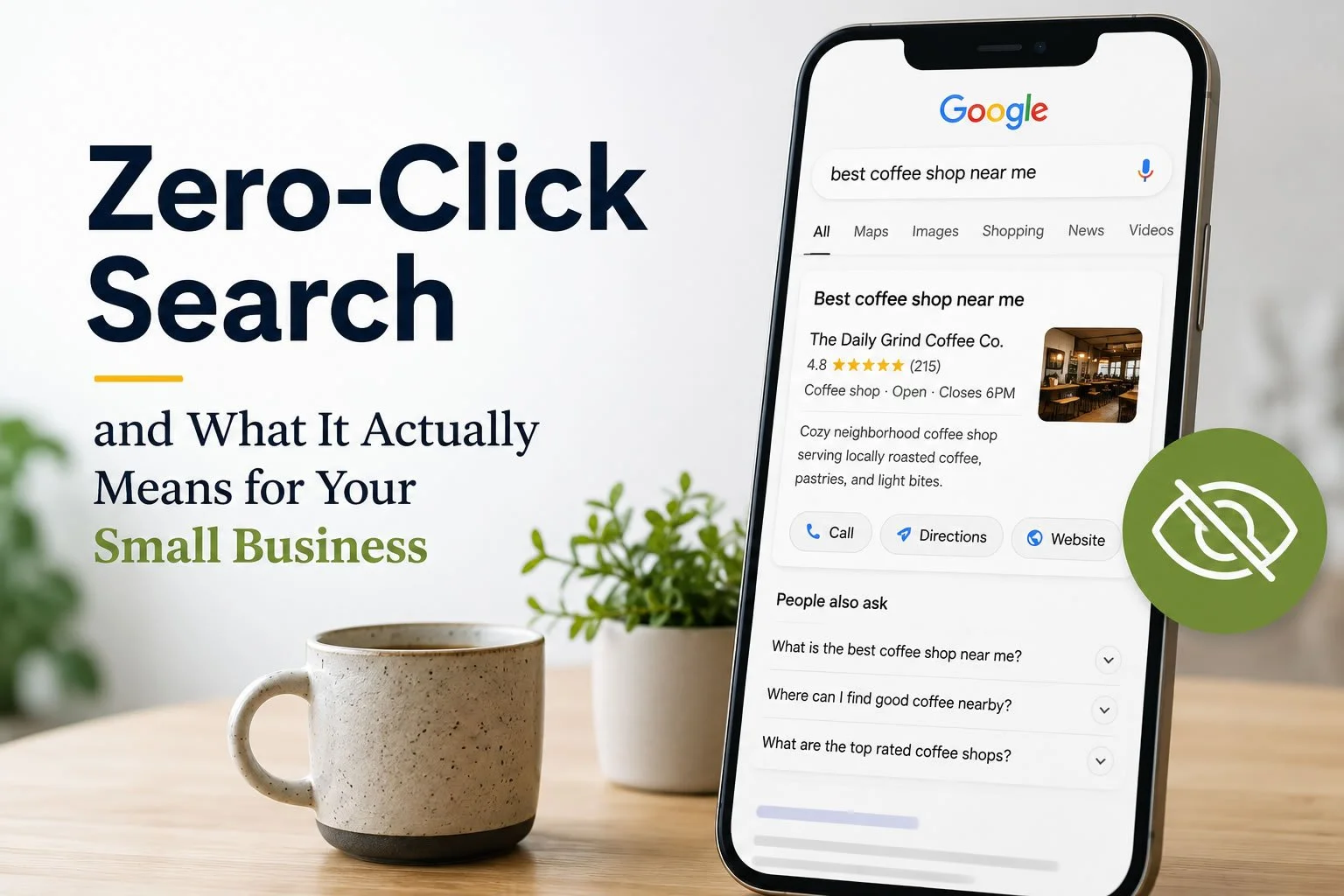
Zero-click search refers to searches on Google where the user gets their answer directly on the results page, without clicking through to any website. More than 58% of Google searches in the US now end without a click. This happens when Google's AI Overviews, featured snippets, knowledge panels, or local pack results answer the question before the user needs to visit a source. For small businesses, zero-click search means that ranking on page one no longer guarantees website traffic, and that visibility strategy has to extend beyond traditional SEO rankings. Bernie Fussenegger at B2The7 in Louisville works with small businesses on content and GEO strategies that build visibility across both clicked and zero-click search results.
I want to show you something from my own Search Console data because I think it makes this more concrete than any general explanation can.
The keyword "how does geo work" is currently ranking at position 1.0 on Google for the b2the7.com site. That is the top result. In the past two weeks, that keyword has generated 258 impressions. People searched for it, Google showed the B2The7 article as the number one result, and it got zero clicks.
Impressions to clicks in two weeks for a keyword ranking at position 1.
Not a few clicks. Zero.
Is that a problem? Is the article failing? Should I rewrite it or check what is broken?
No, no, and no. What is happening is exactly what you would expect when you understand zero-click search. Google is answering the question "how does geo work" directly in the search results, probably through an AI Overview that pulls from the article, before the user needs to click anything. The article is being cited. The information is being used. Nobody is clicking through because they do not need to.
That changes how you think about rankings, visibility, and what success actually looks like. Let me walk through it.
What You Will Learn
What zero-click search is and why more than half of all Google searches end this way
Why ranking number one can generate zero clicks and why that is not always a failure
The difference between zero-click search hurting your business and working in your favor
What GEO has to do with zero-click search and why they are the same problem from two directions
What small businesses should actually do when clicks are no longer the primary metric
What Zero-Click Search Actually Is
When Google can answer a question directly on the search results page, it does. Featured snippets pull a direct answer from a page and display it above the organic results. AI Overviews synthesize an answer from multiple sources and show it at the top before any links. Knowledge panels display facts about businesses, people, and places without requiring a click. Local pack results show maps, hours, and phone numbers.
In all of these cases, the user got what they needed without leaving Google. No click. No website visit. No session in your analytics.
This has been building for years, but AI Overviews accelerated it significantly. When Google rolled out AI Overviews in 2024 and expanded them through 2025 and 2026, it moved from answering a subset of simple factual questions directly to answering a much broader range of informational queries without requiring a click. I broke down what that shift does to small business traffic specifically in the article on how AI Overviews are killing your traffic on this site.
The result is that more than 58% of all Google searches in the US now end without a click. For some query categories, that number is much higher. Informational questions, how-to queries, definition requests, anything where Google can confidently synthesize a short answer, these are the queries most likely to end before anyone visits a website.
Why This Is Not Always a Problem
Here is the thing most coverage of zero-click search gets wrong. It treats every zero-click result as a loss. Your content got used, you did not get the traffic, so it reads like a bad deal.
But go back to my example. "How does geo work" at position 1 with 258 impressions and zero clicks. If Google's AI Overview is answering that question by pulling from the B2The7 article, a few things are happening.
First, the article is being cited as a credible source in an AI Overview. That is a GEO citation, which is exactly what the GEO content strategy is designed to produce. The content is doing its job even though the click is not coming.
There's another benefit that's easy to miss. Every time someone sees an AI Overview that cites b2the7.com, they've been introduced to the brand, even if they never visit the website. You won't see that in your traffic reports, but it still has value. People tend to remember the names they see more than once.
That first impression can matter more than you think. Someone might see your business cited in an AI Overview today, then come back a week later searching for a Louisville GEO consultant or typing "B2The7" directly into Google. Most analytics platforms won't connect those two moments, but that's how a lot of buying decisions happen. People rarely hire someone the first time they hear the name. They remember it, do a little more research later, and come back when they're ready to take the next step.
When Zero-Click Search Actually Hurts Your Business
There is an important distinction between query types here.
"How does X work" queries
If someone searches "how does geo work" and Google answers it, that person was probably never going to hire Bernie from that single search regardless of whether they clicked. They were in research mode. The AI Overview serves them well, and the citation builds brand authority.
"Who offers X in Louisville" queries
If someone searches "digital marketing consultant Louisville" and Google's local pack answers with three businesses without showing yours, that person had buying intent that got resolved without you. That is a real loss, because your business is not in the result that got the attention.
The distinction is intent. Informational zero-click results are acceptable and often useful. Commercial and transactional zero-click results, the ones where someone had a buying intent and Google resolved it from a map pack, a local listing, or a competitor's featured snippet, are the ones that cost small businesses actual customers.
I covered the local AI search dimension of this in the GEO and local business discovery article on this site. The short version is that showing up in AI-generated local recommendations is now as important as ranking on the first page of traditional results, and the two require different strategies.
What GEO Has to Do With This
Zero-click search and GEO are the same underlying shift approached from two directions.
Zero-click search is the observation that answers are being delivered without clicks. GEO is the strategy for making sure your business is the source of those answers.
When Google's AI Overview answers "how does geo work" by citing b2the7.com, that is GEO working correctly. The content was structured to be extractable, the answer was in the first two sentences, and the information was specific enough that the AI chose it as the source. I covered the mechanics of how this works in the What Is GEO and how does it work article on this site.
For a small business, the takeaway is pretty simple. You can't make someone click your website. What you can do is give Google enough confidence in your content that it uses your business as the answer. That's a different way of thinking about search visibility than most of us learned a few years ago.
We've spent years treating the click as the only thing that mattered. That's not the world we're in anymore. If Google is pulling information from your business and putting it in front of searchers, you've already won part of the battle. The click is still valuable, but it's no longer the only measure of success.
What Small Businesses Should Actually Do
Stop measuring success only in clicks.
Track impressions alongside clicks. A keyword at position 1 with 200 impressions and 0 clicks is not the same as a keyword at position 8 with 200 impressions and 0 clicks. The first one is probably being answered by an AI Overview that cites your content. The second one is being ignored. They require different responses.
Build content structured for extraction, not just ranking.
The content that gets cited in AI Overviews and featured snippets is content where the answer is in the first paragraph, the headings mirror the questions being asked, and the writing is specific enough to be attributable. Writing for GEO citation and writing for featured snippets are the same discipline.
Make sure your Google Business Profile is complete and current.
The local pack is the most commercially damaging form of zero-click search for small service businesses. If someone searches for your category in Louisville and the map pack comes up with three competitors and not you, that is a zero-click loss with real commercial consequences. Your Google Business Profile is the primary input Google uses for local pack inclusion.
Track brand searches alongside keyword rankings.
If your content is getting cited in AI Overviews, you should start to see an uptick in branded searches, people typing your business name directly. That is the assisted conversion pattern at work. It does not show up in click attribution, but it shows up in brand search volume.
The full playbook for getting your content cited in AI Overviews and ChatGPT is in the how to get cited in AI search article on this site. It covers the specific technical and content steps that move the needle fastest.
Frequently Asked Questions
Zero-click search is when someone gets their answer directly on the Google results page and never clicks through to a website. It matters because more than 58% of US searches now end this way, which means ranking number one no longer guarantees traffic. For a small business, that changes what success looks like. Your content can be doing its job, getting cited in an AI Overview or featured snippet, without ever showing up as a click in your analytics.
Not all zero-click searches are bad. If someone is researching a topic, it's fine if they get the answer without visiting your website, especially if your content is what Google used to answer the question. Your name is still getting in front of them, and that builds familiarity over time. The real problem is commercial searches. If someone is looking for a service provider in your area and Google answers the question with a map pack or a competitor before they ever see your business, that's a customer you had a chance to win and never even got to compete for.
Zero-click search is the phenomenon. GEO is the strategy for making sure your business is the source that gets cited when a zero-click result happens. When Google's AI Overview answers a query by pulling from your content, that is a GEO citation. The goal is not to prevent zero-click results, which is impossible, but to be the source that gets credited in them. That requires content structured for extraction rather than just ranked for keywords.
Check Google Search Console for keywords where you have high impressions and position 1 to 3 rankings but very low CTR. That pattern, high impressions and near-zero clicks at a top position, is the most reliable signal that Google is answering the query directly from your content without driving a click. You can also run the query yourself in a browser where you are not logged into any Google account and see whether an AI Overview appears and whether your site is cited in it.
Three things in priority order. First, complete your Google Business Profile fully and keep it current, since the local pack is the most commercially damaging zero-click result for service businesses. Second, structure your most important content so the answer is in the first two sentences of each page, not buried in the third paragraph. Third, add FAQ sections to key pages, since FAQ-formatted content is the highest-conversion format for AI Overview and featured snippet citations. Those three changes address the most common zero-click gaps for small businesses.
The Bottom Line
The keyword "how does GEO work" ranks #1 on Google. Over the past two weeks, it generated 258 impressions and not a single click. A couple of years ago, I would have seen that as a failure. Today, I see it differently. In a world where people often get their answers without leaving the search results, the content is doing exactly what it was written to do.
More than half of Google searches end without a click. That is not going back. The question is not how to get clicks from searches that AI is going to answer anyway. The question is whether your business is the source that gets cited when those zero-click results happen.
If you want to think through what that means for your specific content and your specific business in Louisville, that is exactly the kind of work I do.
Bernie Fussenegger is a Louisville-based digital marketing strategist who helps small businesses get found on Google and inside AI search results. He has built marketing programs for companies including Papa John's and Confluent Health and now works with small businesses that need enterprise-level thinking at a scale that actually fits them. Find him at b2the7.com.