Local SEO for Small Business: The Complete 2026 Playbook
Local SEO for small business in 2026 means showing up when nearby customers are searching — on Google Maps, in the Local Pack, and increasingly in AI-generated answers that surface local recommendations before a traditional search result ever appears. This complete playbook by Bernie Fussenegger of B2The7 covers everything small business owners need to rank higher locally: optimizing your Google Business Profile from top to bottom, building a consistent review acquisition process, fixing NAP inconsistencies across directories, adding LocalBusiness schema markup, and creating location-specific content that earns visibility in your service area. Follow this guide and you'll have the foundation to turn local searches into real customer revenue.
With 25+ years of working alongside small businesses, I have seen the same pattern over and over. The ones that understand local search win the calls, the traffic, and the revenue.
This playbook shows you exactly how to make that happen.
What You’ll Learn from This Article
How to optimize your Google Business Profile so it generates leads around the clock
The review system that builds rankings and converts searchers into customers
Why NAP consistency is a ranking factor most businesses overlook
How to build a website that Google rewards with local traffic
How to show up in AI-powered local search results in 2026
The Local Search Problem: Most Small Businesses Do Not Know They Have
Here is something I have seen hundreds of times in 25 years of marketing: a business owner works incredibly hard, delivers a great product or service, and then wonders why their phone is not ringing the way it should. Meanwhile, a competitor across the street with half the quality is fully booked. The difference, almost every single time? That competitor showed up on Google, and they did not.
Local SEO for small businesses closes that gap. In 2026, it is the foundation of how local customers find, trust, and choose you.
The good news: you do not need a massive budget. You need a strategy. This playbook gives you the same framework I have used with real businesses to move them from invisible to ranking well in local search, step by step.
“Why This Matters Right Now
88% of consumers who conduct a local search on their smartphone visit or call a business within 24 hours (BrightLocal)
Businesses in Google’s top 3 local results get 126% more traffic and 93% more calls than those ranked 4-10 (Whitespark)
40% of local business queries now trigger Google’s AI Overviews, so visibility goes well beyond the traditional blue links
Google considers over 149 different ranking factors for local search (Whitespark 2026 Local Search Ranking Factors Report)”
What Is Local SEO for Small Business and Why Does It Work?
Local SEO for small business is the process of optimizing every digital signal associated with your business so that Google surfaces you when a nearby customer is looking for what you offer. It is not about gaming an algorithm. It is about showing search engines, and potential customers, that your business is legitimate, local, and trustworthy.
Think of it this way: when someone searches for 'best plumber near me' or 'Italian restaurant downtown,' Google runs a rapid assessment of every local business that could match.
It is asking three core questions:
Relevance: Does this business actually match what I searched for?
Distance: How close is this business to the searcher?
Prominence: How well-known and trusted is this business online?
Your local SEO strategy is your answer to all three questions. Every tactic in this playbook is designed to improve at least one of these signals. When all three are strong, you rank. When any one is weak, a competitor steps in. And if you are wondering, SEO is not dead.
Step 1: Master Your Google Business Profile (Your Most Powerful Free Tool)
Your Google Business Profile is the single most important factor for ranking in the Google Maps local pack. Industry data shows GBP signals account for as much as 32% of all map pack ranking factors. If you have not fully built this out, everything else you do will underperform.
How to Optimize Your Google Business Profile in 2026
Work through each of these in order:
Choose your primary category carefully. According to Whitespark's 2026 Local Search Ranking Factors survey, which pulls data from 47 top local SEO experts, your primary GBP category is the #1 ranking factor for the local pack. Pick the category that most precisely defines what you do.
Complete every single field. Businesses with complete profiles are 2.7 times more likely to be seen as trustworthy. Add your hours, services, description, phone, website, and attributes. Do not leave anything blank.
Add real photos regularly. Upload images from actual jobs, your location, your team. Google evaluates recent behavior more heavily than historical completeness. Static profiles decay.
Post weekly. GBP posts signal to Google that your business is active. Businesses that stop posting lose ground, even if everything else looks good.
Use up to 4 additional categories. A BrightLocal study found businesses using four additional GBP categories have an average map ranking of 5.9, compared to lower rankings for those using just one.
Respond to every review , within 24 hours where possible. More on this in the next section.
Step 2: Build a Review Engine (Google Is Reading Every Word)
NoReviews are the digital version of word-of-mouth, and in 2026 they are one of the most heavily weighted local search ranking factors you control. Here is what most business owners do not know: Google's AI does not just count your reviews. It also reads the sentiment in the text.
According to industry research, review signals account for over 15% of how you rank in the local pack. That is a big number. And yet most small businesses treat reviews as something that just happens, hoping customers leave them rather than building a real system around it.
Your Simple Review System
Ask immediately after a positive experience. The moment a customer says they are happy, whether in person, by text, or by email, make the ask. Timing matters more than most people realize.
Make it frictionless. Create a short link directly to your Google review page. Text it, email it, print it on receipts.
Respond to everything. Positive reviews, negative reviews, respond thoughtfully to all of them. Owner responses show Google your business is active and engaged.
Aim for 200+ reviews. Businesses in Google's top 3 positions average nearly 250 reviews. Those in positions 4-10 average under 200. That gap matters. Some mistakes a brand makes is not having a review strategy.
Velocity over volume. A steady stream of new reviews each month outperforms a burst followed by silence. Consistency signals an active, popular business.
“Critical Warning
Never buy fake reviews. Google’s August 2025 spam update specifically targeted fake review manipulation. Penalties are serious, and recovery takes a long time. Build your reviews the right way. It is the only approach that actually holds up and grows over time.”
Step 3: Lock Down Your NAP Consistency (The Trust Signal You Are Probably Getting Wrong)
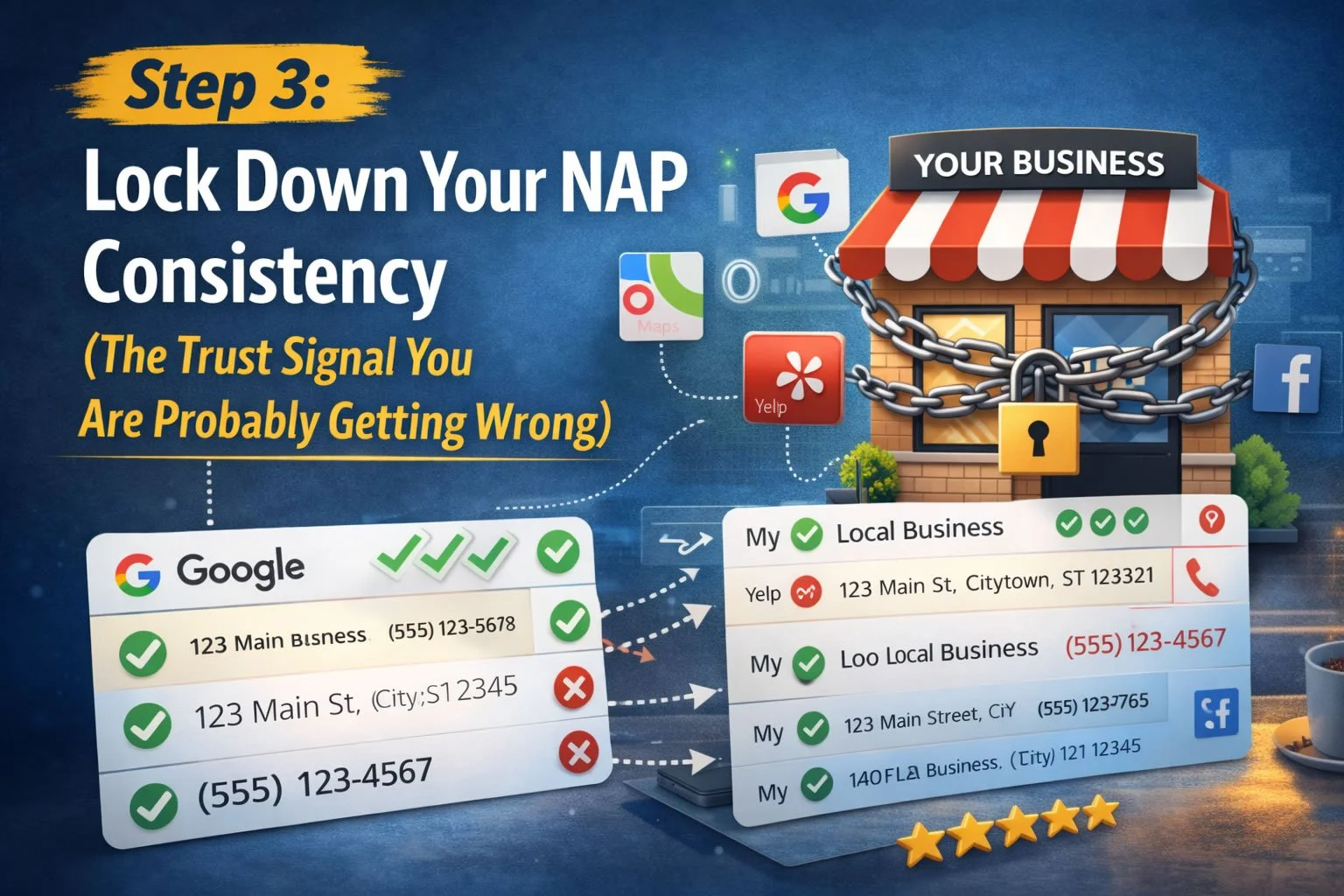
NAP stands for Name, Address, and Phone Number. In 2026, inconsistencies in how your business information appears across the internet are not minor. They slow down Google's ability to index and trust your business.
Think of it from Google's perspective: if your business is listed as 'Main St' in one place and 'Main Street' in another, and the phone number on Yelp is slightly different from the one on Facebook, those inconsistencies create doubt. And Google does not rank businesses it doubts.
Where Your NAP Needs to Match Exactly
Google Business Profile
Your website (header, footer, and contact page)
Facebook Business Page
Yelp
Apple Maps
Bing Places
All industry directories relevant to your business
Use a tool like BrightLocal or Moz Local to run a citation audit. Fix every inconsistency you find. This one step alone can improve your local search ranking noticeably within 30-60 days.
Step 4: Optimize Your Website for Local Search (Where Most Small Businesses Drop the Ball)
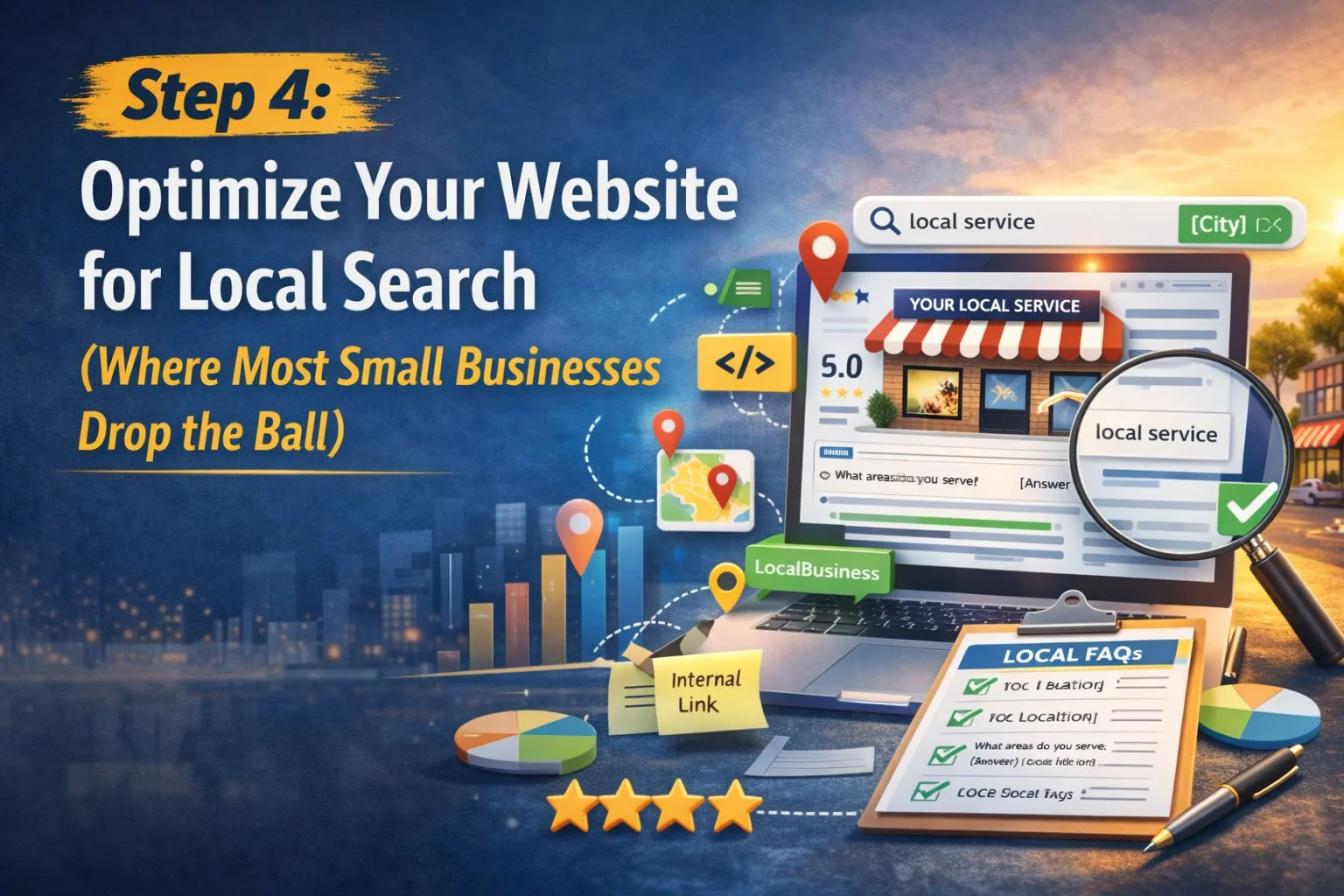
Your website and your Google Business Profile should function as one connected local SEO system. In 2026, Google looks at your business as a single digital footprint, not as separate pieces. If your website is weak, it will hold back even a fully optimized profile. Content is your growth engine and don’t just think SEO, think search EVERYWHERE optimization.
Key Website Optimizations for Local Ranking
Create a dedicated page for each service. This is the #1 local organic ranking factor according to Whitespark's 2026 data. A single 'Services' page covering everything is weak. Give each service its own page with unique content, location-relevant keywords, and an FAQ section.
Add your location naturally throughout your content. Avoid cramming it into every sentence. Work your city name into the content naturally, where it makes sense. When it is used in real context, it performs far better than awkward keyword repetition.
Add LocalBusiness schema markup. This is structured code that explicitly tells Google who you are, where you operate, and what you do. It significantly improves your chances of appearing in AI Overviews and rich results.
Build internal links strategically. Every new piece of content should link to your important service pages. Internal links distribute authority throughout your site and help Google understand which pages matter most.
Make your site fast and mobile-first. Mobile devices account for 62.5% of all global web traffic in 2026. A slow, hard-to-navigate mobile site undermines your ranking potential. Test your site at Google PageSpeed Insights.
Step 5: Create Local Content That Answers Real Questions
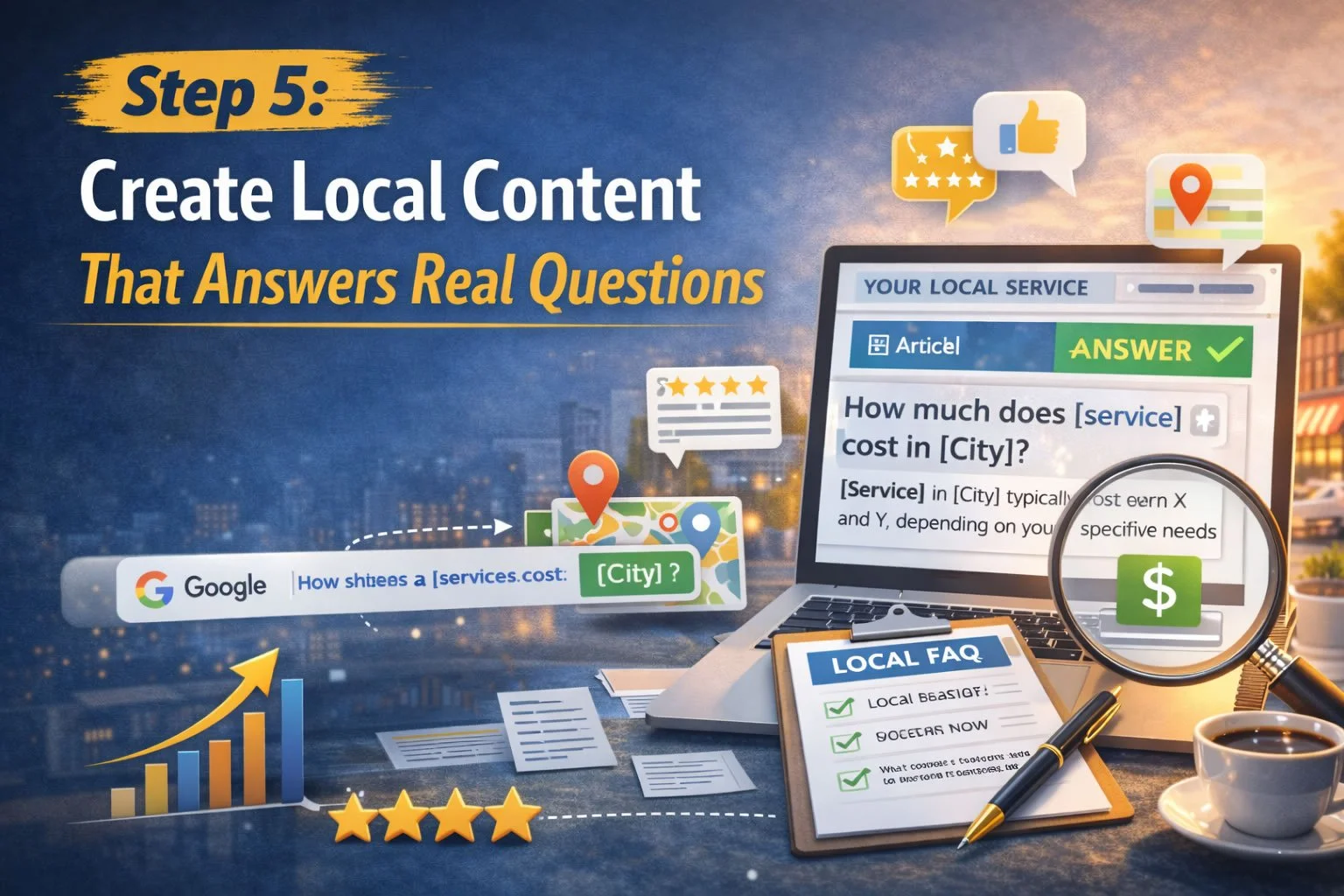
Here is where your local SEO strategy gets a serious competitive advantage: most small businesses in your area have no blog, no FAQs, and no locally relevant content. This is your opportunity to dominate.
I have been saying this for 25 years in different contexts: the business that answers questions best wins the customer. In 2026, that truth is built directly into Google's algorithm. Content that answers real questions from real local customers earns both rankings and trust. But, content visibility alone isn’t enough.
What Local Content to Create
FAQ pages per service. Answer the exact questions your customers ask every day. “How much does this cost in [city]?” “How long does this take?” Questions like these attract high-intent searches and build confidence at the same time.
Location-specific landing pages. If you serve multiple cities or neighborhoods, give each one its own page with genuinely different content. Not just a find-and-replace of the city name.
Before-and-after or project pages. Document the real work you have done. These serve as both social proof and locally relevant content that competitors cannot replicate.
'Near me' content. Create content naturally around '[Your Service] near [Neighborhood/City]'. These phrases have enormous search volume and high purchase intent.
“A Note From Experience: After 25 Years, Here Is What I Know
Fewer, better pages outperform more, thinner pages every single time. I have seen businesses try to create 50 city pages at once and get penalized for it. I have seen others build 10 genuinely comprehensive service pages and dominate an entire region. Quality wins. Always.”
Step 6: Prepare for AI-Powered Local Search
This is the part of local SEO for small businesses that most guides skip over, and it is where the next wave of local visibility is being decided right now.
In 2026, 40% of local business queries trigger Google's AI Overviews. These are AI-generated summaries that appear above traditional results. Being cited in an AI Overview is the new version of ranking #1. And the rules for getting there are different from traditional SEO. Most brands are optimizing for AI wrong.
How to Get Featured in AI Local Results
Write clear, direct answers early on every page. Under each question heading, include a clear one- or two-sentence answer near the top of the section. Keep it concise and straightforward so AI systems can easily identify, extract, and reference it.
Structure your content consistently. Use clear H2 and H3 headings, organize steps with bullet points, and keep your paragraphs tight. Structured, easy-to-scan content performs better because AI systems prioritize clarity and logical formatting.
Build citations and mentions across the web. AI evaluates how often and where your business is mentioned across the internet. Get featured in local news, join your Chamber of Commerce, and earn placements in local directories.
Maintain strong review sentiment. AI systems factor in positive review sentiment when determining which businesses to recommend. This loops directly back to your review strategy.
Your Local SEO Quick-Win Checklist for 2026
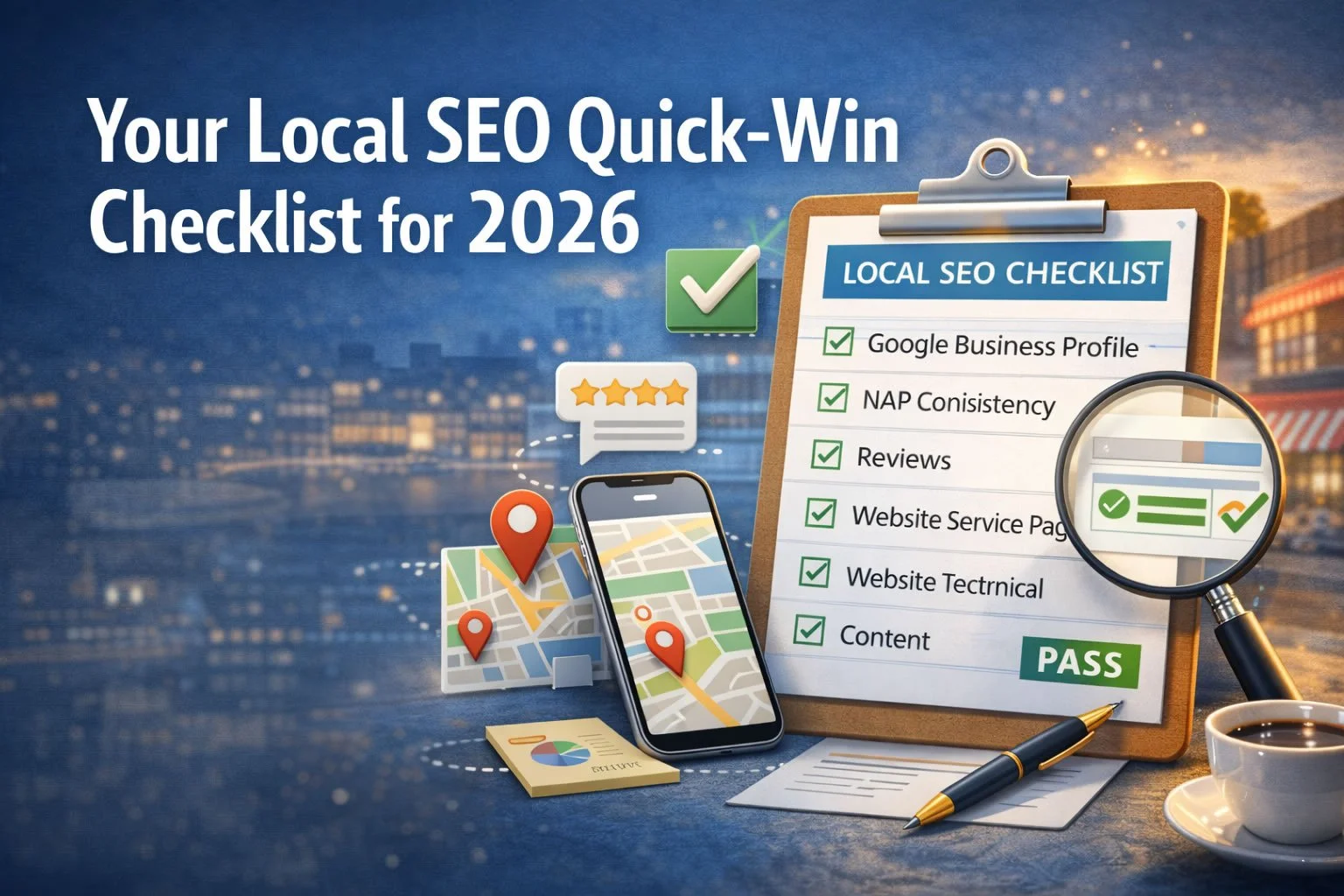
Run through this list and check off what you have done. Each unchecked item is a ranking opportunity waiting to be captured:
Google Business Profile: Fully completed, primary category correct, photos updated in the last 30 days, weekly posts live, all reviews responded to
NAP Consistency: Identical name, address, and phone number across Google, Yelp, Facebook, Apple Maps, and all directories
Reviews: Active system generating new reviews monthly, all reviews responded to within 24 hours.
Website Service Pages: Individual page for each service with local keywords, FAQs, and internal links to other pages
Website Technical: LocalBusiness schema in place, mobile speed under 3 seconds, Core Web Vitals passing in Google Search Console
Content: At least one location-relevant FAQ page or blog post targeting a real customer question
AI Readiness: Direct answer paragraphs under each H2, structured heading hierarchy, external mentions, and citations are being built
🙋♀️ Frequently Asked Questions: Local SEO for Small Business
What is the most important factor for local SEO in 2026?
The most important factor for local SEO in 2026 is your Google Business Profile primary category. According to Whitespark's 2026 Local Search Ranking Factors survey, which draws on data from 47 top local SEO experts, it is the #1-ranked factor for the local pack. After that, review quality, on-page signals, and NAP consistency in that order.
How long does local SEO take to work?
Most small businesses start seeing meaningful results from local SEO within 3 to 6 months of consistent work. Some things move faster: a fully optimized GBP and cleaned-up NAP data can improve visibility in as little as 30 days. Solid, competitive rankings usually take 6 to 12 months.
Is local SEO free?
The core tools for local SEO, including Google Business Profile, Google Search Console, and Google Analytics, are completely free. The real investment is time and strategy. Many small businesses work with an experienced local SEO partner to accelerate results and avoid costly mistakes that take months to fix.
Do I need a website for local SEO?
Yes, and in 2026 more than ever. Your website and Google Business Profile work as a unified local SEO system. Businesses with optimized websites consistently outperform those relying solely on GBP. At minimum, you need a mobile-optimized site with dedicated service pages, your NAP information, and LocalBusiness schema markup.
What is the Google 3-Pack, and how do I get in it?
The Google 3-Pack is the set of 3 local business listings that appear at the top of Google Maps results. Businesses that appear in the 3-Pack see 126% more website traffic and 93% more calls compared to those ranked in positions four through ten. To earn a spot: complete and actively update your Google Business Profile, build a strong review velocity, maintain NAP consistency across the web, and optimize your local website.
The Bottom Line: Local SEO Is the Great Equalizer for Small Business
Here is what I want you to take away from this: you do not need to outspend the big guys. You need to outrank them. And with a disciplined local SEO strategy, a small business can absolutely dominate local search, even against larger, better-funded competitors.
I have watched this happen again and again over 25 years. A business with 100 Google reviews, a fully optimized GBP, consistent NAP data, and service-specific pages will beat a faceless national chain almost every time in local results. Google is not rewarding size. It rewards trust, relevance, and consistent activity.
The businesses that win local search in 2026 are those that treat their online presence as a system, not a set of one-off tasks. This guide is your starting point. Now it is time to put it to work.
📩 Get Weekly Trend Alerts in Your Inbox
Want these insights delivered straight to your inbox every week?
Sign up here to subscribe to the Trend Brief
Stay ahead of what’s moving in marketing, social, and tech.