10 Digital Marketing Mistakes Small Businesses Make That Kill Growth
Most small business digital marketing failures come down to the same ten mistakes — and the good news is every one of them is fixable without a massive budget. In this guide, Bernie Fussenegger of B2The7 breaks down the ten most costly errors he sees repeatedly: no clear strategy, chasing the wrong metrics, ignoring local SEO, posting without a content plan, neglecting email, underinvesting in creative, missing review management, failing to track conversions, ignoring mobile experience, and not building owned audiences. Each mistake comes with a specific, actionable fix you can start implementing this week.
What You’ll Learn from This Article
Your social strategy might be hurting you
The website mistake is costing you leads
Vanity metrics won't grow your business
Fix your email before it flatlines
Inconsistency is weakening your brand
You're targeting the wrong audience
The SEO basics are too many skip
Stop guessing. Start using data.
No clear CTA? You're losing money.
Every platform is not the same
Mistake 1: Posting on Social Media Without a Strategy
This is the one I see the most. Small business owners are posting content on social media because they feel like they should, not because they have a plan. According to Sprout Social, 45% of consumers will unfollow a brand on social media if the content is irrelevant. That is almost half your audience walking out the door.
Effective social media marketing is not about volume. It is about intention. Every post should have a purpose tied to a business goal, whether that is brand awareness, lead generation, or driving traffic. If you cannot answer why you are posting something before you hit publish, that is your first problem.
Build a 30-day content calendar, give every post a clear goal, track what actually drives engagement, and adjust based on results, because that is what separates brands that grow from brands that make noise.
Mistake 2: Ignoring Your Website Performance
Your website is your 24/7 salesperson. And right now, many small business websites are essentially sending customers away. Google research shows that 53% of mobile users abandon a site that takes more than three seconds to load. Three seconds. That is it.
Small-business website optimization is no longer optional. Your website sets the tone for everything else you do online. If your website is slow or hard to use, visitors will leave. Check it on your phone; if it drags or has a cluttered menu, make improvements. These basic fixes can determine whether users stay or go.
Mistake 3: Focusing on Vanity Metrics Instead of Revenue Metrics

Likes. Followers. Impressions. These numbers feel good, but they do not pay the bills. I talk to small business owners all the time who are thrilled about their follower count and cannot explain where a single customer came from.
Digital marketing ROI is what matters. Track conversions. Track cost per lead. Track which channels are actually driving revenue. A business with 500 engaged followers and a clear conversion path will always beat the one with 50,000 followers and no strategy.
The shift from vanity to value is one of the hardest mental changes to make, and it is one of the most important.
Mistake 4: Neglecting Email Marketing
Email marketing has an average ROI of $36 per $1 spent, according to Litmus. That is not a typo. And yet small businesses treat email like an afterthought, sending occasional newsletters with no segmentation, no personalization, and no clear purpose.
Email marketing for small businesses should be one of your highest-priority channels. Build your list intentionally. Segment it based on where people are in the buyer journey. Create sequences that nurture leads toward a decision. This is where the money is.
If you are not emailing your list at least twice a month with value-driven content, you are leaving real revenue on the table.
Mistake 5: Being Inconsistent With Your Brand
Consistency is trust. When your logo looks different on your website than it does on your Instagram, when your tone is professional in emails and casual on Facebook, when your colors shift from one piece of content to the next, you are eroding your brand equity every single time.
Research from Lucidpress found that consistent brand presentation across all platforms increases revenue by up to 23%. That is not a small number for a small business.
Brand consistency in digital marketing means your audience can recognize you without seeing your name. That takes work. It takes documented brand standards and the discipline to follow them.
Mistake 6: Targeting Everyone Instead of Someone Specific
When you try to market to everyone, you end up connecting with no one. This is one of the most expensive mistakes a small business can make because it dilutes every dollar you spend.
Defining the target audience is the starting point for every marketing decision you make. Who exactly are you trying to reach? What do they care about? What keeps them up at night? What language do they use to describe their problem?
When you know the answer to those questions, your content becomes sharper, your ads convert better, and your messaging actually lands. Get specific. The more specific you are, the more your ideal customer feels like you are talking directly to them.
Mistake 7: Skipping the SEO Fundamentals
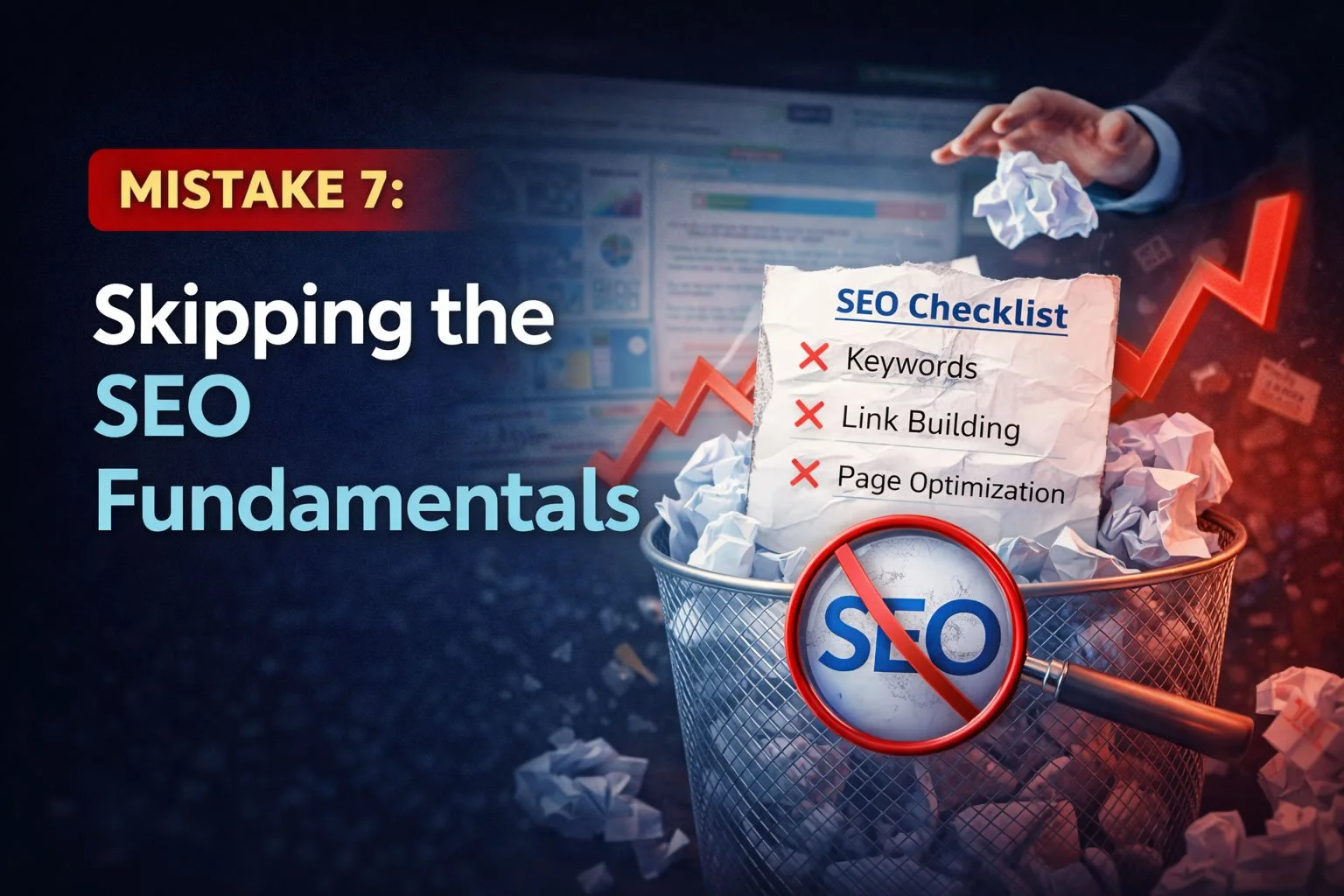
You do not need to master every aspect of SEO. But you do need to get the basics right. According to BrightEdge, organic search drives 53% of all website traffic. If you are not showing up in search results, you are invisible to more than half the people looking for what you offer.
SEO for small businesses begins with essential fundamentals: keyword research, optimized page titles and meta descriptions, internal linking, quality content that addresses real questions, and a technically sound website.
Stop treating SEO like a luxury. It is the long game that pays off for years. Every blog post you write with the right keyword focus is an asset that keeps working while you sleep.
Mistake 8: Making Decisions Based on Gut Feeling
Your instincts matter. But your instincts should be informed by data. Small business owners are notorious for running campaigns based on what they think will work rather than on the numbers.
Data-driven marketing does not require a data science degree. It requires setting up Google Analytics correctly, checking your numbers regularly, and being willing to change direction when the data indicates.
What are your top traffic sources? Which pages convert? Where do people drop off? Answer those questions, and you will make better decisions every single time.
Mistake 9: Not Having a Clear Call to Action
Every piece of content you create, every ad you run, every email you send needs to tell the reader exactly what to do next. Don't hint at it. Do not suggest it. Tell them.
Best practices for call-to-action (CTA) are simple: Don't use more than one CTA per piece of content. Make it action-oriented and match it to where the reader is in their decision. Someone reading a top-of-funnel blog post isn't ready to buy, they want to learn, subscribe, or grab a resource. Give them that.
A small business website without strong CTAs is like a store with no checkout counter. You got people in the door and then gave them nowhere to go.
Mistake 10: Treating Every Platform the Same Way
What works on LinkedIn is not what works on Instagram. What performs on TikTok will likely fall flat on Facebook. And yet I watch small businesses copy and paste the same content across every platform, wondering why nothing is gaining traction.
Multi-platform digital marketing requires understanding the culture, format, and audience behavior of each channel. LinkedIn is professional and long-form. Instagram is visual and story-driven, and TikTok rewards authenticity and entertainment. X (formerly Twitter) rewards wit and speed.
Adapt your message to fit the medium. The core idea can stay the same. The delivery has to change.
🙋♀️ Frequently Asked Questions About Digital Marketing Mistakes
What is the most common digital marketing mistake small businesses make?
The most common digital marketing mistake small businesses make is posting on social media without a strategy. They are active but not intentional, and activity without direction does not produce results. Every post, every campaign, every piece of content needs a goal attached to it before you hit publish.
How much should a small business spend on digital marketing?
Most marketing experts recommend that small businesses allocate between 7% and 10% of their gross revenue to marketing. For businesses in a growth phase, that number can go higher. The more important question is not how much you spend but how strategically you spend it. A focused $2,000 budget will outperform an unfocused $10,000 budget every time.
How is my digital marketing actually working?
If you can’t trace customers back to specific channels or campaigns, your tracking isn’t functioning properly. Set up Google Analytics, use UTM parameters, and define your conversion goals before launching any campaigns. Focus on key metrics like cost per lead, conversion rate, and customer acquisition cost—likes and follower counts are not important.
How long does it take to see results from digital marketing?
It depends on the channel. Paid ads can produce results within days if set up correctly. SEO typically takes three to six months to gain traction, and content marketing builds over time. Email can work almost immediately with a warm, segmented list. The mistake most small businesses make is expecting every channel to deliver overnight and abandoning strategies before they have had time to work.
Do I need to be on every social media platform?
No. And trying to be everywhere at once is one of the fastest ways to burn out and produce mediocre content across the board. Pick one or two platforms where your ideal customer actually spends time and go deep on those. Do them really well before you expand. A strong presence on two platforms beats a weak presence on five every single time.
The Bottom Line on Digital Marketing Mistakes
Here is the hard truth. None of these mistakes is complicated. They are all fixable. But fixing them requires stepping back, being honest about where you are, and committing to doing the work differently.
At B2The7, we work with small businesses every day who are done guessing and ready to build a real strategy. The businesses that grow are the ones that stop doing marketing to check a box and start doing it with intention and clarity.
You do not need a massive budget. You need a better approach.
If you are ready to stop making these digital marketing mistakes and start building a strategy that actually moves the needle, let us talk. Your customers are out there searching for what you offer right now. The only question is whether they will find you or your competitor.
📩 Get Weekly Trend Alerts in Your Inbox
Want these insights delivered straight to your inbox every week?
Sign up here to subscribe to the Trend Brief
Stay ahead of what’s moving in marketing, social, and tech.