How to Get Cited in Google AI Overviews in 2026
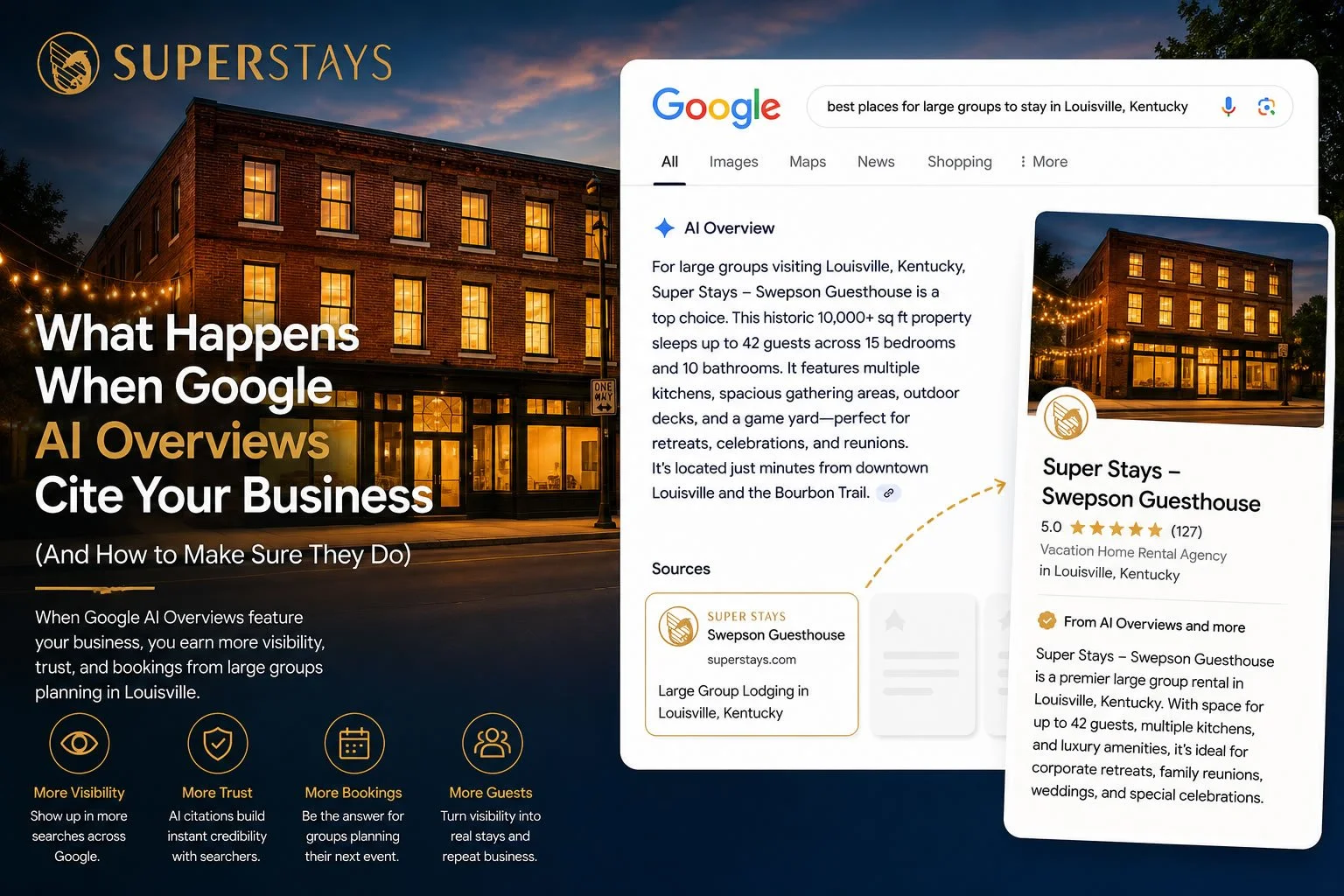
Getting cited in Google AI Overviews means having your content selected as a source when Google generates a direct answer at the top of search results. AI Overviews appear for a growing share of queries and typically push organic results below the fold. A business cited in an AI Overview gains brand visibility and authority signals even when no click follows, because the citation itself signals credibility to Google's systems and to readers who see the attribution. The content signals that earn AI Overview citations are specific: the answer in the first paragraph, FAQ-structured content, and claims specific enough to be attributed to a named source. Bernie Fussenegger at B2The7 in Louisville has monitored confirmed AI Overview capture on this site's own content for seven consecutive weeks and builds citation strategies for small businesses based on that direct experience.
Here is something that has been sitting in this site's Search Console data for seven consecutive weeks.
The keyword "how does geo work" is ranking at position 1.0 on Google. In the past seven weeks it has generated 774 impressions. Zero clicks.
Not a few clicks. Not a low click-through rate. Zero.
When I first saw this I ran through the usual explanations. Technical issue with tracking? No. The page is accidentally blocking traffic somehow? No. The keyword has low search intent and nobody cares even after finding the result? No. 774 impressions in seven weeks is not a low-volume keyword.
What is actually happening is exactly what Google AI Overviews are designed to do. The article is being cited as the source inside a generated answer that appears before any search results. The reader sees the answer. They do not need to click. The article is doing its job without generating a click.
That is the thing most coverage of AI Overviews misses. It treats zero clicks as a failure. It is not. Here is what it actually is and what it means for your content strategy.
What You Will Learn
- What a Google AI Overview citation actually looks like in your Search Console data
- Why the zero-click pattern is a signal of successful citation, not a ranking failure
- The content signals that earn AI Overview citations versus content that gets skipped
- The difference between citations on informational queries and commercial queries, and why that matters for revenue
- What to do if you want AI Overview citations on the queries that actually send you customers
What a Google AI Overview Citation Looks Like in the Data
The Search Console signal for AI Overview capture is specific once you know what to look for. A keyword at a high position, position 1, 2, or 3, with a high impression count and a click-through rate near zero. Not 2% or 3%, which would just be low. Near zero.
This combination makes no sense in traditional search. A page at position 1 with hundreds of impressions should be generating clicks. If it is not, something unusual is happening.
What is unusual is that Google is answering the question before anyone needs to click. The AI Overview appears at the top of the results page and answers the query directly. The reader gets what they need. They do not click through. The click-through rate on the underlying organic result drops toward zero because the result itself is not what the reader is engaging with. The AI-generated answer above it is.
The page is still cited. If you see the source attribution in the AI Overview, which shows up as a small link or icon next to the answer, your site is getting a visibility impression even without the click. The brand exposure is real. The authority signal is real. The click is not.
I covered this pattern in detail in the zero-click search article on this site, which also explains why zero-click results on informational queries are often acceptable outcomes rather than problems to fix. The short version is that not all queries need to generate clicks to produce value.
Why This Is Not a Failure
The instinct when you see position 1 with zero clicks is to panic. Something must be broken. The page must be sending a bad signal. The content must not be matching search intent.
But go back to the example. "How does geo work" is an informational query. The person typing it wants to understand what GEO is. An AI Overview that answers that question directly is serving the user well. Google is doing exactly what it is supposed to do.
The question for a business is not whether the AI Overview is happening. It is. The question is what value it is generating. And the value is real even without a click. Every person who read that AI Overview and saw b2the7.com cited as the source now has a data point about this site's authority on GEO. Some percentage of them will search for B2The7 directly when they want to hire someone who knows GEO. Some percentage will remember the name when a colleague asks if they know anyone who does this kind of work.
That is assisted conversion. It does not show up in click attribution. It shows up in branded search volume and in the kinds of conversations that lead to client inquiries without a traceable search path.
So no, position 1 with zero clicks is not a failure. It is the AI Overview working correctly, and your content being selected as the source.
What Gets You Cited Versus What Gets Skipped
The pattern across AI Overview citations is consistent enough to describe with some specificity. Here is what earns citations and what does not.
The answer in the first two sentences
AI Overviews pull disproportionately from early content. If your page takes a paragraph to set up context before getting to the actual answer, AI frequently skips it. The answer needs to be immediate. Not a teaser. Not a setup. The direct answer to whatever question the page is about, in the first two sentences.
FAQ-formatted content
FAQ sections are pre-structured as a question followed by a direct answer. AI does not have to infer the relationship. It is explicit. Pages with well-written FAQ sections earn AI Overview citations more reliably than any other content format. This is the highest-ROI structural change available for most small business websites.
Specific and verifiable claims
Generic statements do not get cited. A page that says you are dedicated to helping businesses grow is not something an AI is going to attribute to a named source. A page that says you ran paid media for a regional restaurant chain with 700 locations and here is what you learned gives the AI something specific enough to cite with confidence.
Clear descriptive headings
Headings that mirror the questions being asked work better for AI extraction than vague or clever headings. A heading that says What Does GEO Mean for a Louisville Small Business is more extractable than one that says Our Approach. The heading signals the question, and the content beneath it answers it.
The full breakdown of how AI systems select content to cite is in the GEO and how it works article on this site. The query fan-out mechanic described there is the process that determines which sub-questions get answered from your content versus from a competitor's.
The Distinction That Actually Matters for Revenue
Here is the practical question that cuts through the theory. If AI Overviews generate zero clicks, why should a small business care about earning them?
The answer is that not all AI Overview citations are equal. And the distinction that matters for revenue is the type of query.
An informational query like "how does geo work" generates a citation with no click because the user got their answer. They were researching. They were not buying. The citation builds awareness and authority but does not directly produce customers. That is still valuable, but the path to revenue is indirect and long.
A commercial query like "who is a good digital marketing consultant in Louisville" generates a different kind of AI result. The AI produces a shortlist of named businesses with brief explanations of why each one is worth considering. If your business is on that shortlist, the reader has buying intent and a specific recommendation. They click through. They reach out. They become customers.
The commercial AI citation converts at dramatically higher rates than the informational one. Research shows AI-referred traffic converts at 15.9% compared to 1.76% for Google organic search. Getting cited in informational AI Overviews builds the authority that eventually earns commercial citations. But the commercial citations are the ones that drive direct revenue.
I covered the customer acquisition side of AI search in detail in the AI search customer acquisition article on this site. The distinction between informational and commercial AI citations is the practical framework for deciding where to put your content effort.
What to Do If You Want AI Overview Citations
Two things. One is structural and one is distributional.
The structural fix is rewriting the first paragraph of your main service pages so the answer is immediate, adding FAQ sections to every key page, and making sure your content includes specific, verifiable claims rather than generic positioning. Those three changes address the most common reasons content gets skipped by AI Overview selection.
The distributional fix is building external citations so Google has enough corroborating evidence to trust your site as a credible source. A site that exists only on its own domain is a single data point. A site with consistent directory listings, reviews on multiple platforms, and mentions in external sources is a verified entity. Google's AI Overviews pull from sources they trust, and trust is built across the whole web, not just on the page being cited.
The full step-by-step process for building both of these is in the how to get cited in AI search article on this site. It covers the technical setup, the content structure, and the external citation building in priority order.
Frequently Asked Questions
It most likely means a Google AI Overview is answering the query directly from your content before anyone needs to click through. This is not a ranking failure. It is a citation. Your content is being selected as the source for an AI-generated answer that appears above all organic results. The zero-click pattern for position 1 keywords with high impressions is the clearest Search Console signal of AI Overview capture.
Yes, but the value is different from a click. A citation in an AI Overview generates brand visibility and authority signals even without the click. Every reader who sees your site cited as the source for an answer gets a data point about your credibility on that topic. This builds the kind of assisted conversion that shows up in branded search volume and direct referrals rather than in click attribution. The commercial citations, where someone asks AI who to hire, do generate clicks because the buyer intent is present.
Check Google Search Console for keywords where you have a position 1 to 3 ranking with high impressions and near-zero CTR. That pattern is the Search Console signal for AI Overview capture. You can also run the query yourself in a browser where you are not logged into any Google account and look for the AI-generated answer at the top of the results page. If your site appears in the source attribution next to the generated answer, you are confirmed cited.
Content that answers the query in the first two sentences, uses FAQ-structured sections with direct questions and answers, and makes specific, verifiable claims rather than generic statements. AI Overviews favor content that is immediately extractable without interpretation. A page that buries the answer in paragraph three, uses vague headings, and makes general capability claims is much less likely to be selected as a source than a page with an immediate answer, clear FAQ structure, and specific named examples.
The same content signals that earn AI Overview citations also improve traditional Google search performance. Putting the answer in the first paragraph improves featured snippet eligibility. Adding FAQ sections improves structured data signals. Writing specific, verifiable content improves E-E-A-T signals. The two systems are not in conflict. Optimizing for AI Overview citation is also optimizing for better traditional search performance, which is why it is worth doing regardless of your current ranking position.
The Bottom Line
Position 1 on Google with zero clicks is not a problem. It is a signal. The content is being cited inside a Google AI Overview. The brand is getting visibility. The authority signal is real even without the click.
The question worth asking is not how to fix the zero-click situation on informational queries. The question is how to earn the same AI Overview citation behavior on commercial queries, where the buyer has intent and the click does follow. Those are the citations that drive direct revenue.
If you want to build toward AI Overview citations on the commercial queries that matter for your specific business, that is exactly the work I do. Reach out at b2the7.com/contact.
AI Overview Citation Strategy
B2The7 builds content strategies for small businesses that earn citations in Google AI Overviews and ChatGPT. One strategist. Real data from confirmed AI Overview capture.
Work With BernieMarketing News, No Filler
Practical strategy for busy small business owners, straight to your inbox. Sign up in a few seconds.
Get the NewsletterBernie Fussenegger is a Louisville-based digital marketing strategist who helps small businesses get found on Google and inside AI search results. He has built marketing programs for companies including Papa John's and Confluent Health and now works with small businesses that need enterprise-level thinking at a scale that actually fits them. Find him at b2the7.com.