Email Marketing Strategy for Louisville Small Businesses
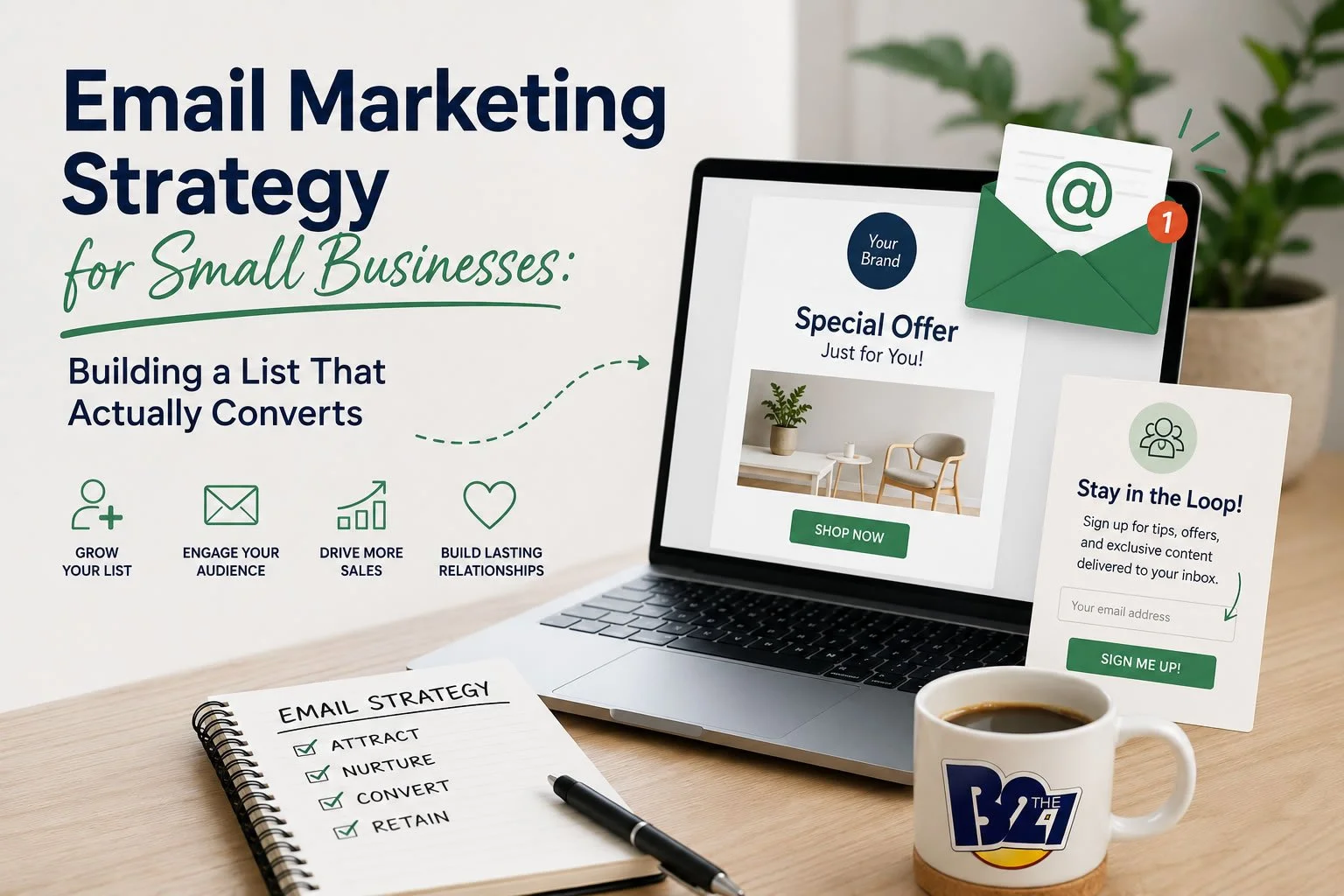
An email marketing strategy for Louisville small businesses means building a list intentionally, segmenting it based on where subscribers are in the customer relationship, and sending content that moves each segment toward a specific next action. Most Louisville small businesses that do email marketing have a list but not a strategy. They send the same newsletter to everyone, at irregular intervals, with no clear conversion goal, and they measure success by open rate rather than by revenue or lead generation. The businesses seeing consistent returns from email have a welcome sequence for new subscribers, a segmented list that separates customers from prospects, and a publishing cadence they can sustain without a full-time marketing person. Bernie Fussenegger at B2The7 builds email marketing strategies for Louisville small businesses as part of a broader digital marketing approach.
Here is the thing about email marketing that nobody who is trying to sell you an email platform wants to say out loud.
Having a list is not a strategy. Sending a newsletter is not a strategy. Growing your subscribers from 400 to 600 is not, by itself, a meaningful achievement if the 600 people on the list are not moving closer to buying from you.
I see this constantly with Louisville small businesses. They have collected emails for years. Through a signup form on the website, at events, from old customers, from people who downloaded something or entered a contest. The list exists. Maybe it has a thousand people on it. And they send a monthly newsletter that goes to all of them with the same content and gets a 20% open rate and maybe a handful of clicks.
That is not bad, exactly. But it is leaving most of the potential value on the table.
The email lists that actually drive revenue for small businesses are not necessarily bigger. They are more intentional. Here is what that looks like in practice for a Louisville small business.
What You Will Learn
- Why list size is the wrong metric and what to track instead
- How to segment a small business list without a technical setup
- What a welcome sequence does and why email one matters most
- Louisville-specific tactics that produce higher-quality subscribers
- The right publishing cadence for a business with no marketing team
The Wrong Metric
Open rate is the metric most email marketing platforms show you first because it is the metric that makes you feel good about your list. A 20% open rate means one in five people opened your email. That is better than the average. Good job.
But open rate does not tell you whether anyone bought anything, booked a call, visited your store, or moved any closer to becoming a customer. It tells you how many people looked at the subject line and decided it was worth a click. That is useful information but it is an input to conversion, not conversion itself.
The metrics that actually matter for a small business email list are click rate on specific calls to action, conversion rate from email to whatever action you care about (booking, buying, inquiring), and revenue attributed to email campaigns. Those numbers are harder to track and they look smaller, which is why most platforms do not lead with them. But they are the ones that tell you whether email is working.
Reorienting to these metrics changes how you think about every decision you make about your list. Not "what subject line will get the most opens" but "what email content will move the most people toward buying." Those are different questions with different answers.
Segmentation Without the Complexity
When people hear email segmentation, they picture elaborate CRM workflows with behavioral triggers and lead scoring and automated sequences branching in seventeen directions. That is real, and it works at scale, and it is completely unnecessary for a Louisville small business with a list under five thousand people.
The only segmentation that matters to start is separating customers from prospects.
A customer is someone who has already bought from you or hired you or worked with you in some capacity. They know what you do. They have had an experience with you. The email they need is different from the email a prospect needs.
A prospect is someone who showed interest but has not yet bought. They signed up for your list, they downloaded something, they attended an event, they filled out a contact form. They are interested but not committed.
Sending the same email to both groups is leaving money on the table. The customer needs a relationship maintenance email, a reason to come back, a referral ask, a new service announcement, something that builds on the relationship you already have. The prospect needs a reason to take the next step, a specific offer, social proof, a reason why now is the time to act.
One list, one segment switch, completely different conversion potential. Where those emails point matters too. A prospect who clicks through should land on content that answers the question they still have, which is why content marketing for a Louisville small business and email work best as one system rather than two separate efforts.
The Welcome Sequence Is the Most Important Email You Will Ever Send
Welcome email open rates average 69%. Regular newsletter open rates average around 20%. The gap is because new subscribers are at their highest level of interest the moment they sign up. They just took an action to join your list. They are thinking about you right now. The next email they receive from you is the one that sets the tone for every email that follows.
Most small businesses send one welcome email, a confirmation message that says thanks for subscribing, here is what to expect, and then immediately add the new subscriber to the same list as everyone else. That misses the moment when subscriber attention is highest.
A three-email welcome sequence is not complicated. Email one, within an hour of signup: who you are, what you do, and one specific thing the subscriber gets from being on your list. Not your company history. One clear sentence about what value you deliver. Email two, three days later: something genuinely useful. A piece of content, a tip, a resource that demonstrates what you know. Email three, seven days later: an invitation to engage. A specific next step. Book a call. Use a coupon. Reply to this email with a question. Whatever the appropriate next step is for your business.
Those three emails, running automatically, turn new subscribers into warm prospects before you ever send a regular newsletter. The conversion rate from welcome sequence subscribers to customers is consistently higher than from cold list sends because the relationship started with intention rather than with someone's email address sitting in a database for six months.
If you are still working out what email marketing is and why it produces strong ROI for small businesses before getting into strategy specifics, the email marketing Louisville article on this site covers the foundational case. This article is the strategy companion for businesses that are already convinced and want to know how to execute it.
Louisville-Specific List Building
Generic list building advice tells you to put a signup form on your website and offer a lead magnet. That works. But Louisville small businesses have specific list building opportunities that generic advice does not cover.
Local events and the Louisville community calendar
Louisville has a genuinely active event culture. Thunder Over Louisville, the Derby, Forecastle, the many neighborhood festivals and business networking events throughout the year. A business that participates in these events and collects emails from attendees is building a list of Louisville-specific subscribers who have demonstrated local engagement. That is a different quality of subscriber than someone who found your website through a Google search.
Cross-promotion with other Louisville small businesses
Louisville has enough of a small business community that cross-promotion arrangements are genuinely accessible. A partnership with a complementary business where each promotes the other's newsletter to their existing list is one of the most efficient list growth strategies available to small businesses without a large advertising budget. The subscribers come pre-qualified because they came from a trusted referral source in the same community.
In-person and at-point-of-sale
If your business has any in-person component, that is a list building opportunity. The person who just hired you, the customer who just bought from you, the attendee at your event. The conversion rate on direct email collection from people who just had a positive interaction with your business is dramatically higher than from a passive signup form.
The connection between email list building and search visibility is direct. The more people discover your business through Google or AI search, the larger the pool of potential email subscribers. I covered how Louisville small businesses build that search visibility in the Louisville small business visibility article. Search visibility and email list growth compound together. More visibility brings more subscribers, and more engaged subscribers generate the kind of review and referral behavior that improves search visibility.
What to Send and How Often
Once a week or once every two weeks. That is the publishing cadence that produces consistent engagement for most Louisville small businesses without a dedicated marketing team. Below that frequency and subscribers forget who you are by the time the next email arrives. Above that frequency and you are producing content faster than you can maintain quality.
What to send is the question I hear most often. And the honest answer is: whatever you know that your subscribers do not but would benefit from knowing. That might be a piece of local market intelligence relevant to your category. A case study from a recent client engagement. A behind-the-scenes look at how something in your business works. A direct take on something happening in your industry that affects your customers.
The Louisville angle helps. An email that references a specific Louisville business challenge, a specific local event, or a specific local context signals to Louisville subscribers that this came from someone who is actually here and understands their situation. That is a trust builder that a national email service or a generic content provider cannot replicate.
And the email should have one clear call to action. Not three links and two buttons and a sidebar. One thing you want the reader to do after reading this email. That clarity is the difference between an email that drives action and one that gets archived after a quick skim.
Quick Answer
Build the list intentionally, split it into customers and prospects, run a three-email welcome sequence automatically, publish every week or two on a schedule you can sustain, and give every email one clear call to action. That is the whole strategy. It does not require a big budget or a complex platform.
Frequently Asked Questions
What is an email marketing strategy for a Louisville small business?
An email marketing strategy for a Louisville small business means building a list intentionally, segmenting it based on where subscribers are in the customer relationship, sending a welcome sequence to new subscribers, and publishing regular emails that move subscribers toward a specific next action. Most Louisville small businesses that do email have a list but not a strategy. The difference in results between a list and a strategy is significant and does not require a large budget or a complex technical setup to implement.
How do I build an email list for my Louisville small business?
Start with the people you already know. Import existing customers with their permission. Add a signup form to your website on high-traffic pages. Collect emails at in-person interactions and events. Look for cross-promotion opportunities with complementary Louisville businesses where each promotes the other's newsletter. Offer something specifically useful to Louisville subscribers in exchange for the signup, such as local market intelligence, a Louisville-specific resource, or early access to something relevant to the community. List quality matters more than list size.
What should I send in a welcome email sequence?
Three emails over the first week. Email one within an hour of signup: who you are, what you do, and one clear statement of what value the subscriber gets from being on your list. Email two at three days: something genuinely useful that demonstrates what you know, such as a tip, a resource, or a piece of content relevant to why they signed up. Email three at seven days: a specific invitation to engage, whether that is booking a call, using an offer, or replying with a question. These three emails, running automatically, convert new subscribers into warm prospects before you send a single regular newsletter.
How often should a Louisville small business send marketing emails?
Once a week or once every two weeks works for most Louisville small businesses without a dedicated marketing team. Below that frequency and subscribers forget who you are between sends. Above that frequency and content quality typically suffers because the volume exceeds what one person can produce while running a business. The exact right frequency is the highest rate you can sustain without quality dropping. Consistency matters more than frequency within that range.
How do I know if my email marketing strategy is working?
Track click rate on specific calls to action, conversion rate from email to the action you care about (booking, buying, inquiring), and revenue or leads attributed to email. Open rate tells you whether your subject line and send timing are working but it does not tell you whether email is driving business. The businesses that use email effectively have at least a rough attribution model for where email-driven revenue comes from, even if it is as simple as asking new clients how they heard about you.
The Bottom Line
Most Louisville small businesses have an email list. Very few have an email strategy. The gap between those two things is where most of the potential revenue from email is sitting unused.
The strategy does not require a large budget or a complex technical platform. It requires a welcome sequence that runs automatically, a simple segmentation that separates customers from prospects, a publishing cadence that is sustainable, and emails that have one clear call to action rather than five competing ones.
If you want help building an email strategy that fits your specific Louisville business and your actual capacity to execute it, that is exactly the kind of work I do.
Email Marketing Strategy
B2The7 builds email marketing strategies for Louisville small businesses as part of a broader digital marketing approach. One strategist, direct execution.
Work With BernieGet the Newsletter
Marketing news and practical strategy for Louisville small business owners. See what a well-built small business newsletter looks like in practice.
Get the NewsletterBernie Fussenegger is a Louisville-based digital marketing strategist with senior-level experience at Papa John's, Confluent Health, and other major brands. He works directly with small businesses that need real marketing results without agency overhead. Find him at b2the7.com.