How AI Search Changes Customer Acquisition for SMBs
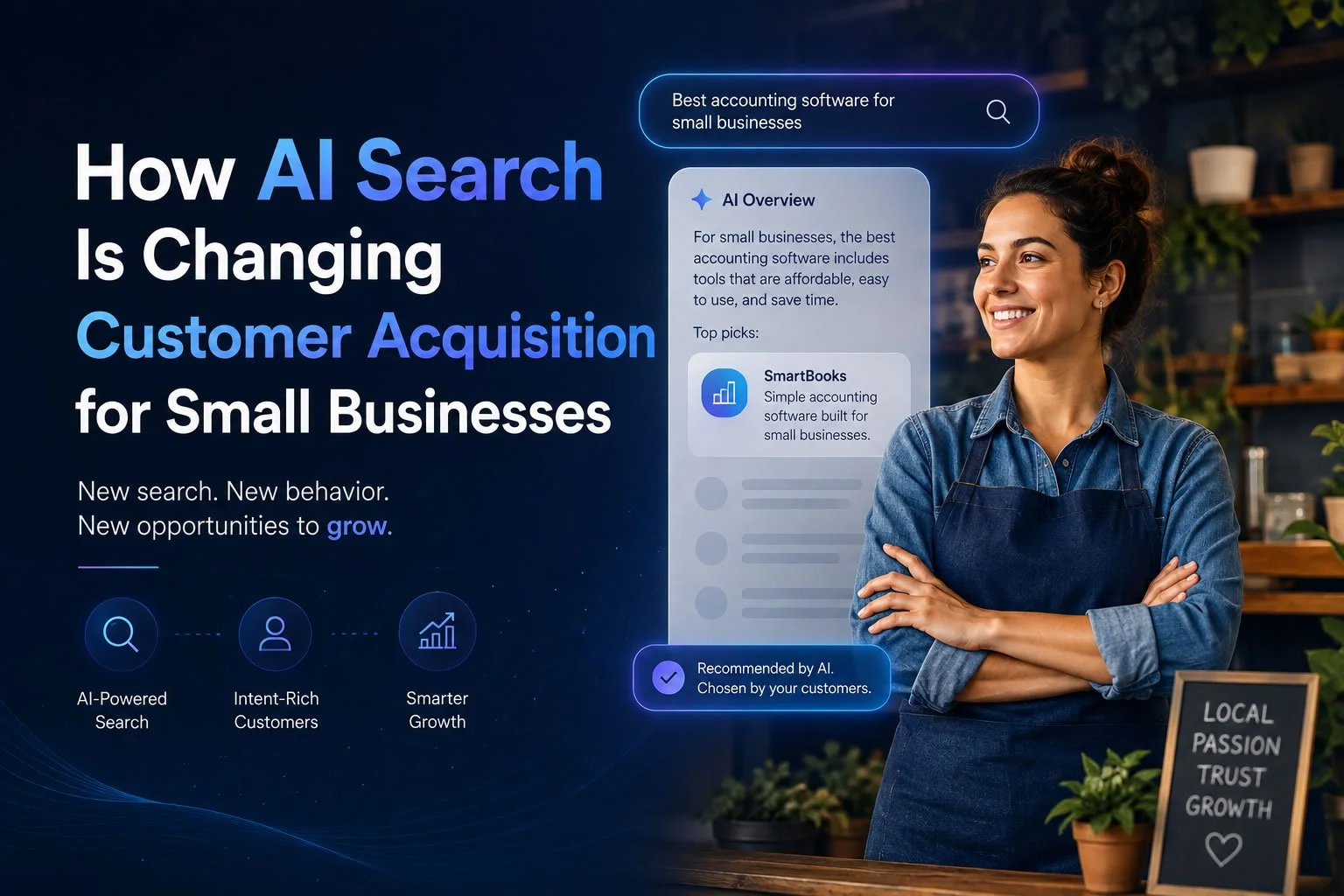
AI search is changing customer acquisition for small businesses because AI tools like ChatGPT, Google AI Overviews, and Perplexity now generate recommendations directly in response to buyer-intent queries. When someone asks an AI tool who is a good digital marketing consultant in Louisville or where to find original Kentucky photography on canvas, the AI names two or three businesses and stops. There is no page two. A business not in that answer has lost a potential customer to a competitor without ever knowing the interaction happened. Research shows that ChatGPT referral traffic converts at 15.9% compared to 1.76% for Google organic search. The businesses earning AI citations are acquiring customers at significantly higher conversion rates than traditional search traffic. Bernie Fussenegger at B2The7 helps Louisville small businesses build content and visibility strategies that earn AI citations and turn AI search into a consistent customer acquisition channel.
Quick Answer
How is AI search changing customer acquisition? AI tools now answer buyer-intent questions by naming two or three businesses and stopping. If you are not in that answer, you never get considered. And the traffic that does arrive from AI converts far higher than a traditional search click.
This site ranks at position 1 on Google for the keyword "how does geo work." In the past five weeks, that keyword has generated 645 impressions. Clicks: zero.
That is not a failure. That is a Google AI Overview answering the question before anyone needs to click. The site is being cited as the source inside the answer. The information is being used. The reader got what they needed without ever visiting the page.
The interesting part is what those 645 impressions do not show. The searches happened, the content appeared, and people saw B2The7 connected to GEO without ever visiting the site. There is no click to measure, but that does not mean nothing happened. Someone may remember the B2The7 name when they need help with AI search later. They might search for it directly or mention it when another business owner asks who knows this stuff. None of that shows up in the original search data, but the exposure still has value.
That is the customer acquisition story inside the visibility metric. And it is the part most GEO articles do not get to, because they stop at the ranking.
I am Bernie. I run B2The7, and I work with small businesses in Louisville on this exact problem. Here is the customer acquisition version of what AI search is actually doing.
What You Will Learn
The Conversion Rate Data Is the Starting Point
Research published in 2026 found that ChatGPT referral traffic converts to customers at 15.9%. Google organic search traffic converts at 1.76%. That is roughly nine times the conversion rate from a single AI citation compared to a traditional search click.
Why? Because by the time someone clicks through from an AI-generated answer, they have already been pre-qualified. The AI told them this business or this service is the answer to the question they asked. They are not browsing. They are not comparing options. They are arriving at your site with a recommendation already in hand.
That is a fundamentally different buying posture from someone who searched a keyword and clicked the third result out of ten. And it explains why AI citation, even with lower absolute traffic volume than a page-one Google ranking, can produce comparable or better customer acquisition outcomes.
This is the number that changes how a small business should think about GEO. Not the ranking. Not the impression count. The conversion rate on the traffic that does arrive from AI sources. If you are getting 50 AI-referred visitors per month converting at 15%, that is 7 to 8 customers. The same number of traditional search visitors converting at 1.76% gives you fewer than 1.
What AI Search Does to the Discovery Process
Traditional search gave potential customers a list of ten options and let them decide. The customer had agency over the decision process. They clicked around, compared options, read reviews, came back tomorrow and searched again. The path from search to customer was long and involved multiple touchpoints.
AI search shortens that process. Ask ChatGPT for a digital marketing consultant in Louisville, and you may get a handful of recommendations instead of a page full of options to sort through. For the person searching, that becomes the starting list. Businesses that are not mentioned may never get considered. What makes the list depends on what the AI can find about a business and whether there is enough reliable information online to support recommending it.
For a small business, this means the discovery phase of the customer journey has effectively been outsourced to AI systems. And AI systems are making that shortlist decision based on criteria that are different from traditional search ranking signals.
I covered what those criteria actually are in the how to get cited in AI search article on this site. The short version is that AI tools favor content that directly answers questions, business information that is consistent across multiple credible sources, and external citations that verify the business is real and credible. Traditional SEO signals like backlinks and keyword optimization matter less than they used to.
What a Business Loses When It Is Not in the AI Answer
This changes the value of simply being visible. If a potential customer asks an AI tool for a recommendation and your competitors are mentioned but you are not, they may never know your business was an option. That is especially important when the question comes from someone ready to hire, buy, or make a decision. At that point, being left out is not just a visibility problem. It can mean a potential customer goes straight to someone else.
Here is a rough way to think about it. If 100 people per month ask an AI tool for a recommendation in your service category in Louisville, and the AI mentions two or three businesses, and you are not one of them, those 100 people never learned your business exists. At a 15% AI referral conversion rate, 100 potential AI-referred visitors would represent roughly 15 customers. If that traffic is going to competitors instead, the opportunity cost is real and measurable.
And unlike traditional search, where a business might still pick up traffic on page two or through long-tail keywords, AI recommendations are binary. There is a shortlist, and then there is everyone who did not make it.
The Two Kinds of AI Citation and What Each One Does
Not all AI citations produce the same outcome. Understanding the difference changes how you think about what to optimize for.
Informational citations build awareness
When someone asks how GEO works, and the AI cites B2The7 as the source of the answer, the business gets an awareness impression. The person may not have been in buying mode. They were researching. But they now know B2The7 exists and is credible on this topic. This is the zero-click, high-impression pattern visible in the site's own Search Console data. The conversion rate on informational citations is lower because the buyer intent is lower.
Commercial citations generate direct leads
When someone asks who is a good digital marketing consultant in Louisville and the AI names B2The7, that is a commercial citation. The person asking that question has buying intent. The AI referral conversion rate of 15.9% applies most directly to this type of citation. This is the one that turns AI search visibility into direct customer acquisition.
The distinction between informational and commercial AI citations is also why building a content cluster matters more than writing a single page. I covered the cluster strategy in detail in the how to build a GEO content cluster article on this site. Informational citations from cluster content build the topical authority that earns commercial citations over time. Both types compound together.
What Actually Changes When You Take This Seriously
The businesses that treat AI search as a customer acquisition channel rather than a visibility metric make different decisions about their content and their digital presence.
They write content that ends with a clear reason to hire them
Informational content that explains something well is valuable for building authority. But authority does not pay bills directly. Content that generates commercial AI citations answers the specific question a buyer-intent searcher would ask and then makes clear what the next step is. Every key page should answer a specific question and end with a specific invitation to engage.
They make sure their Google Business Profile is complete and current
Commercial AI citations for local service queries pull heavily from local search signals, including the Google Business Profile. A profile that is incomplete, inactive, or has outdated information is suppressing your probability of appearing in AI recommendations for local buyer-intent queries. This is the highest-ROI single action for local customer acquisition through AI search.
They track AI-referred traffic as a distinct channel
ChatGPT appends utm_source=chatgpt.com to links when it cites sources. Other AI platforms are adding similar attribution. Check your Google Analytics referral traffic for traffic from chatgpt.com, perplexity.ai, and similar sources. If you see any, that is your AI customer acquisition channel working and generating trackable data.
They build external citations systematically
AI tools build confidence in a business by seeing it referenced across multiple credible sources. A business that exists only on its own website is a single data point. A business with consistent listings across directories, reviews on multiple platforms, and external mentions in local media or industry publications is a verified entity that AI tools trust enough to recommend.
The full diagnostic for why a small business is not showing up in AI recommendations is in the why Louisville small businesses are invisible online article on this site. The problems covered there map directly to the reasons AI tools skip a business when building a recommendation list.
Frequently Asked Questions
AI search tools like ChatGPT, Google AI Overviews, and Perplexity now generate shortlists of recommended businesses directly in response to buyer-intent queries. A business not appearing in those shortlists is invisible to those potential customers. Research shows ChatGPT referral traffic converts to customers at 15.9%, compared to 1.76% for Google organic search. The businesses earning consistent AI citations are acquiring customers at significantly higher conversion rates than traditional search traffic from the same volume of impressions.
AI search can send a very different kind of visitor to your website. If someone asks for a recommendation and the AI points them to your business, they have already been given a reason to consider you. By the time they click through, they may be past the stage of opening ten tabs and comparing every option they can find. They are coming to learn more about a business that was specifically recommended for what they need. That can make the visit much more valuable than a click from someone who is still figuring out what they want.
There are two kinds of AI citations worth paying attention to. The first happens when someone is looking for an answer. They might ask what something means or how it works, and your site gets used as a source. That is good exposure, even if that person is not looking to buy anything yet. The second is much closer to a sale. Someone asks who they should hire, what company offers a certain service, or where they can find it, and the AI recommends your business. Those are the citations that can turn into calls, form fills, and new customers. You want both, but the second type is where the real lead opportunity is.
Check your Google Analytics referral traffic for sessions from chatgpt.com, perplexity.ai, and similar AI platform domains. ChatGPT appends utm_source=chatgpt.com to citation links, making attribution trackable in analytics. You can also run the audit process described in the how to check your AI search visibility article on this site, which walks through testing what each AI platform says about your business in response to buyer-intent queries in your category.
Complete your Google Business Profile fully and keep it current. This is the single highest-impact action for local commercial AI citations, because AI tools pull heavily from local search signals when answering buyer-intent local queries. After that, audit your business information across all directories and standardize it to one exact format. Then rewrite the first paragraph of your main service pages so the answer to the buyer-intent question is immediate rather than buried in context-setting. Those three changes address the most common reasons AI tools skip a business when building a local recommendation list.
The Bottom Line
AI search is not a visibility trend to watch. It is a customer acquisition channel that is already operating at higher conversion rates than traditional search traffic, and it is operating right now whether or not a small business has thought about it.
The businesses earning those citations are acquiring customers at nine times the conversion rate of Google organic traffic from the same number of interactions. The businesses not earning them are not just missing impressions. They are missing customers.
Turn AI search into a customer acquisition channel
B2The7 helps Louisville small businesses build content and presence strategies that earn AI citations and turn AI search into a consistent source of leads.
Bernie Fussenegger is a Louisville-based digital marketing strategist who helps small businesses get found on Google and inside AI search results. He has built marketing programs for companies including Papa John's and Confluent Health and now works with small businesses that need enterprise-level thinking at a scale that actually fits them. Find him at b2the7.com.