Brand Strategy for Louisville Small Businesses
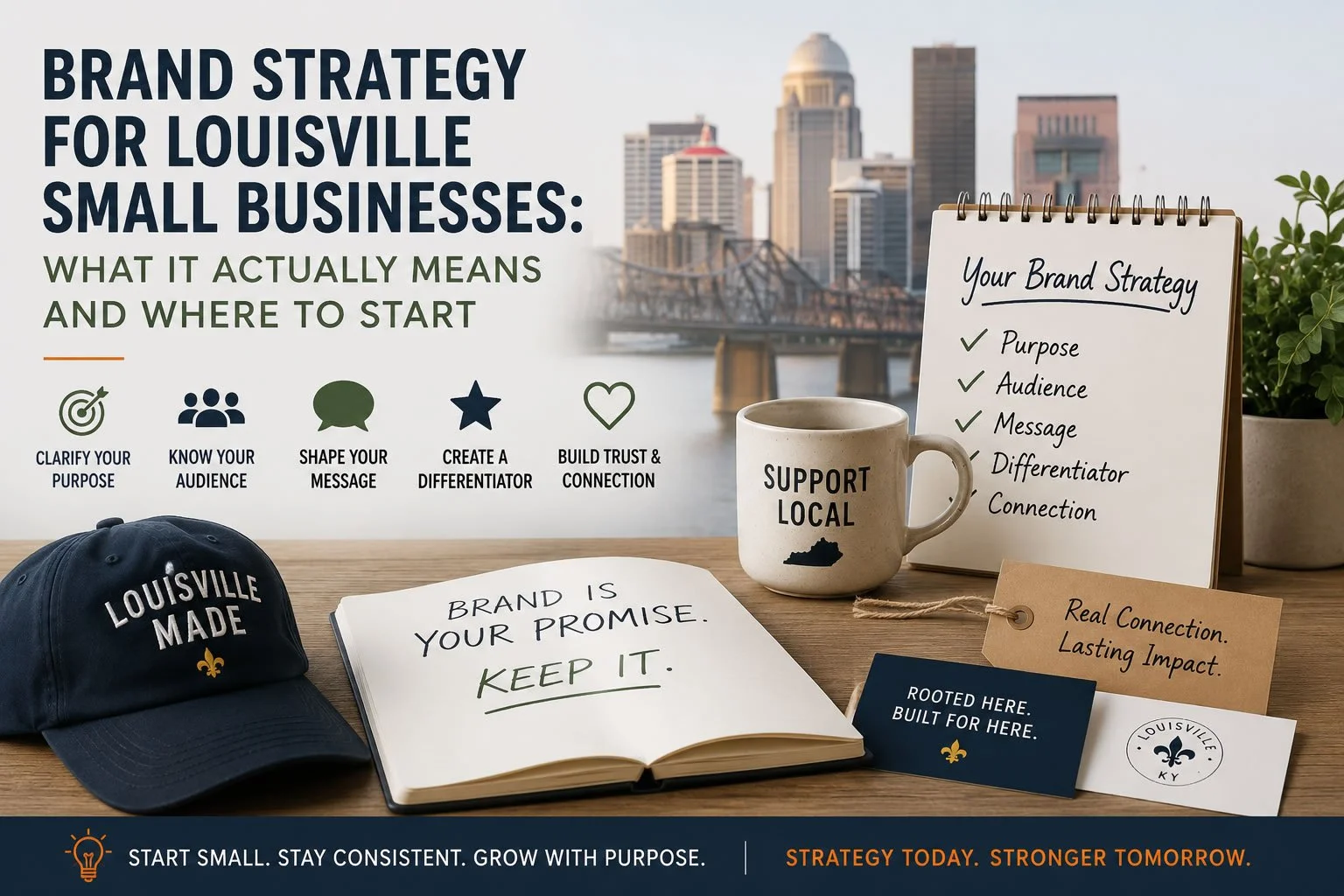
Brand strategy for a Louisville small business means defining what your business is, who it serves, what it does differently from competitors, and what it sounds like when it communicates. Done well, it is not just a marketing deliverable. It is the foundation that determines what content you create, how you position yourself in search, and what AI tools say about you when a buyer asks for a recommendation in your category. Bernie Fussenegger at B2The7 builds brand and content strategies for Louisville small businesses grounded in enterprise-level positioning experience.
Quick Answer
Brand strategy is not your logo, tagline, or color palette. It is the set of decisions about who you serve, what you do differently, and why a buyer should choose you over every alternative. A specific brand position produces specific content that ranks on Google and earns citations in AI answers. A generic position produces content that does neither.
When most Louisville small business owners say they need a brand strategy, they usually mean one of three things. They need a new logo. They need a better tagline. Or they need someone to help them figure out how to describe what they do in a way that does not make people's eyes glaze over.
All three of those are real needs. But none of them is brand strategy.
Brand strategy is the set of decisions that determine how your business is positioned in the market, who it is specifically for, what it does differently from every other option the buyer has, and what it sounds like when it says those things. It is the answer to the question: why would a Louisville business choose you over the alternatives?
That answer has to be specific. And it has to be honest. And in 2026, it has to be legible not just to human buyers but to AI systems that are increasingly making the first cut of which businesses get recommended and which ones do not.
I'm Bernie. I ran brand and marketing programs at Papa John's and Confluent Health. Here is the Louisville small business version.
What You Will Learn
- What brand strategy actually is for a Louisville small business, and what it is not
- Why brand strategy matters more now than it did two years ago, because of AI search
- The three questions that produce a working brand position without a branding agency
- How brand strategy connects to content, search visibility, and AI citations directly
- Where to start if you have no brand strategy or the one you have is not working
What Brand Strategy Is Not
Start here because the confusion is so common and so expensive.
Brand strategy is not your logo. A logo is a visual identifier. It tells people which container the brand lives in. It does not tell them why they should care about what is inside the container.
Brand strategy is not your tagline. A tagline is a compression of your position into a few words. It can be useful once you have a position. But writing a tagline before you have a position is like labeling a box before you know what goes in it.
Brand strategy is not your color palette or your font choices or your photography style. Those are brand identity decisions. They matter for consistency and recognition. They do not create the underlying reason for someone to choose you.
Brand strategy is the answer to the question a potential customer is actually asking when they evaluate their options. Why this business and not a different one? What does this business know or do or have that the others do not? What is the cost of choosing wrong, and why is this business the safer choice?
A Louisville business that cannot answer those questions clearly and specifically is leaving its brand positioning to chance. And chance produces generic positioning that sounds like every other option in the market.
Why Brand Strategy Matters More in 2026
There is a new reason brand strategy matters that did not exist two years ago, and it connects directly to the AI search shift.
When someone asks ChatGPT to recommend a digital marketing consultant in Louisville, the AI generates a shortlist. The businesses on that shortlist are the ones the AI can describe specifically and confidently. A business with a clear, specific brand position gives AI tools something to work with. A business with a generic brand position gives AI tools nothing citable.
Think about what a brand position actually produces in content terms. A Louisville marketing consultancy whose position is enterprise-level marketing strategy for small businesses without agency overhead, using named enterprise credentials like Papa John's and Confluent Health, gives AI tools a specific, attributable description that can be cited with confidence. A Louisville marketing consultancy whose position is we help businesses grow with innovative digital solutions gives AI tools nothing to attribute to a credible source.
This is why brand strategy and GEO (Generative Engine Optimization) are connected at the root. GEO is about being cited by AI tools. Being cited by AI tools requires content that is specific enough to be attributed to a credible source. Specific content requires a specific brand position. You cannot have AI visibility without brand clarity.
I covered the AI search connection in detail in the GEO vs SEO article on this site. The brand strategy piece is the upstream decision that makes GEO content possible. If you are trying to build AI visibility without a clear brand position, you are building on sand.
You cannot have AI visibility without brand clarity.
Three Questions That Produce a Working Brand Position
These are not the only questions worth asking. But they are the three that cut through the noise fastest for a Louisville small business.
Who specifically is your best customer?
Not a demographic description. A specific kind of person with a specific kind of problem at a specific kind of stage in their situation. A Louisville-based small business owner who has been in business for more than five years, is generating revenue but cannot scale past a certain point, and needs someone who can think at a strategic level without requiring an agency relationship. That is a specific customer. It is also a customer who can be described specifically enough to build content around.
What do you do that your specific competitors do not or cannot do?
Not what you do better in a vague sense. What you do that is genuinely different and specifically attributable to something real about your business. Enterprise-level marketing experience brought down to small business scale and budget is different from we offer personalized service. One of those is specific. One of those is generic. AI tools and human buyers both respond to the specific version.
What is the cost of choosing wrong?
This question produces the urgency in a brand position. If a Louisville small business hires the wrong marketing consultant, what happens? They spend money on generic strategies that do not move their specific needles. They get agency-model service where the person they hired hands the account to someone else. They wait six months to discover the approach is not working and have to start over. A brand position that articulates what a buyer avoids by choosing you is more compelling than one that only describes what they gain.
How Brand Strategy Connects to Louisville Search Visibility
A clear brand position produces specific content. Specific content ranks. This is the direct line between brand strategy and search visibility that most brand conversations never draw.
A Louisville marketing consultancy with a generic brand position produces generic content. Generic content about digital marketing, social media, and content strategy joins the millions of other pages saying the same things. Google has no reason to surface it over more established sources.
The same consultancy with a specific brand position produces content that no one else is writing. What enterprise marketing strategy looks like at small business scale. What the difference is between hiring a consultant and hiring an agency in Louisville specifically. What small businesses in Louisville's healthcare and logistics economy need from their marketing that generic national content does not address. That content ranks because it is specific enough to be valuable to a specific audience.
The content strategy that flows from a clear brand position is what I covered in the content marketing Louisville article on this site. Brand strategy is the input. Content strategy is the output. You cannot do the second well without having done the first.
Where to Start in Louisville
The brand strategy work that produces the fastest practical improvement for a Louisville small business is not a full rebranding project. It is a positioning clarification that takes a few hours and produces something specific enough to build content around.
Start by writing three specific sentences. Who your best customer is, described specifically. What you do that your specific competitors do not or cannot do. What your customer avoids by working with you rather than the alternatives.
Then look at your website home page. Does the first paragraph reflect those three sentences? Does a visitor who has never heard of you understand immediately who you serve, what you specifically do, and what makes you different? If the answer is no, that is the first thing to fix.
Then look at your Google Business Profile description. Does it say something specific or something generic? A description that sounds like every other business in your category is suppressing your local AI search visibility. A description that reflects your specific position is building it.
The visibility diagnostic I covered in the Louisville small business visibility article gives you a five-point checklist for the technical visibility gaps. Brand clarity is the sixth item that article did not cover because it predates the content. A business with all five technical fixes in place but no brand position will still produce generic content that does not rank and does not earn AI citations.
Frequently Asked Questions
Brand strategy for a Louisville small business is the set of decisions that determine how your business is positioned in the market, who it is specifically for, what it does differently from competitors, and how it communicates consistently across every channel. It is the answer to the question a potential Louisville customer is asking when they evaluate their options: why this business and not a different one? Done well, brand strategy produces specific positioning that generates specific content, which earns search rankings and AI citations that generic positioning cannot.
A clear brand position produces specific content. Specific content ranks on Google and earns citations in AI-generated answers because it is specific enough to be valuable to a specific audience and attributable to a credible source. A Louisville business with generic brand positioning produces generic content that competes against millions of pages saying the same things. A Louisville business with a sharp, specific position produces content that no other business in the market is writing, which is why it gets ranked and cited.
Brand strategy is the thinking: who you serve, what you do differently, why buyers should choose you over alternatives. Brand identity is the expression: logo, colors, typography, photography style, tone of voice. Brand identity should flow from brand strategy. Most small businesses invest in brand identity, which is visible and tangible, without first investing in brand strategy, which is less visible but more foundational. A distinctive logo for a business with generic positioning is expensive decoration. A specific position expressed through consistent visual identity is an asset.
The positioning clarification exercise that produces something specific enough to build content around takes a few focused hours. Answering three questions clearly: who specifically is your best customer, what do you do that competitors do not or cannot do, and what does a customer avoid by choosing you rather than an alternative. Applying those answers to your website and Google Business Profile is another few hours. The full articulation of a brand voice, content strategy, and messaging hierarchy across all channels takes longer but can be built iteratively from the positioning foundation.
Yes, directly. AI tools build their vendor recommendations from content that is specific enough to be attributed to a credible source. A business with a generic brand position produces generic content. Generic content does not earn AI citations because there is nothing in it specific enough to attribute. A business with a sharp, specific brand position produces content that AI tools can extract and cite with confidence. Brand strategy is the upstream decision that makes AI visibility possible.
The Bottom Line
Brand strategy for a Louisville small business is not a branding agency project or a logo redesign. It is an answer to the question every buyer is asking when they evaluate their options.
And in 2026, it is also the upstream decision that determines whether AI tools have anything specific enough to say about your business when a buyer asks for a recommendation.
If you want help working through the brand positioning questions for your specific Louisville business and translating them into content that ranks and earns AI citations, that is exactly the work I do. Reach out at b2the7.com/contact.
Brand Strategy Louisville
B2The7 builds brand positioning and content strategies for Louisville small businesses grounded in enterprise marketing experience. One strategist, no agency overhead.
Work With BernieGet the Newsletter
Marketing news and practical strategy for Louisville small business owners. No filler. Straight to your inbox.
Subscribe FreeBernie Fussenegger is a Louisville-based digital marketing strategist with senior-level experience at Papa John's, Confluent Health, and other major brands. He works directly with small businesses that need real marketing results without agency overhead. Find him at b2the7.com.