Content Marketing for Louisville Small Businesses
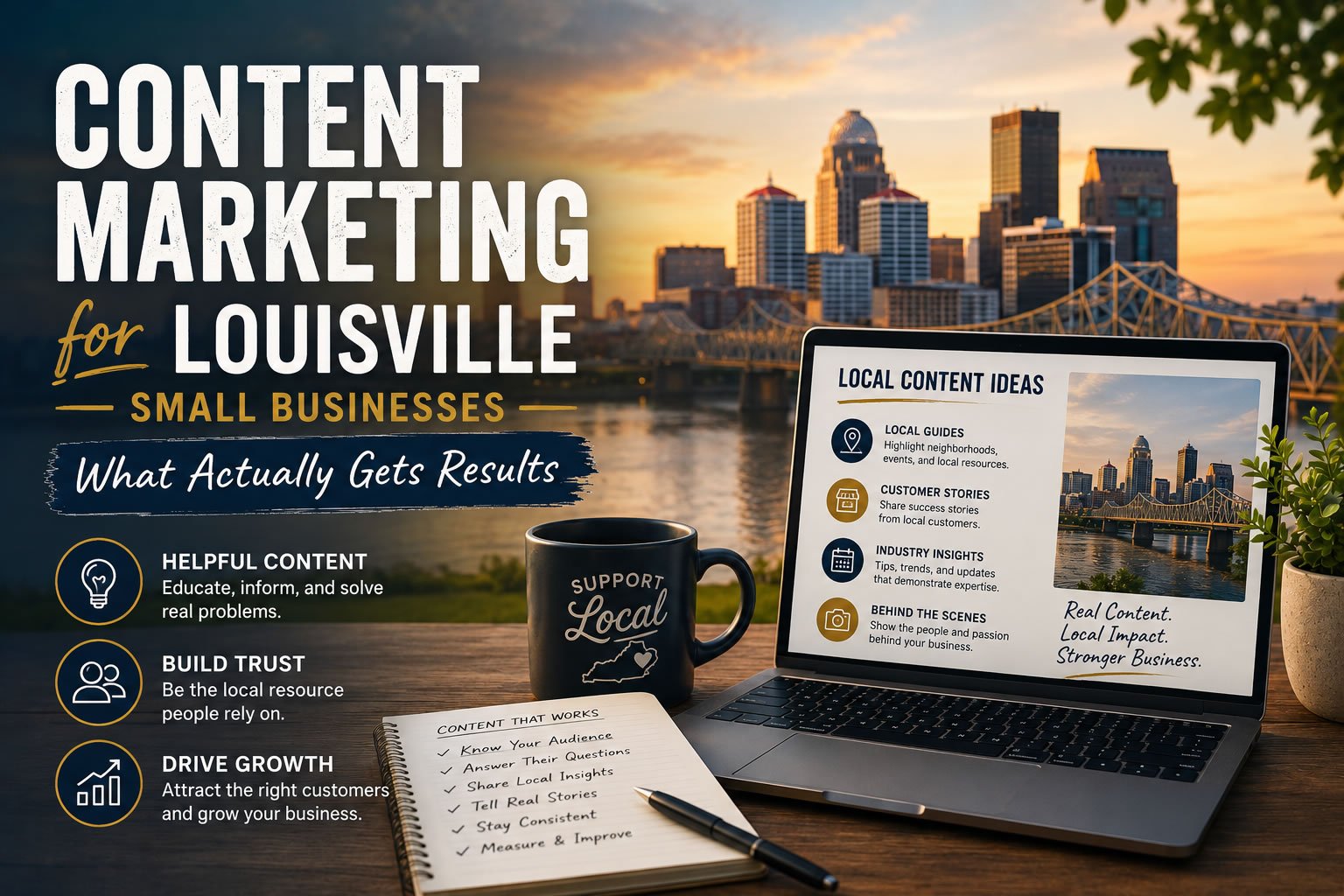
Content marketing for a Louisville small business means publishing specific, useful content that answers the questions Louisville customers are actually asking, structured so Google can rank it and AI tools can cite it, at a frequency the business can sustain without a dedicated content team. Generic content that could have been written by any business in any city does not rank, does not earn AI citations, and does not build local authority. The specific version compounds. The generic version does not.
Here is the version of content marketing advice nobody in Louisville wants to give you, because it makes the job sound harder than the version that leads to a monthly retainer.
Most content marketing advice for small businesses is some version of: publish consistently, use keywords, be valuable to your audience. That is true. And it is also so general that it is basically useless as a strategy. What does publish consistently mean for a business owner running their company without a dedicated marketing person? What does use keywords mean if you have never done SEO research? What does be valuable mean when you are not sure what your customers are actually searching for?
I'm Bernie. I run B2The7 in Louisville, and I do this work directly with small businesses as a Louisville digital marketing consultant. Here is the specific version.
What You Will Learn
- Why generic content does not work, and what specific content actually means in practice
- The content types that produce the most consistent results without a content team
- How to find the topics your Louisville customers search for without a keyword tool
- The right publishing frequency for a one-person or small team operation
- How content connects to GEO and AI search visibility, and why it matters now
The Generic Content Problem
If your content could have been published by any business in your category in any city, it is not going to rank for anything specific. And it is not going to get cited by AI tools that are specifically looking for content attributable to a credible, specific source.
A Louisville HVAC company that publishes "tips for keeping your home cool in summer" is producing content that ten thousand HVAC companies have already published. Google does not need another version of it. ChatGPT is not going to cite it when someone asks about air conditioning in Louisville.
A Louisville HVAC company that publishes an article about why Louisville's combination of humidity and clay soil creates specific duct sealing challenges that most national HVAC guides do not address is producing something that cannot be replicated without local knowledge. That is the kind of content that ranks. That is the kind of content AI tools cite.
The specific version always feels harder to write, because it requires actual knowledge rather than general competence. But it is also the only version that compounds over time.
If your content could have come from anyone, Google and AI tools have no reason to pick you over the thousands of other sources saying the same thing.
What Content Types Actually Work for Louisville Small Businesses
Local diagnostic content
Not how to fix leaky pipes in general. How Louisville's aging housing stock in the Highlands and Cherokee Triangle creates plumbing challenges newer construction does not have. The local specificity is the ranking and citation advantage.
Answer-structured content
The questions you answer ten times a week on the phone or in consultations. Each one is a keyword real people search for, and answering it from direct experience is something no content farm can replicate.
Service area content
Content that names Louisville and the neighborhoods and conditions relevant to your customers. The geographic specificity signals to AI tools that this content is credible and relevant for a Louisville searcher.
Content that takes a position
Opinion-free content is generic content. Saying here is what I have seen work and here is what I have seen fail, based on doing this in Louisville for years, is a point of view no generic source can provide.
The connection between this kind of specific content and AI search visibility is direct. I covered exactly why specific, attributable content is what AI tools select in the how to get cited in AI search article on this site. The short version: AI tools are looking for the same thing Google has always rewarded, content specific enough to be credible and attributable to a named, credible source.
How to Find Topics Without a Keyword Research Tool
You do not need to pay for SEMrush or Ahrefs to find content topics your Louisville customers are searching for. You already have most of the information you need.
Start with the questions you answer every week in consultations, on phone calls, in emails. Each one is a topic. If you answer a question five times a week, people are searching for the answer to it.
Go to Google and type the beginning of the most common question your customers ask. Do not finish it. Look at what Google autocompletes. Those are the actual searches people are running, and each suggestion is a content topic.
Go to the People Also Ask boxes at the bottom of the search results page for your main service category. Every question in that box is something your potential customers are asking. If you can answer it better than the results currently showing, you can rank for it.
Then talk to your best customers. Ask what they were trying to find when they were looking for someone like you. Not the exact words they typed, which they probably do not remember, but the problem they were describing to themselves before they searched. That framing is usually closer to the real query than the technical keyword would be.
What Publishing Frequency Actually Looks Like for a Small Business
The right publishing frequency for a Louisville small business without a dedicated content person is one good article every one to two weeks. Not daily. Not three times a week. Once every week or two, consistently.
Here is why that number matters. Search engines look for a consistent publishing signal. A site that publishes one solid article per week for twelve weeks signals active, maintained content production. A site that publishes ten articles in one week and then nothing for two months signals inconsistency, which is a negative signal.
every one to two weeks beats ten articles in one week and then silence
The articles also need to be genuinely useful and specific. One 1,200-word article that answers a specific question your customers ask, written with real expertise, does more for your content authority than five 300-word articles covering general ground.
And you need FAQ sections on every article. This is not optional for 2026. AI tools extract FAQ-structured content for their responses more readily than any other format. Adding a five-question FAQ at the bottom of every article takes fifteen minutes and improves both Google featured snippet eligibility and AI citation probability.
The structure I am describing, specific content answering real customer questions with FAQ sections published consistently, is the same structure behind the GEO cluster approach I covered in the how GEO works article on this site. Content marketing and GEO are not separate strategies. GEO is content marketing done with the specific structure that earns AI citations on top of traditional rankings.
How Content Connects to AI Search Visibility
Two years ago, content marketing for a Louisville small business was primarily a strategy for Google rankings. You published content, Google ranked it, people clicked through to your site. The path was clear.
That path is still real and still worth building. But it now has a parallel path that did not exist before. When someone asks ChatGPT or Google AI Overviews who is a good digital marketing consultant in Louisville, or what to look for in a content strategy for a small business here, the AI generates an answer. If your content is structured right and your business has enough credibility signals, your content is in that answer.
The connection between traditional content marketing and AI search visibility is not a separate strategy. It is a structural layer added to the same content. The answer in the first paragraph instead of the third. The FAQ section at the bottom. The specific claims instead of the generic positioning. Those changes make the same article perform better for both traditional search and AI search at the same time.
For a Louisville small business that has been doing content marketing for a few years and wonders why AI tools do not seem to know it exists, the answer is almost always one of the problems I covered in the why Louisville small businesses are invisible online article on this site. The content exists. The structure is what is missing.
Frequently Asked Questions
Content marketing for a Louisville small business means publishing specific, useful content on topics your Louisville customers are actually searching for, at a frequency you can sustain without a dedicated content team, structured so Google can rank it and AI tools can cite it. The most important word is specific. Generic content that could have been published by any business in any city does not rank, does not earn AI citations, and does not build the local authority that produces inbound leads.
One solid, specific article every one to two weeks is the right frequency for a small business without a dedicated content person. Consistency matters more than volume. A site that publishes one good article per week for twelve weeks signals active, maintained production to search engines. A site that publishes ten articles in one week and then goes quiet for two months signals inconsistency, which works against you. Quality and specificity matter more than frequency within that range.
Start with the questions your customers ask most often in consultations, on calls, and in emails. Each of those is a content topic real people are searching for. Then go to Google and type the beginning of those questions to see what it autocompletes. Those are actual search queries. Check the People Also Ask boxes at the bottom of results for your main service category. Every question there is a topic your potential customers are asking. The Louisville-specific angle on any of these is your advantage over generic national content.
Yes, directly. The same content that ranks on Google also earns AI citations when it is structured correctly. Content that answers the question in the first paragraph, includes FAQ sections, uses specific and verifiable claims, and is published consistently on a site with consistent business information builds visibility in both traditional search and AI-generated answers at the same time. The differences between content optimized for traditional SEO and content optimized for AI search are mostly additions, not replacements.
Early signals in Google Search Console typically appear within four to eight weeks of consistent publishing. Meaningful ranking movement on competitive local keywords usually takes three to six months of sustained work, and AI citation signals follow a similar timeline. The businesses that build durable content authority are the ones that treat publishing as an ongoing practice rather than a campaign with an end date. Content compounds over time in a way paid advertising does not.
The Bottom Line
Content marketing works for Louisville small businesses when it is specific enough to be worth ranking, structured to be AI-citable, and published consistently enough to signal active expertise to search engines.
The generic version, blogging about broad topics with industry-standard advice that could have come from anyone, does not work, because it gives Google and AI tools nothing to distinguish you from the thousands of other sources saying the same things.
The specific version takes longer to start but compounds in a way the generic version never does. A Louisville business that builds twelve months of specific, locally relevant, FAQ-structured content on topics it genuinely knows well builds an authority position a competitor cannot replicate quickly.
If you want help building a content strategy that fits your specific business and your capacity to execute it, that is exactly the kind of work I do. Reach out at b2the7.com.
Content Marketing Strategy
B2The7 builds content strategies for Louisville small businesses that produce Google rankings and AI citations without requiring a content team. One strategist, direct execution.
Work With BernieGet the Newsletter
Marketing news and practical strategy for Louisville small business owners. No filler. Straight to your inbox.
Subscribe FreeBernie Fussenegger is a Louisville-based digital marketing strategist with senior-level experience at Papa John's, Confluent Health, and other major brands. He works directly with small businesses that need real marketing results without agency overhead. Find him at b2the7.com.