What the G2 Answer Economy Means for Small Business
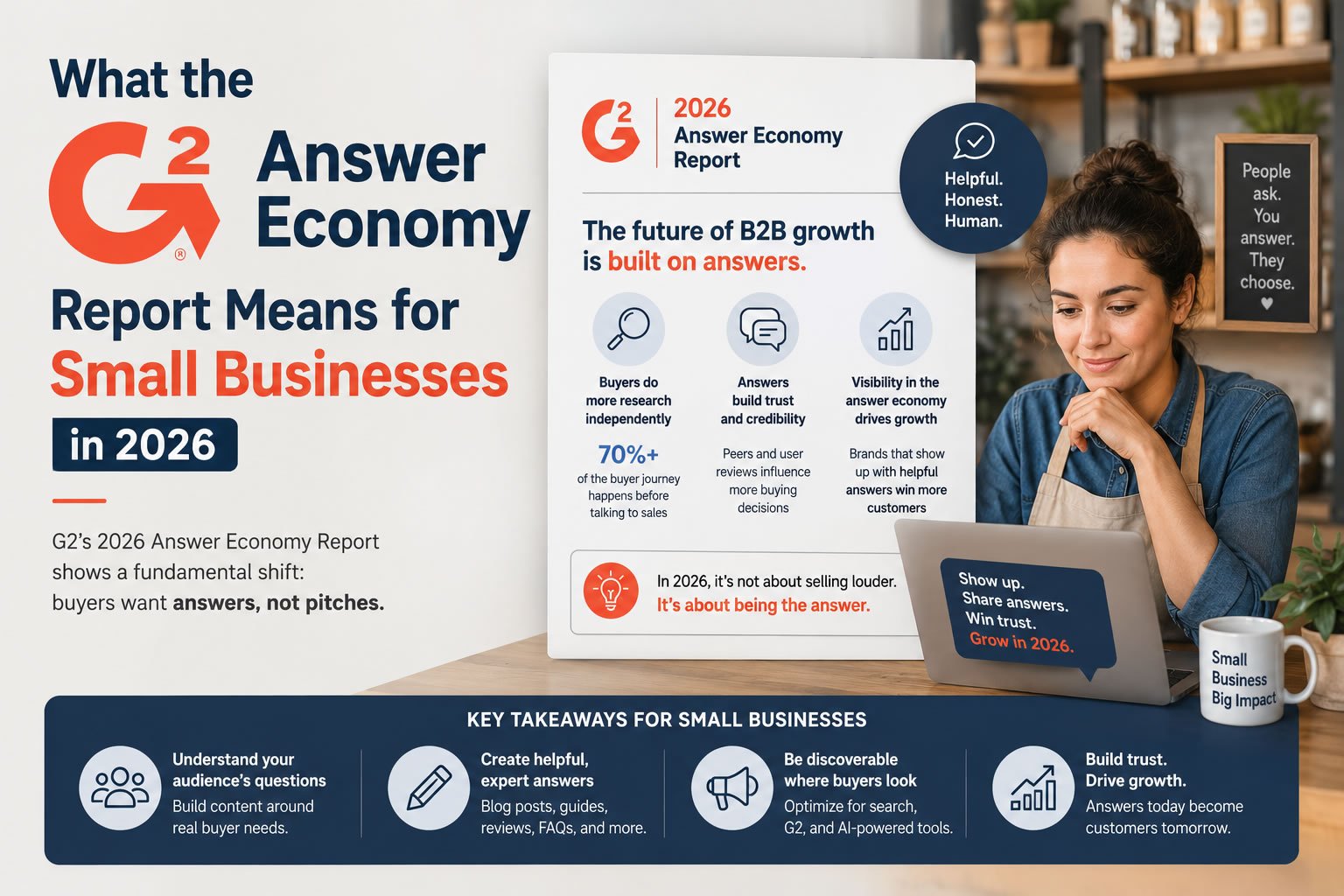
The G2 2026 Answer Economy Report found that 51% of B2B software buyers now begin vendor research in an AI chatbot, and 85% view vendors more favorably when AI systems cite them by name. The report also found that B2B buyers who start research in AI chatbots are further along in their buying process before they ever contact a vendor, which means the evaluation that used to happen during sales conversations is now happening before the first email gets sent. For small businesses, these findings confirm that AI search visibility is no longer a future consideration. It is a current factor in whether buyers discover and shortlist them at all. Bernie Fussenegger at B2The7 builds content and visibility strategies for small businesses based on direct experience with how enterprise buyers actually make purchasing decisions.
Quick Answer
The G2 Answer Economy report shows AI-first vendor research is already standard: 51% of B2B buyers start in an AI chatbot and 85% favor vendors AI cites by name. For a small business, that means AI citations now decide whether you get shortlisted, and the work to earn them is specific case study content, LinkedIn authority, and professional directory presence built before your competitors start.
G2 published their 2026 Answer Economy Report a few months ago. It is the most compelling buyer research I have seen this year, and I have not seen a single article address what it actually means for a small business rather than for an enterprise vendor or a marketing agency.
So that is what this is.
Two numbers from the report drive everything. 51% of B2B software buyers now begin their vendor research in an AI chatbot. And 85% of those buyers view a vendor more favorably when the AI cites them by name during that research.
Both of those numbers are higher than I expected. And together they describe a buying process that is meaningfully different from what it looked like two years ago.
I'm Bernie. I ran marketing at Papa John's and worked inside Confluent Health. I have been on the buyer side of this process and I now work with small businesses on the vendor side of it. Here is the honest interpretation of what these numbers mean.
What You Will Learn
- What the G2 Answer Economy report actually found and why these two numbers matter most
- Why AI-first research is specifically challenging for small businesses
- What the 85% favorability finding means for the economics of AI visibility
- What to build to show up in AI vendor research before traditional search
- Why this is urgent right now in a way it was not twelve months ago
What the Report Actually Found
The G2 Answer Economy report surveyed B2B software buyers across industries and company sizes. The headline findings are the two numbers above. But the context around them matters.
The 51% who start in AI chatbots are not using AI as a replacement for their eventual Google search or their eventual conversation with a sales rep. They are using it as a first filter. A way to get oriented before they invest time in traditional research. An AI chatbot can answer a question like who are the main vendors in this space in thirty seconds in a way that would take twenty minutes of Google searching and tab management to replicate.
That first-filter role is what makes the statistic significant. It is not that buyers are never reaching Google or vendor websites. They are. But the vendors who make it to the consideration set, the ones who get evaluated at all, are increasingly the ones who passed the AI filter first.
The 85% favorability finding is the one that surprised me more. Buyers do not just trust AI recommendations. They actively view the cited vendors more favorably. The citation functions as a trusted endorsement in a way that a position-one Google ranking does not. Finding a vendor in a Google search tells a buyer that the vendor's website is well-optimized. Finding a vendor in an AI recommendation tells the buyer that the AI evaluated the options and chose this one. Those are different signals with different psychological weight.
Why This Is Specifically Challenging for Small Businesses
Large enterprise vendors have a structural advantage in this new environment that is worth naming directly.
A company like Salesforce or HubSpot or Adobe does not need to build AI visibility from scratch. AI tools already know they exist because they have been cited in thousands of articles, mentioned in millions of conversations, and described across every conceivable professional platform for years. Their brand recognition automatically generates the kind of multi-source corroboration that AI tools use to confirm credibility.
A small business does not have that. A twenty-person marketing consultancy or a regional technology firm or a local professional services practice is not automatically in the AI's training data in a way that generates confident citations. They have to build the signals that earn those citations deliberately.
And the window to do that while the field is still relatively open is closing. The businesses building B2B AI visibility in 2026 will have a compounding head start over the ones who wait until 2027 or 2028 to pay attention. The answer economy is not a future shift. It is a current shift that is already affecting which vendors get shortlisted.
What the Favorability Finding Changes About the Economics
This is the part that changes how to think about the return on investment for AI visibility work.
Traditional search visibility produces a click. The buyer arrives at your website neutral, with no particular predisposition toward your business beyond the fact that you ranked for a relevant keyword. From there, your website has to do all the work of building credibility and moving the buyer toward contact.
AI-driven vendor discovery produces a buyer who already views you more favorably before they visit your website. The AI citation has done pre-sales work before the first interaction. The buyer arrives warmer. The conversation starts from a different baseline.
This connects directly to the conversion rate data I covered in the AI search customer acquisition article on this site. ChatGPT-referred traffic converts at 15.9% compared to 1.76% for Google organic. The G2 favorability finding explains the mechanism: AI-referred buyers are predisposed to view you favorably before they arrive. That is a fundamentally different starting point for a sales conversation.
What this means practically is that AI citation is not just a visibility metric. It is a sales funnel advantage. A small business that earns consistent B2B AI citations is effectively getting a warm referral at scale, without the relationship infrastructure that warm referrals usually require.
What Small Businesses Need to Build
The report does not tell small businesses specifically what to do, which is part of why there is a gap in the available coverage. Here is the practitioner version.
Named, specific case study content
The most important single thing a small B2B business can publish for AI vendor discovery is a specific named client story with specific outcomes. Not a generic capability statement. Not a testimonial quote. A description of a specific engagement: who the client was (by name or description), what the specific challenge was, what you did specifically, and what happened as a result. AI tools building a vendor shortlist look for content specific enough to be attributed to a credible source. Generic content does not earn citations. Specific content does.
LinkedIn authority signals
For B2B professional services, LinkedIn is the single most important platform for AI vendor visibility. A complete profile, personal profile posts demonstrating specific expertise, and recommendations from named clients with specific outcomes build the professional authority that AI tools treat as a B2B credibility signal.
Professional directory presence
Clutch, G2, relevant industry association directories, and any professional platform where your category of buyers evaluate vendors. These are the B2B equivalent of Google Business Profile for local consumer AI. AI tools verify B2B vendors by looking for consistent, credible information across multiple professional sources. It is the same corroboration logic behind getting cited in Google AI Overviews, applied to vendor evaluation queries.
Content that answers buyer evaluation questions
Not just content about your services. Content that directly answers the questions B2B buyers ask when evaluating vendors: what distinguishes this firm from alternatives, what specific experience do they have in my industry, what has their work actually produced for clients like me. This is the content that earns citations on vendor evaluation queries where buyers have high intent.
The complete B2B GEO strategy, including which platforms matter most and how to build authority signals in priority order, is in the GEO for B2B small businesses article on this site.
Why This Is Urgent Right Now
The G2 data is from buyers who are already operating this way. 51% is not a prediction. It is a current behavior pattern.
And the competitive dynamic in AI vendor discovery right now favors early movers in a specific way. AI tools build confidence in a business by seeing it referenced consistently across multiple credible sources over time. That confidence accumulates. A business that starts building B2B AI authority signals now will have a significantly stronger citation profile six months out than one that starts six months from now.
The businesses that will dominate B2B AI vendor shortlists in 2027 and 2028 are mostly already doing the work right now. Some of them are your competitors. Most of them are not, because most small businesses have not yet engaged with what the Answer Economy shift means for their vendor discovery pipeline.
That gap is closing. But it is still open.
If you want to check where your business currently stands in B2B AI vendor discovery before doing anything else, the audit process in the how to check your AI search visibility article takes about twenty minutes and gives you a baseline picture of what AI tools currently say about your business.
Frequently Asked Questions
The G2 Answer Economy report is a 2026 research study by G2 (the B2B software review platform) that surveyed B2B buyers about how they research and select vendors. The two most significant findings for small businesses are that 51% of B2B software buyers now begin vendor research in an AI chatbot, and 85% view vendors more favorably when AI systems cite them by name. Together these findings confirm that AI-first vendor discovery is already a current buying behavior, not a future trend, and that being cited by AI produces a measurable favorability advantage before buyers ever contact a vendor.
It means an AI citation functions as a trusted third-party endorsement rather than just a visibility impression. When an AI tool recommends a vendor by name in response to a buyer's research query, the buyer's predisposition toward that vendor is already more favorable before they visit the website, read reviews, or speak to anyone. This pre-qualification is what explains why AI-referred traffic converts at significantly higher rates than traditional search traffic. The endorsement has already happened before the buyer arrives.
Large enterprise vendors have automatic AI visibility because they have been referenced across thousands of articles, platforms, and professional conversations for years. Small businesses do not have that accumulated citation history and have to build it deliberately. The G2 findings make this deliberate building urgent because the buyers who are already using AI-first vendor research are making shortlisting decisions before they ever reach traditional search. Small businesses that have not built AI visibility are being filtered out of the consideration set before the traditional evaluation process even begins.
Publish one specific, named (or described) client case study on your website and LinkedIn. The case study should include who the client was, what the specific challenge was, what you did specifically, and what the outcome was in measurable terms. This is the content that is most directly extractable by AI tools building vendor shortlists. Generic capability statements do not earn citations. Specific, attributable, outcome-focused content does.
For content changes like case studies and service page rewrites, early signals can appear in four to eight weeks. LinkedIn authority signals build more gradually, typically three to six months of consistent content before they meaningfully influence B2B AI recommendations. Professional directory listings take effect faster, often within two to four weeks of being correctly listed. The businesses that build the most durable B2B AI vendor visibility treat these changes as ongoing practices rather than one-time projects.
The Bottom Line
The G2 data is not speculative. 51% of B2B buyers are already starting in AI chatbots. 85% already view AI-cited vendors more favorably. These are current behaviors, not projections.
The small businesses that build B2B AI visibility now, through specific case study content, LinkedIn authority, and professional directory presence, are building an advantage that compounds faster because most competitors have not started yet.
If you want to understand what your specific business needs to do to show up in the B2B AI vendor research that buyers in your category are already running, that is exactly the work I do. Reach out at b2the7.com/contact.
B2B AI Visibility Strategy
B2The7 builds content and visibility strategies for B2B small businesses that earn AI citations in vendor research queries. Enterprise experience applied at small business scale.
Work With BernieThe Newsletter
Marketing news and practical strategy for small business owners. No filler. Straight to your inbox.
Get the NewsletterBernie Fussenegger is a Louisville-based digital marketing strategist with senior-level experience at Papa John's, Confluent Health, and other major brands. He works directly with small businesses that need real marketing results without agency overhead. Find him at b2the7.com.