How AI Search Changes B2B Vendor Discovery in 2026
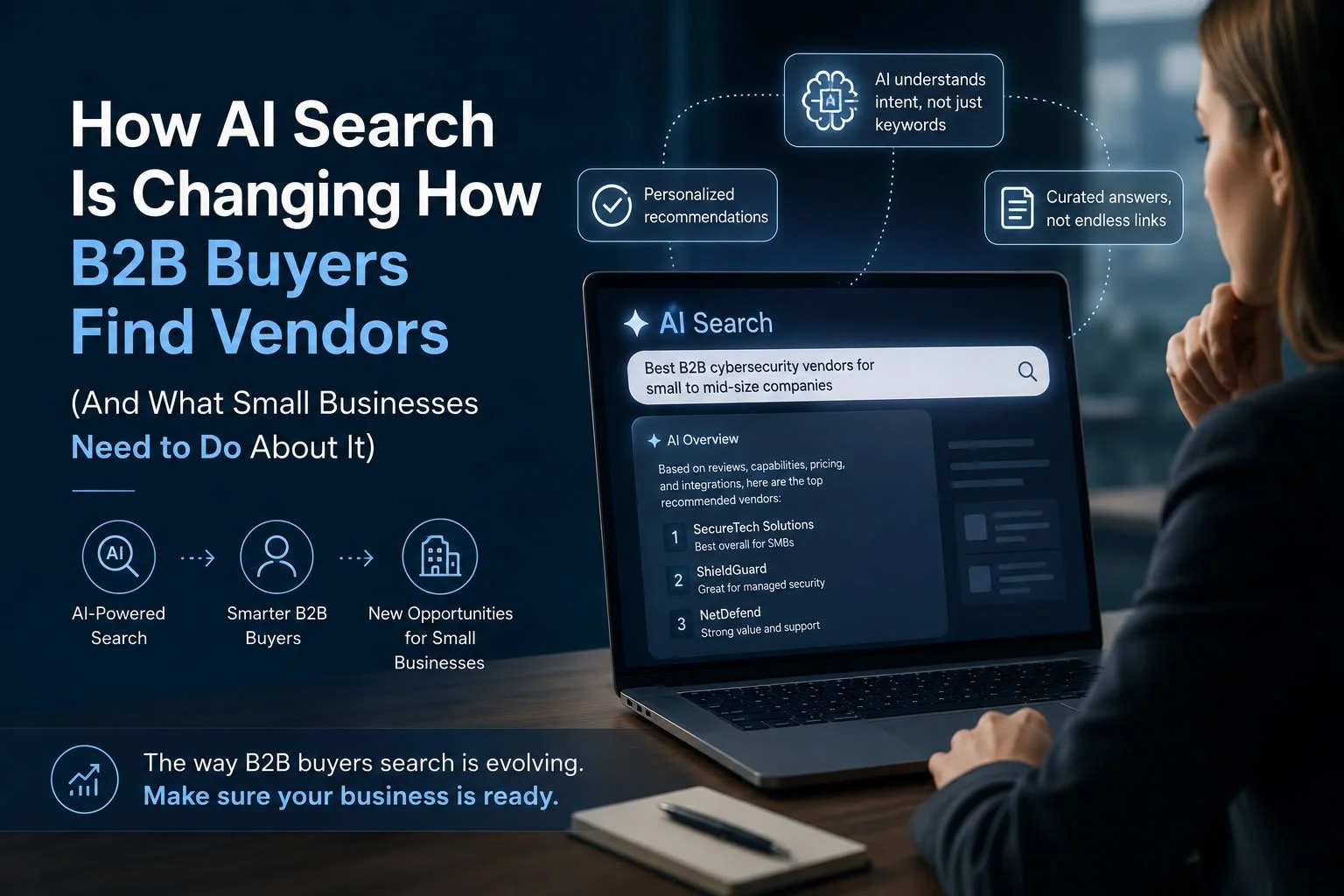
AI search is changing B2B vendor discovery in a specific and measurable way. G2's 2026 Answer Economy report found that 51% of B2B software buyers now begin their vendor research in an AI chatbot, and 85% view vendors more favorably when AI systems cite them by name. The implication for small businesses is direct: if an AI tool does not include your business in its vendor recommendation when a buyer asks about your category, that buyer may never reach your website, your Google listing, or your sales team. The discovery process is being intercepted before traditional search ever begins. Bernie Fussenegger at B2The7 helps small businesses build the content and presence strategies that earn AI citations in B2B vendor discovery queries.
AI search is changing B2B vendor discovery by intercepting it before traditional search begins. G2's 2026 Answer Economy report found 51% of B2B buyers now start vendor research in an AI chatbot, and 85% view AI-cited vendors more favorably. Businesses that earn citations get shortlisted. The ones that do not are never considered.
There was a moment at Confluent Health where we were evaluating marketing partners. The shortlist did not come from a Google search. It came from asking around. Colleagues, contacts, a few industry forums. Someone typed a question into a tool. Names came back. We looked at those names first.
That was a few years ago. The tool was not AI. But the pattern was the same as what AI has now formalized. The vendor discovery process starts somewhere other than a keyword search.
G2's 2026 Answer Economy report put hard numbers on what a lot of B2B practitioners have been observing. 51% of B2B software buyers now begin their vendor research in an AI chatbot. Not Google. Not a colleague recommendation. An AI chatbot. And 85% of buyers view a vendor more favorably when an AI system cites them by name during that research.
That is not a future trend. That is a current buying behavior that is already affecting which vendors get contacted and which ones get overlooked.
I'm Bernie. I run B2The7. Here is what this means for a small business and what the practical response looks like.
What You Will Learn
What B2B Vendor Discovery Through AI Actually Looks Like
Here is a concrete scenario that is happening in procurement departments right now.
A VP of operations at a mid-size company needs to find a digital marketing consultant. They have a budget and a timeline. They open ChatGPT and type something like: recommend a digital marketing consultant with experience in B2B healthcare marketing. The AI generates two or three names with brief summaries of why each one is relevant. The VP looks at those names. Maybe they Google the top result. Maybe they reach out directly.
Notice what did not happen. No Google search for digital marketing consultant B2B healthcare. No scrolling through page-one results comparing five options. The AI handled the initial filtering and returned a shortlist. The discovery process was over before traditional search began.
This is what the G2 data is confirming. 51% of B2B software buyers are starting in AI chatbots. The number for professional services buyers is likely similar and growing. And for those buyers, the vendor discovery process now has a first gate that did not exist two years ago: does AI know your business exists and consider it worth recommending?
A business that passes that gate gets on the shortlist. A business that does not pass it is not considered, regardless of how good its Google rankings are.
of B2B software buyers now begin vendor research in an AI chatbot (G2 2026 Answer Economy report)
Why This Is Different From Traditional Search
Traditional search gave buyers a list of ten results and let them decide. They had agency. They could click through to position seven, compare two options side by side, come back tomorrow and look again. The path from search to vendor selection was long and involved multiple decision points where a smaller vendor could still enter the consideration set.
AI vendor discovery is binary. You are in the shortlist or you are not. There is no position seven. There is a generated recommendation with two or three names, and then there is everyone else who did not make it.
The 85% favorability finding from G2 makes the stakes even clearer. It is not just that being cited gets you on the shortlist. Being cited makes buyers actively more favorable toward you before they have even visited your website. The AI citation functions as a trusted third-party endorsement in a way that a Google ranking does not. A buyer who finds you in an AI recommendation arrives with a different level of pre-qualification than one who found you on page one of a keyword search.
I covered the conversion rate implications of this in the AI search customer acquisition article on this site. AI-referred traffic converts at 15.9% compared to 1.76% for Google organic search. The G2 favorability data explains the mechanism: buyers who arrive from an AI citation are already predisposed to view you favorably. That is a fundamentally different sales conversation.
What Signals AI Uses to Build a B2B Vendor Shortlist
This is where most small business GEO advice gets too generic. The signals that get a local restaurant recommended in ChatGPT are not the same signals that get a B2B professional services firm recommended when a procurement manager asks for vendor options. The B2B version is worth understanding specifically.
Named case studies and specific client outcomes
AI tools evaluating B2B vendor credibility are looking for content that is specific enough to be attributed to a credible source. A marketing consultant who has published a detailed description of how they built a content strategy for a multi-location healthcare company, with specific context about the challenge and specific outcomes, gives AI something to cite. A consultant whose website says they help businesses grow their brand gives AI nothing it can confidently attribute.
LinkedIn presence and professional content
For B2B professional services, LinkedIn is a primary AI authority signal. A complete profile, recent published content from personal profile posts, recommendations from named clients with specific outcomes, connections to credible professionals in relevant industries. AI tools read LinkedIn as a professional verification signal the same way they read Yelp for local consumer businesses.
Industry and professional directory listings
Clutch, G2, professional association directories, industry-specific platforms relevant to your category. For B2B AI visibility these are the equivalent of Google Business Profile for local consumer AI. They are the external citation sources that verify your professional credibility across multiple sources.
Content that answers the specific questions B2B buyers ask
Not just about your services. About the problems buyers in your category face. A B2B marketing consultant who has published detailed content about what goes wrong in B2B content strategies, what procurement managers should ask when evaluating vendors, and how to measure marketing ROI in a professional services firm is building the kind of topical authority that earns AI citations on B2B buyer queries. If you want the mechanics of earning those citations across any category, the how to get cited in AI search guide on this site walks through the full process.
The full B2B GEO strategy, including how to build these authority signals specifically for professional services, is in the GEO for B2B small businesses article on this site. This article covers the broader shift in buyer behavior that makes that strategy urgent.
What Most Small Businesses Are Missing
The gap is almost always the same. The business has a website with reasonable SEO. It ranks on page one for some of its main keywords. It has a Google Business Profile. It has done the basics of traditional search optimization.
And none of that is enough for B2B AI vendor discovery because B2B AI does not optimize for the same signals.
The typical small business B2B website is written from the inside out. Here is what we do, here is who we serve, here is our process. It is organized around the vendor's perspective rather than the buyer's questions. AI tools building a vendor shortlist are looking for content that answers the buyer's questions directly. What does this vendor do specifically, who have they done it for, what happened as a result, how do they differ from alternatives.
That is a different content brief from a traditional service page. And most small businesses have not written it yet.
The businesses that will be consistently on B2B AI vendor shortlists in 2027 are the ones writing that content right now. Not because they have bigger budgets. Because they understood earlier that the discovery process had changed.
The Priority Order for B2B AI Vendor Visibility
If you have limited time and no dedicated marketing person, here is where to put effort first.
Start with one detailed named case study or client story, published on your website and on LinkedIn. Specific client context (you can use a description rather than the name if needed), specific challenge, specific what you did, specific outcome. This is the single highest-impact B2B AI content action because it gives AI tools the attribution-ready content they are looking for.
Complete your LinkedIn profile fully and publish at least one substantive professional post per week for the next four weeks. Personal profile, not company page. The 360Brew algorithm that LinkedIn deployed in late 2024 rewards personal profile content from real practitioners. That content also builds your LinkedIn authority signals that AI tools read.
Get listed on Clutch or G2 with a complete profile and at least one client review. These are the B2B professional directory signals that AI tools use to verify vendor credibility the same way they use Yelp for local consumer businesses.
Rewrite the first paragraph of each service page so the answer is immediate. What you do. Who you do it for. What outcome you produce. Not a setup. Not context. The direct answer in the first two sentences.
Frequently Asked Questions
According to G2's 2026 Answer Economy report, 51% of B2B software buyers now begin vendor research in an AI chatbot rather than through a traditional Google search. They ask AI tools questions like who are good marketing consultants for healthcare companies or which accounting firms specialize in multi-location retail. The AI generates a shortlist of vendors with brief explanations. Buyers who find a vendor through this process are already predisposed toward the cited vendors. 85% view them more favorably simply because the AI recommended them by name.
Because an AI citation functions as a trusted third-party endorsement. When a buyer asks an AI tool for vendor recommendations and a specific firm is named, the AI has effectively done initial vetting on the buyer's behalf. The buyer arrives with a trusted recommendation already in hand rather than needing to evaluate an unfamiliar name from a search result. This pre-qualification explains why AI-referred traffic converts at roughly nine times the rate of Google organic traffic.
Publish one detailed named case study or client story on your website and LinkedIn. Make it specific: named or described client, specific challenge, specific actions taken, specific outcomes. This is the content that is most directly extractable by AI tools building vendor shortlists. Generic service descriptions do not get cited. Specific, attributable outcomes do. After the case study, complete your LinkedIn profile fully and start publishing substantive professional content from your personal profile at least once per week.
It affects small businesses significantly because B2B buyers at companies of all sizes are using AI to research vendors. A small regional company evaluating marketing consultants, technology providers, or professional services firms is going through the same AI-first research process as a Fortune 500 procurement team. The difference is that large enterprise vendors often have brand recognition that carries them through the AI filter automatically. Small businesses have to build the specific authority signals that earn AI citations because they cannot rely on unaided brand awareness.
Consumer AI search relies heavily on local signals like Google Business Profile, directory listings, and location-based reviews. B2B AI vendor discovery relies more on professional authority signals: LinkedIn presence and published content, named client case studies with specific outcomes, professional directory listings on platforms like Clutch and G2, and website content that directly answers the questions buyers ask when evaluating vendors. The underlying principle is the same. AI needs verifiable, specific, credible information from multiple sources. But the specific signals differ significantly between consumer and B2B contexts.
The Bottom Line
51% of B2B buyers start vendor research in an AI chatbot. 85% view AI-cited vendors more favorably. Those two numbers are already describing the buying process that is happening right now in your category.
The businesses that build B2B AI visibility now, through specific case study content, LinkedIn authority signals, and professional directory listings, will have a compounding advantage over competitors who are still optimizing only for traditional search.
If you want to understand where your specific business stands in B2B AI vendor discovery and what the highest-priority changes are, that is exactly the work I do. Reach out at b2the7.com/contact.
B2B AI Vendor Discovery Strategy
B2The7 builds content and presence strategies for B2B small businesses that earn AI citations in vendor discovery queries. Real enterprise experience. No agency overhead.
Work With BernieEmail Newsletter
Marketing news and practical strategy for small business owners. No filler. Straight to your inbox.
Get the NewsletterBernie Fussenegger is a Louisville-based digital marketing strategist with senior-level experience at Papa John's, Confluent Health, and other major brands. He works directly with small businesses that need real marketing results without agency overhead. Find him at b2the7.com.