Zero-Click Search: What Small Businesses Should Do
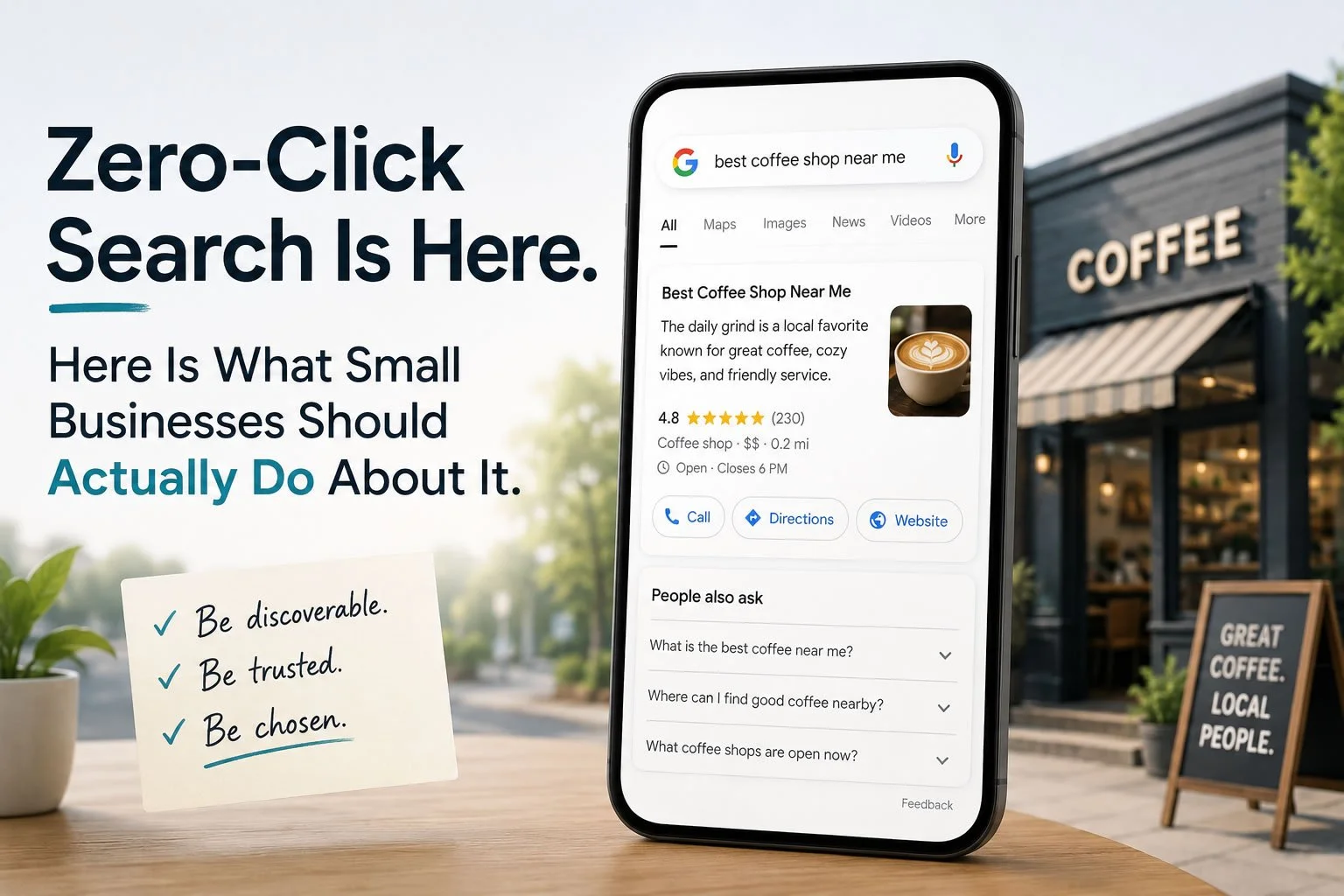
Zero-click search refers to Google searches that end without the user clicking any website link. The answer appears directly on the results page inside an AI Overview, featured snippet, knowledge panel, or local map pack. More than 60% of Google searches now end this way. For small businesses, this does not mean SEO is dead. It means the goal has shifted from getting clicks to getting visibility inside those answer surfaces.
Zero-click search happens when Google answers a query directly on the results page, so users never need to visit a website. It now accounts for more than 60% of all searches. Small businesses can still win in this environment by showing up in local map packs, featured snippets, and AI Overviews. The businesses doing well are focused on answering the question. The ones struggling are still chasing the click.
Your Google rankings look fine. Your site is healthy. You are on page one for a handful of keywords. But your traffic is flat or dropping. And you have no idea why.
There is a decent chance zero-click search is part of the answer.
I flagged this in the marketing trends post from the week of June 8 because it is one of the more significant shifts happening right now, and most small business owners have not connected it to what they are seeing in their own traffic numbers. So let me explain what it actually is, what it means for a small business specifically, and what to do about it.
I'm Bernie. I work in digital marketing, and I help small businesses get found online. Not just in Google search results but inside the AI-generated answers that are increasingly where people get information before they click anything at all.
What You Will Learn
- What zero-click search actually is and why more than 60% of searches now end this way
- Why your traffic can drop even when your rankings stay the same
- The difference between losing to zero-click and winning from zero-click
- Five things small businesses can do right now to stay visible as clicks decline
- What this has to do with GEO and AI search, because they are connected
What Zero-Click Search Actually Is
For most of Google's history, the way it worked was simple. You typed something in. Google showed you a list of links. You clicked one. You went to a website.
That is not how most searches work anymore.
Google now answers many questions directly on the results page. There is an AI Overview at the top that synthesizes an answer from multiple sources. Featured snippets pull a direct answer from a specific page. There are knowledge panels with business information, hours, reviews, and phone numbers. There are local map packs that show the top three businesses for local searches.
In all of these cases, the person asking the question gets an answer without having to click anything. They see what they need and they move on. Or they call the business number directly from the knowledge panel. Or they navigate using the map. The click to your website never happens.
So if your traffic is dropping while your rankings stay stable, zero-click search is probably part of the reason. The people who used to find you through organic search are now getting their answer from Google before they ever reach your site.
Losing to Zero-Click vs. Winning From Zero-Click
This is the part worth understanding because it changes how you think about the whole thing.
Zero-click search is not purely bad for small businesses. It depends entirely on where your business shows up.
When someone searches for services in Louisville and your business appears in the local map pack with five-star reviews, accurate hours, and contact details, that is a zero-click win. Customers connect with you directly from the results page. No click required. Same thing if your article is referenced as the source inside a featured snippet or AI Overview. Your brand is getting seen and credited, even without a visit to your site.
The businesses that miss out are the ones not appearing in any of those surfaces. They rank well in the blue link list but get skipped entirely when Google generates an AI Overview above that list and answers the question before anyone gets there.
Instead of trying to fight zero-click, the goal is to show up in the places where the answer lands. That is where the opportunity actually is.
What Zero-Click Search Has to Do With AI Search
Zero-click search and AI search visibility are related problems with overlapping solutions.
Google AI Overviews, the AI-generated answer blocks at the top of search results, pull from content across the web to build their answers. The sources they pull from are not always the highest-ranking pages. They are the pages with the clearest, most direct answers, structured in a way the AI can extract easily.
This is what GEO is about. Getting your content into the answer surfaces, not just the link list. I covered this in the GEO vs SEO article and the What Is GEO article on this site. The short version is that the same content strategies that get you cited in ChatGPT and Perplexity also increase your chances of appearing in Google AI Overviews. And appearing in AI Overviews is how you win visibility from zero-click searches rather than losing to them.
Your rankings and your AI visibility are becoming two separate things. A business can rank well yet remain invisible in AI Overviews if its content is not structured to be extracted and cited. That is the gap most small businesses have right now.
Five Things Small Businesses Can Do About Zero-Click Search
None of these is complicated. Most small businesses underutilize all of them.
Get Your Google Business Profile in Order
For local businesses, the map pack is the most important zero-click surface. It shows your name, rating, hours, and contact information directly in search results. If your profile is incomplete, inactive, or inconsistent, you are not eligible to compete. Complete every field, add recent photos, respond to reviews, and post updates regularly. This is the fastest path to local zero-click visibility, and most small businesses have not fully done it.
Structure Your Content for Direct Answers
Featured snippets and AI Overviews pull from content that directly answers the question in the first paragraph. If your page takes four paragraphs to get to the point, it will not be pulled. Rewrite your most important pages so the main answer comes in the first two sentences. Then expand on it. That structure serves both featured snippets and AI Overviews at the same time.
Add FAQ Sections to Every Key Page
FAQ-formatted content is one of the most reliable ways to appear in featured snippets because it is already in question-and-answer format. Google and AI tools can pull it easily. Add an FAQ section to your main service pages and key blog posts. Base your questions on what customers actually ask. Four to six questions per page, answered directly in two to four sentences each.
Track Impressions, Not Just Clicks
If you are only measuring success by website traffic, you are missing the picture. Zero-click visibility shows up in Google Search Console as impressions, not clicks. A page with 5,000 impressions and 50 clicks is still being seen by 5,000 people, many of whom are getting your brand name in front of them without ever clicking. Track impression volume and appearance in rich results alongside your traffic numbers.
Build Your Presence Beyond Your Own Site
Google does not rely only on your website when deciding what to show in knowledge panels, AI Overviews, and local search results. It pulls from business directories, review sites, local news coverage, industry websites, and other trusted sources. The more consistent your information is across those sources, the easier it is for Google and AI platforms to understand who you are and what you do. Accurate listings, strong reviews, and mentions from reputable sites all help.
The Honest Version for Small Businesses
Zero-click search sounds like bad news. And for businesses that built their entire marketing strategy around organic click volume, it is an uncomfortable shift.
But for a small business willing to adjust, it is actually an opportunity. The surfaces where zero-click answers appear, map packs, featured snippets, and AI Overviews, are not dominated by the biggest brands with the largest domain authority. They are dominated by whoever has the most specific, clearly structured, locally relevant content.
Many small businesses are in a better position than they realize. A well-maintained Google Business Profile, useful content that answers real customer questions, and consistent business information across the web can go a long way. In many local searches, a small business can earn visibility even when larger competitors are spending more on marketing.
The businesses struggling with zero-click search are focused on getting the click itself. The businesses doing well are focused on answering the question. If your content helps people find what they need, your business has a much better chance of showing up where decisions are being made.
Frequently Asked Questions About Zero-Click Search
Zero-click search refers to Google searches that end without anyone clicking a website link. More than 60% of searches now end without a click. Between AI Overviews, featured snippets, knowledge panels, and local map results, Google often gives people the information they need before they visit a website. The businesses winning today are the ones providing clear answers, keeping their Google Business Profile updated, and creating content that helps customers make decisions. The goal is no longer just getting the click. The goal is being the source of the answer.
If your content is being pulled into featured snippets or AI Overviews, your impressions may stay high while your clicks drop. That is not necessarily a loss. Your brand is still being seen. If you are not appearing in any answer surfaces and Google is answering your keywords with AI-generated overviews from other sources, that is a real traffic loss. Check Google Search Console for impression data, not just click data, to understand which situation you are in.
Yes, specifically local businesses. When someone searches for a service near them and your business appears in the local map pack with accurate information, reviews, and a phone number, that is a zero-click win. They called you directly from the search results page without visiting your site. Local map pack visibility is one of the highest-value places a small business can appear, and it does not require a click to generate a lead.
Google AI Overviews are part of zero-click search. They answer questions directly on the results page by pulling from content across the web. GEO, generative engine optimization, is the practice of structuring your content to be cited in those AI-generated answers. A business that optimizes for GEO is directly optimizing for zero-click visibility in AI Overviews and in tools like ChatGPT and Perplexity. They are the same problem with the same solution.
Open Google Search Console and look at your impressions versus clicks over the last six months. If impressions are holding steady or growing while clicks are flat or declining, zero-click is likely a factor. Also check whether AI Overviews appear when you search your key keywords. If Google is generating an AI Overview for those searches and your content is not cited in it, you are losing zero-click visibility to competitors whose content is better structured for extraction.
The Bottom Line on Zero-Click Search
Zero-click searches are here to stay. The percentage of searches that end without a click will keep rising as Google adds more AI features to the results page. That is not a reason to panic. It is a reason to shift focus.
The businesses doing well in this environment are not the ones with the biggest budgets or the most backlinks. They are the ones showing up in map packs, getting cited in featured snippets, and structuring content so AI Overviews can pull from it. For a small business that does those things consistently, zero-click search is not a threat. It is an opening.
If you want to understand where your business stands in these areas and what it would take to show up more consistently, that is a conversation worth having.