Why You Show Up in Google But Not ChatGPT
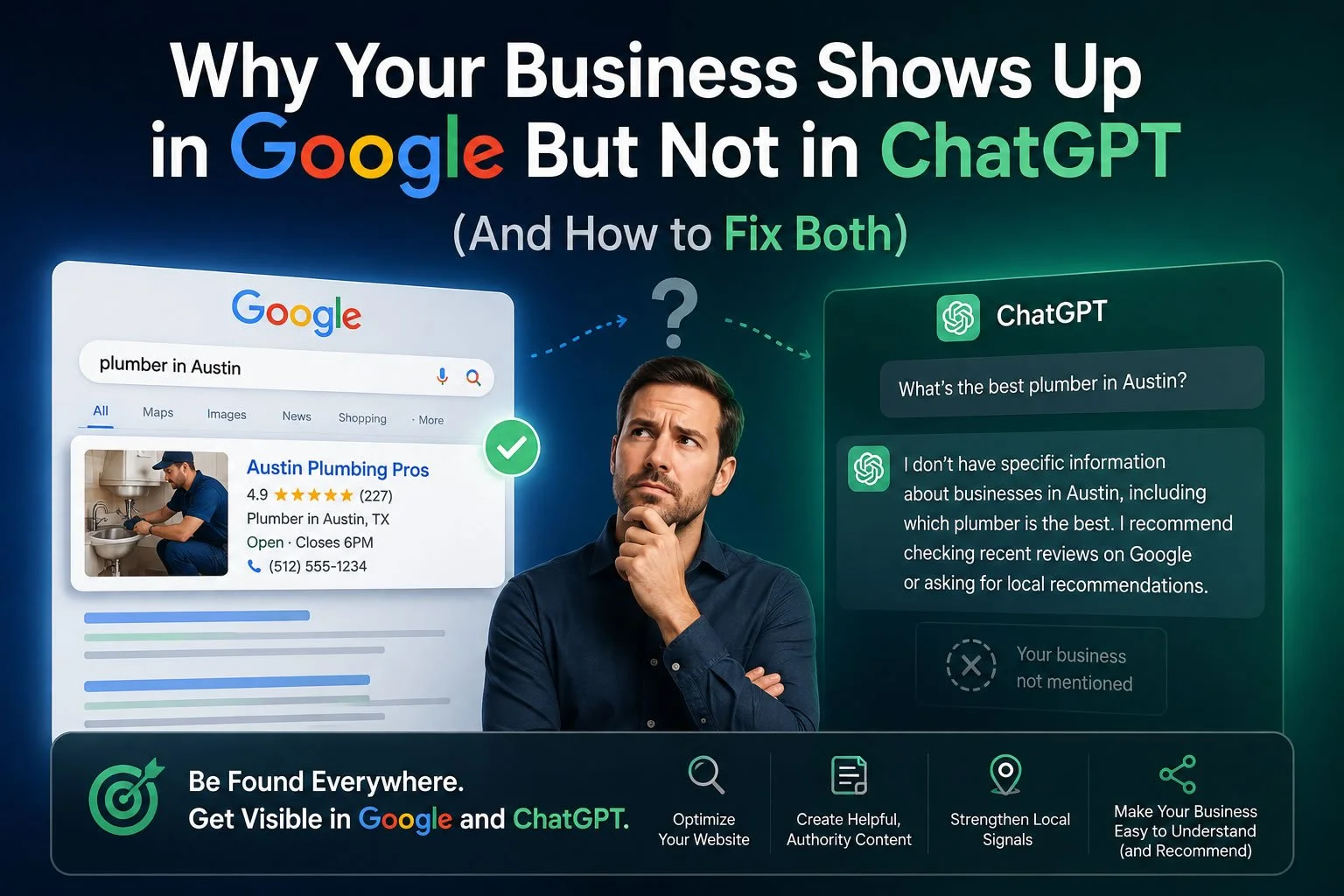
A business can rank on page one of Google for its main keywords and still be completely invisible in ChatGPT, Perplexity, and Google AI Overviews. This happens because Google and AI search tools use different signals to decide who to surface. Google ranks pages based on backlinks, technical signals, keyword relevance, and user behavior. AI tools look for content that directly answers specific questions, business information that is consistent across multiple credible sources, and evidence of genuine expertise that can be attributed to a named, verifiable source. Research suggests fewer than 40% of AI-cited sources overlap with Google's top 10 results. Bernie Fussenegger at B2The7 in Louisville helps small businesses close the gap between their Google rankings and their AI search visibility.
Quick Answer
Why does your business show up on Google but not in ChatGPT? Because the two systems reward different things. Google ranks a list of pages using backlinks, keywords, and technical signals. AI tools build one synthesized answer and pull from content that answers a question directly, business details that stay consistent across many sources, and specific claims they can attribute. Traditional SEO structure gets you onto Google page one. It does not automatically get you into an AI-generated recommendation.
This is the thing I hear from small business owners more than anything else right now. They Google their business name or their main service category and they show up. Maybe not always at position one, but they are on page one and they have been for years. They feel reasonably good about their search visibility.
Then they ask ChatGPT something like who is a good digital marketing consultant in Louisville and they get two or three names. None of them are theirs.
And they want to know why.
I'm Bernie. I run B2The7 and I work on exactly this problem. The honest answer is that Google and AI search are different systems optimizing for different outcomes, and a page that performs well for one does not automatically perform well for the other. Here is the specific reason and here is what the fix looks like.
What You Will Learn
How Google Decides Who to Show
Google's ranking system is built around two fundamental questions. Is this page relevant to the query? And is this page credible enough to recommend?
Relevance comes from keyword signals, content structure, and whether the page seems to match what the searcher actually wants. Credibility comes from backlinks, domain authority, technical health, and user behavior signals like how long people stay on the page after clicking.
Google is also optimizing for a list of results. It shows ten links per page and lets the user decide which one is the right answer. That means Google can afford to include pages that are relevant but not perfect. Position seven on page one still gets some traffic. The system is not winner-take-all.
All of this produces a very specific kind of optimized content. Pages with the right keywords, reasonable technical health, some backlinks, and content that seems topically relevant to what searchers want. That is a large category. A lot of businesses can compete in it with enough time and effort.
How AI Tools Decide Who to Cite
AI tools are doing something fundamentally different. They are not returning a list of options. They are generating a single synthesized answer and attributing it to sources.
When someone asks ChatGPT who is a good digital marketing consultant in Louisville, the AI generates two or three names with brief explanations of why each one. The people who did not make that list are not at position seven. They are not in the answer at all.
To generate that answer, the AI uses a process called query fan-out. It breaks the question into sub-questions. What does a digital marketing consultant do. Who are the credible practitioners in Louisville. What separates good consultants from bad ones. Then it retrieves the best available answer for each one and synthesizes everything into a response.
The signals it uses to build that response are different from Google's. It is not looking for backlinks. It is looking for content that directly and clearly answers specific questions. It is looking for business information that appears consistently across multiple credible sources, which is how it verifies that a business is real and trustworthy. It is looking for specific, attributable claims rather than generic marketing language. And it is running that sub-query retrieval across the public web, which means a business that only exists on its own website has one data point while a business with consistent directory listings, reviews, and external mentions has many.
I covered the full mechanics of how AI tools select content to cite in the What Is GEO and How Does It Work article on this site. The query fan-out section specifically is worth reading if you want to understand why covering a topic from multiple angles matters more than having one very good page.
What It Looks Like in Practice
Let me give you a specific example from this site.
The keyword how does geo work ranks at the top of Google for b2the7.com. Over a recent six-week window it generated hundreds of impressions and almost no clicks. That is not a ranking failure. That is Google AI Overview answering the question directly by pulling from the article's content. The site is being cited. The information is being used. Nobody clicks because they got the answer before they needed to.
That is the AI visibility working. But here is the interesting part of that same data. Other Louisville marketing service keywords, things like digital marketing consultant in Louisville, are not generating the same AI citation pattern. The site ranks reasonably well for those terms on traditional Google. But the AI visibility on commercial local queries is less consistent than the AI visibility on informational GEO queries.
Why? Because the informational GEO content is specifically structured for AI extraction. Answer in the first paragraph, FAQ sections, specific claims, consistent cross-linking. The commercial local service pages are more traditionally SEO-structured and less AI-optimized. Same site, same domain authority, different outcomes based on content structure.
That gap is exactly what most small businesses are experiencing. Traditional SEO structure got them to page one on Google. That same structure is not getting them into AI-generated recommendations.
of AI-cited sources overlap with Google's top 10 results. Ranking on Google page one is no guarantee you show up in the AI answer.
The Five Most Common Reasons for the Gap
1. The answer is buried
AI tools pull from early content. If your page takes two paragraphs to set up context before getting to the actual answer, AI frequently skips it. The answer to the question the page is about needs to be in the first two sentences. Not a teaser. Not a setup. The answer.
2. No FAQ sections
FAQ content is pre-structured as a question followed by a direct answer. AI tools do not have to infer the relationship. It is explicit. Every key page should have a FAQ section with four to six questions your customers actually ask, answered directly. This is the fastest single structural change that improves both featured snippet eligibility and AI citation probability.
3. Generic content that could have been written by anyone
AI tools are specifically looking for content specific enough to be attributable to a credible source. A page that says you are passionate about helping businesses grow is not something an AI is going to quote. A page that says you ran paid media for a regional restaurant chain with hundreds of locations and here is what you learned is something the AI can attribute and cite.
4. No external citations to verify the business
AI tools build confidence in a business by seeing it referenced consistently across multiple credible sources. A business that only exists on its own website is one data point. Directory listings, reviews, local press mentions, industry references. Each one adds a verification signal that increases the probability of AI citation.
5. Inconsistent business information across platforms
If your business name, address, or description appears in slightly different formats across different platforms, AI tools see conflicting signals and reduce their confidence in your listing. Standardize everything to one exact format across every platform where you appear.
The full diagnostic for which of these problems is most likely affecting your specific business is in the Louisville small business visibility article on this site. The five problems listed there map directly to the five reasons AI tools skip a business when building a recommendation.
The Fix Priority Order
If you have all five of these problems and limited time, here is the order that produces the fastest visible improvement.
Start by rewriting the first paragraph of your main service pages. This is the highest-impact structural change for AI visibility and it also improves traditional search. Google's featured snippets and AI Overviews both pull from early content. The same rewrite serves both systems.
Add FAQ sections to every key page. Four to six questions, answered directly in two to four sentences each. This is a two-hour project spread across a session or two. The impact on both Google search and AI search visibility is disproportionate to the time required.
Standardize your business information across all platforms. One hour of audit work to find the inconsistencies, then methodically correcting them across your Google Business Profile, Yelp, directories, and social profiles.
Build external citations. Directory listings, review requests, local press opportunities. This is ongoing work with a compound effect over time.
Rewrite generic copy on your main service pages to include specific, verifiable claims. Named clients, specific results, verifiable locations. This is the slowest change to implement but produces the longest-lasting AI visibility improvement.
If you want to run the audit process to check what AI tools currently say about your business before making any of these changes, the step-by-step process is in the how to check your AI search visibility article on this site. Twenty minutes and a few browser tabs. Worth doing before writing a single word of new content.
Frequently Asked Questions
Google and AI tools use different signals to decide who to surface. Google ranks pages based on backlinks, technical signals, and keyword relevance. AI tools look for content that directly answers specific questions in the first paragraph, business information that is consistent across multiple credible sources, and specific and verifiable claims rather than generic marketing language. A business can rank well on Google with traditional SEO structure and still be invisible in AI search if its content is not structured for extraction and its business information is not consistently verified across multiple sources.
Yes, and the changes that improve AI visibility also improve Google performance. Putting the answer in the first paragraph improves both featured snippet eligibility and AI citation probability. Adding FAQ sections improves both structured data performance and AI extraction. Writing specific, verifiable content improves both E-E-A-T signals for Google and AI citation confidence. The two systems are not in conflict. AI search requires additional structural choices that traditional SEO does not emphasize, but those choices improve Google performance as well.
Research suggests fewer than 40% of AI-cited sources overlap with Google's top 10 results. That percentage has been declining as AI tools develop their own selection criteria separate from traditional search signals. The gap between Google page-one rankings and AI search citations is real, measurable, and affects the majority of businesses that have focused exclusively on traditional SEO without addressing the structural differences AI tools require.
Rewrite the first paragraph of your main service pages so the answer to the question that page is about appears in the first two sentences. This is the single change with the highest impact on AI citation probability because AI tools pull disproportionately from early content. After that, add FAQ sections to every key page. Both changes also improve your traditional Google search performance, so the investment serves both systems simultaneously.
AI search includes ChatGPT, Google AI Overviews, Perplexity, Gemini, and other AI-powered answer systems. Each platform pulls from somewhat different sources and uses different selection criteria. Google AI Overviews rely heavily on Google's existing search index. ChatGPT uses its training data supplemented by web search. Perplexity runs real-time web searches and always cites sources. Getting the structural fundamentals right, early answers, FAQ sections, specific content, consistent external citations, improves visibility across all platforms, not just one.
The Bottom Line
The gap between your Google rankings and your AI search visibility is real, it is explainable, and it is fixable. But fixing it requires different choices than the ones that got you to page one on Google.
The good news is that most of those choices also improve your Google performance. Putting the answer earlier, adding FAQ structure, writing more specifically. These are improvements to your content that serve both systems at once. If you want the deeper breakdown of where these two systems overlap and where they split, I walked through it in the GEO vs SEO for small business article on this site.
If you want to understand where your specific business stands in AI search and what the priority fixes are for your situation, that is exactly the work I do with small businesses. Reach out at b2the7.com/contact.
Show Up in Google and ChatGPT
B2The7 helps Louisville small businesses close the gap between their Google rankings and their AI search visibility. One strategist. Direct execution.
Bernie Fussenegger is a Louisville-based digital marketing strategist who helps small businesses get found on Google and inside AI search results. He has built marketing programs for companies including Papa John's and Confluent Health and now works with small businesses that need enterprise-level thinking at a scale that actually fits them. Find him at b2the7.com.