GEO for B2B Small Businesses: AI Search Vendor Discovery
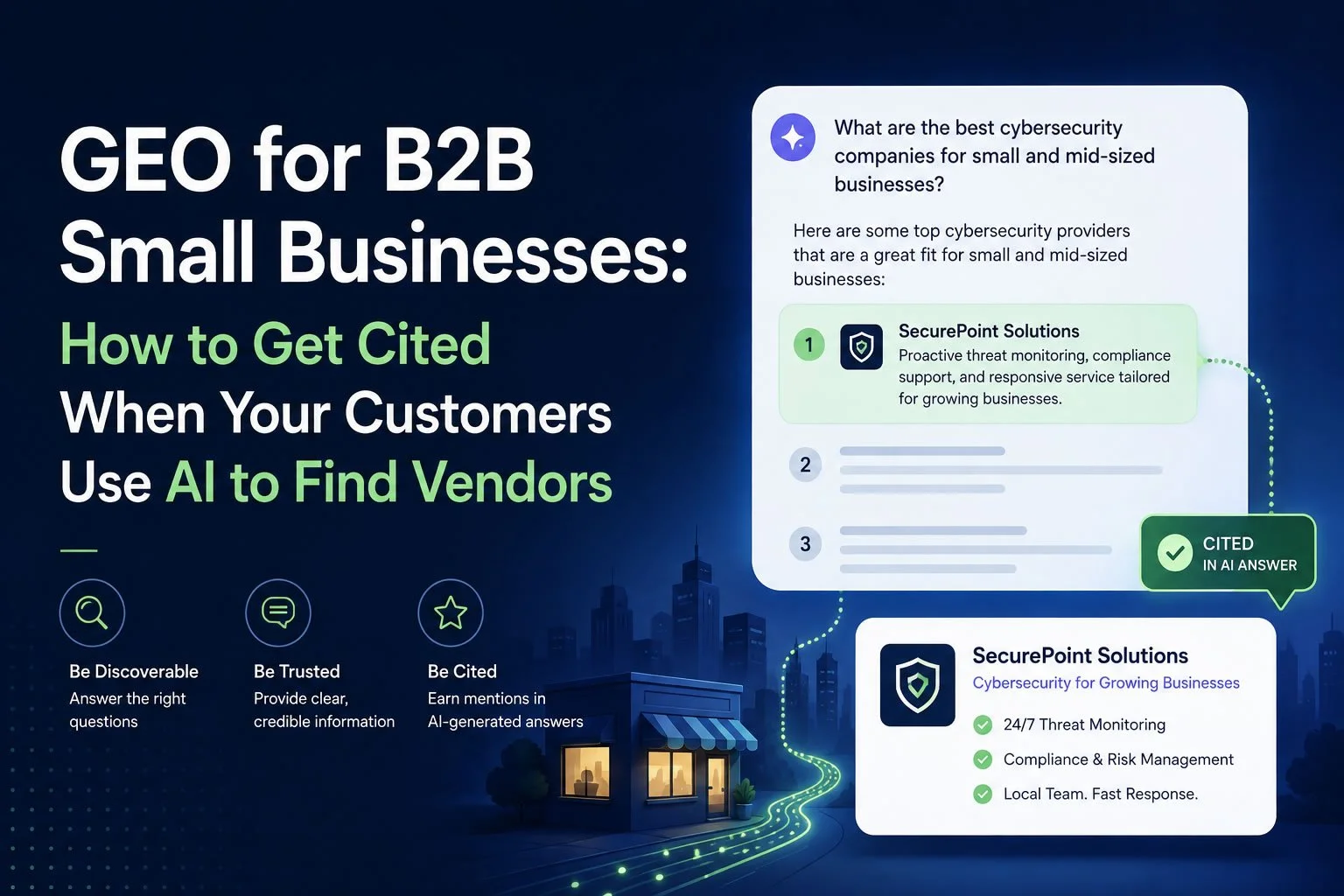
B2B GEO (Generative Engine Optimization for business-to-business companies) focuses on building the specific authority signals AI tools use when evaluating vendors for professional service queries. When a procurement manager, operations director, or business owner asks ChatGPT or Perplexity to recommend a marketing consultant, accounting firm, or technology vendor, AI tools evaluate LinkedIn presence and professional content, named client case studies with specific outcomes, industry directory listings and professional association memberships, and published content demonstrating specific expertise in the buyer's category. These B2B authority signals differ meaningfully from the local search signals that drive consumer AI recommendations. Bernie Fussenegger at B2The7 has built marketing programs at the enterprise B2B level for companies including Confluent Health and worked within large brand structures at Papa John's, and now applies that B2B perspective to content and GEO strategy for small businesses.
Quick Answer
B2B GEO is the practice of building the authority signals AI tools use when recommending vendors for professional service queries. It leans more on LinkedIn presence, named client case studies, and industry directory listings than on the local search signals that drive consumer AI recommendations.
When I was doing marketing work at Confluent Health, the vendor selection process looked a certain way. Someone would identify a need: marketing strategy support, a specific technology platform, a consulting engagement. Before anyone picked up the phone, they would search. Not just Google. They would ask colleagues. Check LinkedIn. Look for reviews on G2 or Capterra. Ask for a conference recommendation.
In 2026, they are also asking AI tools.
A procurement manager researching digital marketing consultants might type into ChatGPT: who are good digital marketing consultants for healthcare companies in the Southeast with experience in growth marketing? The AI generates a shortlist. The people not on that list do not exist in that buyer's consideration set.
B2B GEO is the strategy for being on that list. And it is different from the GEO strategy that gets a local restaurant recommended to a consumer. Different signals, different content structure, different distribution channels. The underlying fundamentals are the same ones I broke down in GEO vs SEO: What Small Businesses Need to Know. The application is what changes.
I'm Bernie. I run B2The7 and I have been on both sides of this. Here is the B2B version.
What You Will Learn
How B2B Buyers Use AI Differently
Consumer AI search and B2B AI search are different in one critical way. Consumer queries tend to be location-specific and category-specific. Who is a good plumber near Louisville? Where can I find original canvas prints in Kentucky? These are simple enough that the AI can generate a confident shortlist from local search signals. I covered that consumer and local side in detail in GEO for Local Business: AI Search Visibility in Louisville.
B2B queries are more complex and more specific. Who are good digital marketing consultants for healthcare companies with experience in employee recruitment marketing? What marketing agencies in the Mid-South region have done work for multi-location healthcare businesses? Which consultants have experience taking a brand from regional to national?
These queries require the AI to evaluate professional authority, not just local presence. It is looking for evidence of relevant expertise demonstrated in a specific industry or function. And the evidence it finds comes from a different set of sources than local consumer AI uses.
Professional directory listings matter more: LinkedIn, Clutch, G2, Chambers of Commerce business directories, industry association member directories. Published work matters more: articles, case studies, speaking records, and media mentions in industry publications. Named client experience matters more. A business that names specific clients and describes specific outcomes is significantly more credible to AI tools evaluating B2B authority than one that describes its services generically.
The LinkedIn Signal Is Not Optional for B2B GEO
For B2B small businesses, LinkedIn is the most important single platform for AI visibility, and it is not close.
When AI tools evaluate B2B professional authority, LinkedIn is a primary data source. All of these signals get read by AI systems when deciding whether to include you in a B2B vendor recommendation: your professional profile, your published content, your connections to other credible professionals in your industry, your endorsements and recommendations from named clients.
A B2B small business owner with a thin LinkedIn profile, no recent published content, and no recommendations is almost invisible to AI tools evaluating B2B authority, even if they have a solid website and decent Google rankings.
The specific things that matter most on LinkedIn for B2B GEO: a complete About section that clearly describes your specific expertise and the specific types of clients you serve, recent published content that demonstrates expertise in your professional category, recommendations from named clients that describe specific outcomes, and connections to credible professionals in your industry or target market.
I covered the LinkedIn algorithm changes in 2026 in detail in the LinkedIn trends for small businesses article on this site. The 360Brew algorithm that LinkedIn deployed in late 2024 rewards personal profile content from real practitioners sharing specific expertise, which is exactly the kind of content that also builds B2B AI authority. The LinkedIn algorithm and B2B GEO are pulling in the same direction.
AI tools cite specific, named, verifiable case studies. Generic capability statements do not get cited.
Named Client Case Studies Are the B2B GEO Differentiator
This is the thing that separates B2B businesses that show up in AI vendor recommendations from the ones that do not.
AI tools evaluating B2B authority are looking for specific, verifiable evidence of relevant expertise. A capability statement that says you are experienced in healthcare marketing or you have worked with multi-location businesses is not verifiable and is not specific enough to be attributable. Every marketing consultant says something like that.
A case study that says we built and ran the recruitment marketing program for Confluent Health's 100-plus-location expansion in the Southeast, here is what the challenge was, here is what we did, and here is what the numbers looked like before and after. That is specific, named, verifiable, and attributable to a credible source. AI tools will cite it. Generic capability statements do not get cited.
You do not need a formal case study format. You need a published description of a specific engagement with a named client, specific context about what you were solving, and specific outcomes. A blog post structured this way serves the same function as a formal case study for AI citation purposes.
And if you cannot use a client's name without their permission, you can still describe the engagement specifically. A 100-plus-location regional healthcare company in the Southeast is specific enough to be credible and verifiable even without the actual name. What you cannot do is stay generic. Generic gets skipped.
What a B2B GEO Content Strategy Actually Looks Like
The consumer GEO content cluster strategy, eight interconnected articles covering a topic from multiple angles, applies to B2B GEO as well. I covered how to build one in the how to build a GEO content cluster article on this site. For B2B, the angles that matter most are different.
For a B2B small business, the highest-priority GEO content angles are specific case study content, expert opinion on category-specific topics your buyers care about, comparison content that helps buyers evaluate vendors in your category, and FAQ content that directly answers the due diligence questions buyers ask when evaluating professional service vendors.
What you are doing with this content is giving AI tools multiple pieces of specific, verifiable, expert-attributed content to pull from when a buyer asks about vendors in your category. Each piece adds a sub-query answer. The cluster builds topical authority that earns consistent citations across multiple B2B buyer queries.
Where to Distribute B2B GEO Content
Consumer GEO relies heavily on local directories, Google Business Profile, and local press. B2B GEO has a different distribution map.
LinkedIn: publish there first
Professional content published natively on LinkedIn reaches your professional network directly and builds LinkedIn domain authority signals that AI tools read. Publish substantive professional observations, case study summaries, and expert takes on category trends from your personal profile. This is the highest-ROI single action for B2B GEO.
Your website: with the right structure
Every B2B service page needs the answer in the first paragraph, a clear description of who you serve and what you specifically do for them, and a FAQ section addressing the due diligence questions buyers ask. Generic About pages and vague service descriptions do not earn B2B AI citations regardless of how well they rank on Google. The specific technical and content steps that make a page extractable are covered in how to get cited in ChatGPT and AI search.
Industry publications and guest content
A mention in an industry publication, a guest post in a relevant trade journal, or a speaking appearance at an industry event generates the kind of third-party professional citation that AI tools weight heavily for B2B authority. Each external professional mention adds a verification signal that your own website cannot provide.
Professional directories
Clutch, G2, industry association directories, local Chamber of Commerce listings, and any professional directory relevant to your category. These are the B2B equivalent of local consumer directories. AI tools use them to verify professional credibility the same way they use Yelp and the BBB to verify local consumer businesses.
Frequently Asked Questions
B2B GEO (Generative Engine Optimization for business-to-business companies) focuses on the authority signals AI tools use when evaluating vendors for professional service queries. Consumer GEO relies heavily on local search signals, Google Business Profile, and local directory listings. B2B GEO relies more heavily on LinkedIn presence and professional content, named client case studies with specific outcomes, industry directory listings, and published expert content in the buyer's category. The underlying principles are similar, but the specific signals and distribution channels are different.
B2B buyers increasingly use AI tools to generate initial vendor shortlists before formal RFP processes or outreach. They ask AI tools questions like who are good marketing consultants for healthcare companies or which accounting firms specialize in multi-location retail businesses. The AI generates a shortlist based on available professional authority signals. A B2B business not appearing in those shortlists is invisible to buyers in that initial research phase, which increasingly determines which vendors get contacted at all.
Yes, significantly. LinkedIn is one of the primary data sources AI tools use when evaluating B2B professional authority. A complete LinkedIn profile, recent published content demonstrating specific expertise, named client recommendations with specific outcomes, and professional connections in relevant industries all contribute to the authority signals AI tools read when generating B2B vendor recommendations. A B2B small business with a thin LinkedIn presence is at a significant disadvantage in AI-driven vendor discovery regardless of how good its website is.
Informal descriptions work as long as they are specific. A published blog post or LinkedIn article that names a specific client, describes the specific challenge, explains what you did, and quantifies the outcome serves the same AI citation function as a formal case study. What does not work is generic capability language that could describe any business in your category. The specificity is what makes content citable. The format matters less than the specificity of the claims.
Similar timeline to consumer GEO: early signals in four to eight weeks, meaningful AI citation patterns in ten to fourteen weeks of consistent effort. B2B GEO compounds more slowly than consumer GEO because B2B authority signals, particularly LinkedIn content engagement and industry publication mentions, build more gradually than local directory listings. The businesses that build durable B2B AI authority are the ones that treat LinkedIn publishing and case study documentation as ongoing practices rather than one-time projects.
The Bottom Line
B2B buyers are using AI to find vendors. The businesses appearing on those AI-generated shortlists are getting contacted. The ones that are not appearing are not getting that first contact even when they are the most qualified option in the market.
B2B GEO is not the same as consumer GEO, but it is not more complicated. It requires specific named case study content, a serious LinkedIn presence with real published expertise, professional directory listings, and service pages structured for AI extraction rather than keyword ranking.
If you want to understand where your specific B2B business stands in AI-driven vendor discovery and what the priority fixes are, that is exactly the kind of work I do. Reach out at b2the7.com/contact.
Bernie Fussenegger is a Louisville-based digital marketing strategist with senior-level experience at Papa John's, Confluent Health, and other major brands. He works directly with small businesses that need real marketing results without agency overhead. Find him at b2the7.com.