Email Marketing for Louisville Small Businesses 2026
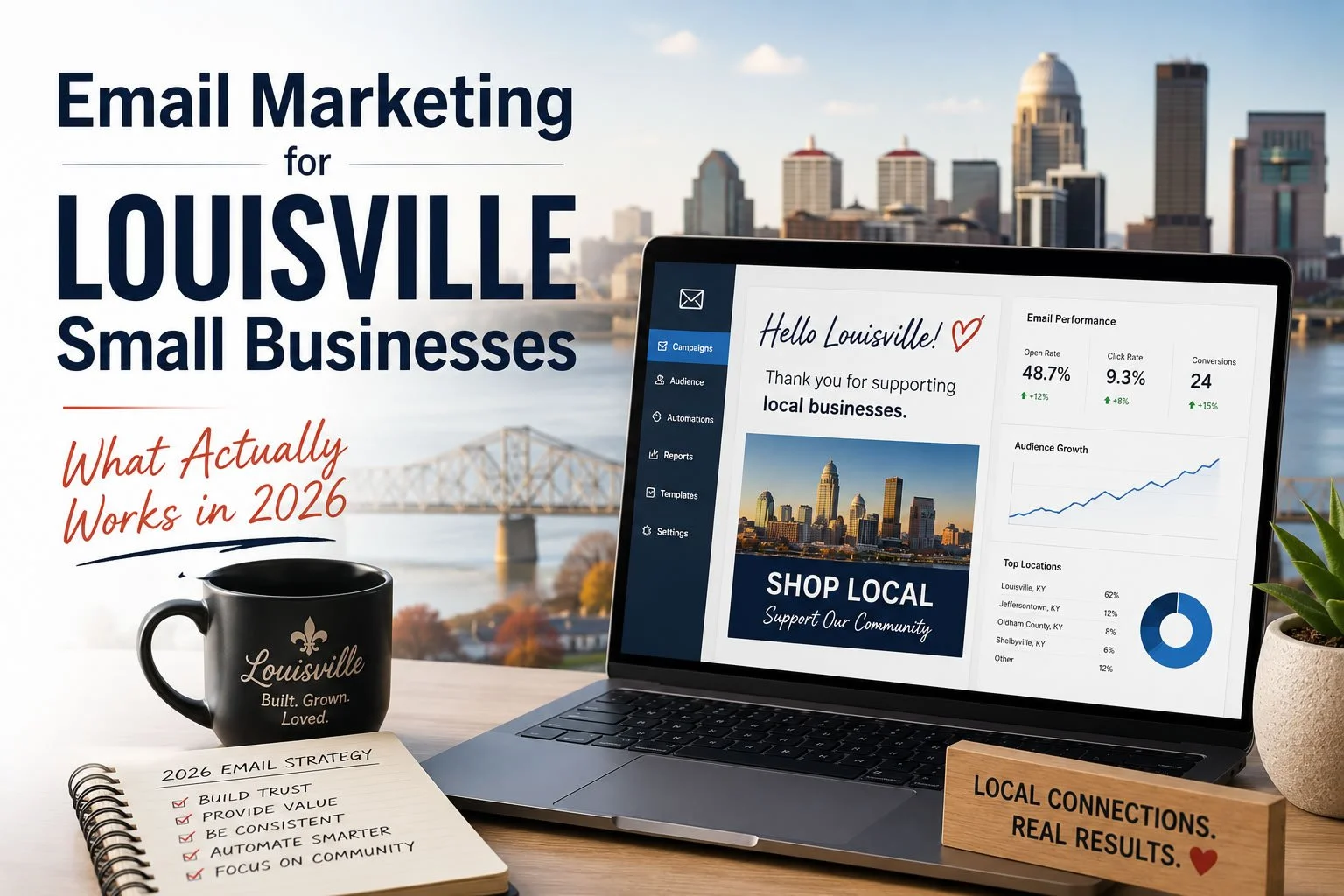
Email marketing for Louisville small businesses delivers the highest ROI of any digital marketing channel, averaging $36 for every $1 spent. Email reaches 100% of your subscriber list, compared to the 2% to 10% organic reach that most social media posts generate. For Louisville small businesses without large marketing budgets, email is the owned channel that keeps working regardless of algorithm changes on social platforms. Bernie Fussenegger at B2The7 works with Louisville small businesses on email strategy and execution as part of a broader digital marketing approach.
Email marketing works for Louisville small businesses when it's sent consistently, written for a specific reader instead of a generic list, and backed by a real welcome sequence. The channel averages $36 in revenue per $1 spent and reaches 100% of your subscriber list. Most businesses that say email "doesn't work" are dealing with a consistency, list quality, or copy problem, not a channel problem.
I ran email programs at Papa John's. At the scale that the organization was operating, email was one of the highest-performing channels we had, not because of some advanced technical setup, but because it is the one channel where you own the relationship. You are not renting attention from a social platform that can change its algorithm next week. You are talking directly to people who asked to hear from you.
I see a lot of Louisville small businesses either not doing email at all or doing it in a way that guarantees it will not work. One newsletter a month is sent to a list they haven't cleaned in 2 years, written the same way for every subscriber, with a generic subject line.
That is not email marketing. That is sending emails.
Here is the honest version of what actually works for a Louisville small business in 2026, and what the problems usually are when it doesn't.
What You Will Learn
- Why email consistently outperforms social media for actual conversions, with the numbers behind it
- The specific things small businesses get wrong that explain why their email is not performing
- What a realistic email setup looks like for a Louisville small business without a marketing team
- How often to send, what to say, and what to track
- When email marketing pays for itself and when it does not
Why Email Still Beats Everything Else on ROI
average ROI per $1 spent on email marketing across all industries. For retail and e-commerce businesses, it goes up to $45. (Litmus / DMA)
Those numbers are cited everywhere, and they are contested by people who point out that they come from surveys run by email platforms with a financial interest in you believing email is magic.
Fair enough. The actual holdout-tested ROI is probably closer to 12 to 1 once you account for the fact that some of that revenue would have happened anyway through other channels. But even 12-to-1 is an excellent return on a marketing channel.
And here is the number that matters more than any ROI stat. Email reaches 100% of your subscriber list. A social media post on your business page reaches 2% to 10% of your followers, depending on the platform and your engagement history. When you send an email, everyone on your list receives it in their inbox.
They might not open it. But it gets there.
That is the fundamental advantage email has over every algorithm-dependent channel. You are not asking a platform to decide who sees your content. You are sending it directly.
What Louisville Small Businesses Are Getting Wrong
A survey of over 1,200 small business owners found that 79% say email marketing is important to their strategy. Only 60% say it is actually working for them. That 19-point gap is where most of the frustration lives.
The businesses that are not seeing results share consistent patterns.
No Consistent Sending Schedule
Send once a month when you remember; nothing in November or December because you got busy, then try to reconnect in January. Your list no longer knows who you are. Your open rates collapse. You assume email does not work. Email worked fine. The sending schedule did not.
Copywritten for Everyone, Which Means It Lands for No One
Generic emails that any business could have written in any category get deleted. An email that reads like it was written specifically for the person getting it, referencing a specific situation, service, or Louisville context, gets opened and clicked.
No Automated Welcome Sequence
The first email someone receives after signing up for your list is the most important one. Welcome email open rates average 69%, compared to around 20% for regular newsletters. Most small businesses either send no welcome email or send a generic message and then add the new subscriber to the same list as everyone else.
A List That Has Never Been Cleaned
A list full of people who stopped opening your emails two years ago drags down your deliverability. Email platforms use engagement rates across your list to decide whether to deliver your emails. A 20% open rate on a clean, engaged list performs better than a 10% rate on a bloated list three times the size.
What a Realistic Email Setup Looks Like
I am not going to tell you to use a specific platform because it genuinely depends on what you are already using. Mailchimp, Klaviyo, ConvertKit, ActiveCampaign, and others all work. Pick the one that connects to your existing systems without requiring a second job to maintain.
Here is the minimum viable email setup for a Louisville small business.
A Welcome Sequence
Three emails are sent over the first two weeks after someone subscribes. Email one: who you are and what they can expect. Email two: something genuinely useful, a tip, a resource, a piece of content that demonstrates your expertise. Email three: an invitation to engage, book a call, visit the site, and reply to this email with a question. These three emails run automatically and convert subscribers into relationships before you ever send a regular newsletter.
A Consistent Regular Send
Once a week or once every two weeks. Pick a frequency you can maintain without sacrificing content quality. The businesses seeing the best email ROI tend to send one to two times per week, but a well-written monthly email beats a poorly executed weekly one every time.
Segmentation, Even Basic Segmentation
At a minimum, separate customers from prospects. A customer who has already bought from you should not receive the same email as someone who signed up from a form and has never spent money. One message that treats these two groups identically is usually not serving either one well.
What to Actually Put in Your Emails
This is where most email advice gets too general to be useful. So let me be specific.
The best-performing small business emails share a few consistent characteristics. They are written in a single voice, usually the owner's voice, not a corporate marketing voice. They address one thing, not five things. They have a clear reason for being sent right now, not just because it is Tuesday. And they are short enough that someone on their phone during lunch can actually finish reading them.
For a Louisville business specifically, local context helps. Mentioning something specific to Louisville, a local event, a season, or a reference your customers will recognize signals that this is not a generic blast. It was written by someone who is actually here. That builds the kind of trust that makes people open the next one.
One thing you want the reader to do. That clarity is the difference between an email that drives action and one that gets archived.
And the emails that convert are the ones with one clear call to action. Not three links, two buttons, and a sidebar.
What to Track
Track open rate, click rate, and conversion rate. But understand what each one tells you.
Open rate tells you whether your subject line and send timing are working. Industry averages hover around 20% to 21% for most categories. If you are hitting that or above, your deliverability and subject lines are fine. Below 15% consistently, and you have a problem worth investigating.
Click rate tells you whether the content and call to action are compelling. An average of 2% to 3% on your list is normal. Above 5% consistently, and you are doing something right that is worth understanding and repeating.
Conversion rate is the one that actually matters for revenue. Track what people do after they click. Do they book? Buy? Fill out a form? That is the number that tells you whether email is working as a business channel.
One thing worth noting. If you are building your email list through your website and social content, the visibility of articles on this site connects directly to list growth. The more people find you through search and AI discovery, the larger the audience you have to convert into email subscribers. I covered this in more detail in what AI search actually knows about your business, since the same visibility problem feeds both your traffic and your list.
Frequently Asked Questions
Yes, and the data is consistent across industries. Email marketing averages $36 in revenue per $1 spent and reaches 100% of your subscriber list, compared to 2% to 10% for organic social media posts. The businesses that say email is not working for them are usually dealing with a consistency problem, a list quality problem, or copy that is too generic to get opened. The channel works. The execution is usually where the problem is.
Once a week or once every two weeks is the frequency that shows the highest consistent engagement for most small businesses without a dedicated marketing team. Research tracking email ROI by frequency found that 5 to 8 emails per month showed the highest overall returns for consumer-facing businesses. But the right frequency is the highest rate you can maintain at a consistent quality level. A well-written email every two weeks outperforms a rushed, generic email every week.
The welcome email. People who just signed up for your list are more likely to open an email in the first 24 to 48 hours than at any other point in the relationship. Welcome email open rates average 69%, compared to around 20% for regular newsletters. A three-email welcome sequence that introduces your business, delivers something genuinely useful, and invites engagement converts new subscribers into actual relationships before your regular content ever reaches them.
Start with the people you already know. Import existing customers with their permission. Add a simple signup form to your website, ideally on the homepage and any high-traffic pages. Mention your newsletter in your social media profiles and posts. Offer something useful in exchange for the signup, not a discount necessarily, but content, a guide, early access, something relevant to why they would want to hear from you. List growth is slow, and that is fine. A small, engaged list of Louisville customers who want to hear from you is worth more than a large list of people who forget who you are.
Use whatever connects to the systems you already have without requiring significant technical setup to maintain. Mailchimp is the most widely used for small businesses and offers a free tier for lists of up to 500 contacts. ConvertKit and ActiveCampaign are better if you are doing more complex automation or selling digital products. Klaviyo is strong for e-commerce. The platform matters less than having a consistent sending schedule, clean copy, and a list of people who actually wanted to sign up.
The Bottom Line
Email is the marketing channel Louisville small businesses underinvest in, while spending more time and money on social platforms that reach only a fraction of their audience. I wrote about that broader visibility gap in why Louisville small businesses are invisible online, and email is one of the fastest, cheapest ways to close it.
The ROI is real. The 100% inbox delivery is real. The ability to own your audience regardless of what any algorithm decides next week is real. None of that requires a large budget or a complex technical setup.
What it requires is a consistent schedule, copy written for real people rather than a generic audience, and the discipline to keep showing up in people's inboxes with something worth reading.
B2The7 works with Louisville small businesses on email marketing strategy and execution as part of a complete digital marketing approach.
Work With Bernie →Marketing news and practical strategy for Louisville small business owners. See what a good small business newsletter actually looks like.
Get the Newsletter