Digital Marketing News: What Changed in September 2026
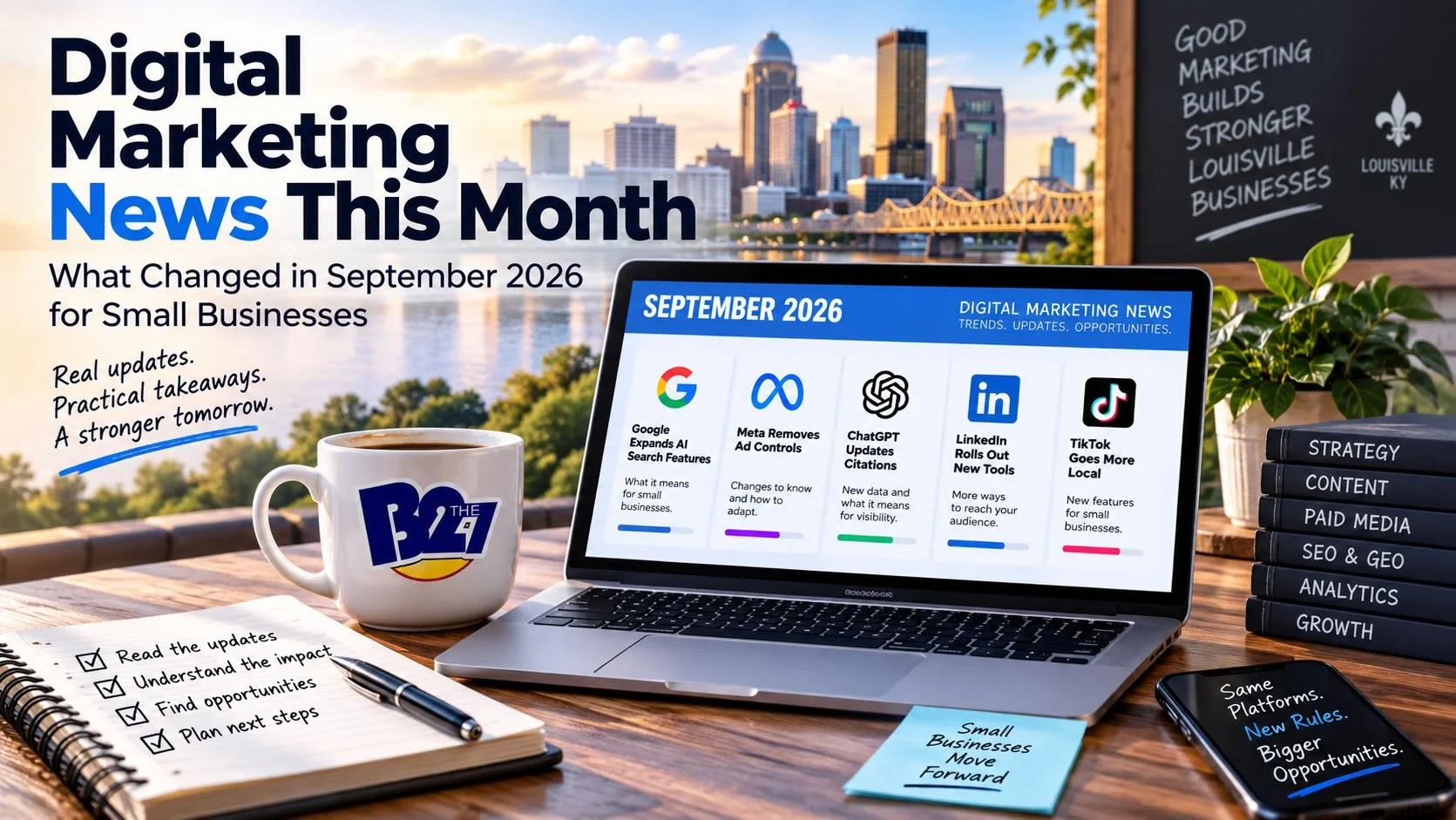
Four platform changes hit small business marketing at the turn of September 2026, and hardly anyone got a loud heads up about any of them. Here is what moved in Google Ads, Meta Ads Manager, Android voice search and ChatGPT, what each one means for a small budget, and the fifteen minute Friday check that catches this stuff early.
The digital marketing news that matters for small businesses this month is four platform shifts that landed between mid-August and the first week of September 2026. Google began moving certain Search campaigns to AI Max, Meta started pulling placement exclusions out of ad sets, Gemini began replacing Google Assistant on Android, and new tracking data showed ChatGPT citing Reddit far less. None of it is a crisis. All of it is worth a look before your next ad budget or content decision.
What You Will Learn
How I Read Marketing News Now
Most digital marketing news is written for people who sell software, or for people who are afraid of missing something. I've read plenty of it and written plenty of it, so I'm allowed to say that.
What I do now is simpler. When something changes, I ask who it costs, who it pays, and whether anybody bothered to tell the small business owner. That last question turned out to be the most revealing one this month, because the thread running through all four changes below is that things moved and the announcements were quiet. If you missed them, you're in good company.
And if you're new here, I keep a running version of this every week in my marketing trends roundups. This post is the September edition, boiled down to what a small business can actually use.
Google AdsChange One: Google Moves Some Search Campaigns to AI Max
The biggest shift of September started on the first of the month. Google began automatically migrating certain Search ad campaigns to AI Max, its AI-powered campaign system. It's the campaigns still running campaign-level broad match or automatically created assets, and the switch happens in place, one campaign at a time, through the end of September.
Google did announce it. There was a Google Ads blog post back in June, and notices show up inside the account. But I'll be straight about how this lands for a small advertiser. If you run a campaign and haven't logged in since summer, it may not be the same campaign anymore. Maybe results improve. Maybe they don't. What bothers me isn't the technology. It's that you'd find out by accident, probably when a monthly number looks strange.
So look. Pull the last four weeks of search terms, cost per lead and conversion counts, and compare them against the four weeks before. If something moved after September 1, that's your answer. And since the rollout runs all month, check again once October starts. My guide to paid media strategy for small business in 2026 explains how I think about spend, and my July roundup on AI Mode ads, GA4 and AI traffic shows this didn't come out of nowhere.
Meta AdsChange Two: Meta Removes Placement Exclusion Controls
Around the same time, Meta started taking placement exclusions out of ad sets in Ads Manager. Those controls let you keep your ads off certain placements you'd decided weren't worth paying for, like Audience Network. It's rolling out account by account with an in-app notice and no firm date, so yours may or may not show it yet.
Now, I don't know Meta's reasoning, and I won't pretend to. The pitch is probably that the system finds the best placement by itself. Sometimes it does. But if your budget is a few hundred dollars a month, you can't afford the system's education. You pay for every experiment it runs.
So watch where the money goes for two weeks. Open the placement report. If one placement eats budget and returns nothing, you'll have fewer ways to shut it off. The ad set checkbox is going away, which leaves creative, targeting, and the account-level Placement Controls under Advertising Settings. That last one applies to every campaign in the account, so use it carefully. I cover how I run these campaigns on my social media marketing page, and if you're local, social media advertising for Louisville small businesses is written for exactly that situation.
Voice SearchChange Three: Google Assistant Becomes Gemini on Android
Google began officially replacing Google Assistant with Gemini on Android devices on September 4, and the switch rolls out over several weeks. On the surface it's a rename, and a small one. But it changes what happens when someone speaks a question into their phone.
Assistant-style questions were short and functional. "Plumber near me." Gemini invites longer, more conversational questions, and it answers with generated responses instead of a list of links. My read, and it's only a read, is that more of your customers will ask full questions out loud and get one answer back.
That's an argument for content that answers full questions in plain words. It's why I keep pushing quality blog content that gets used in AI Overviews, and why I explain SEO, GEO and AEO side by side. If your site is nothing but service pages with keywords stacked in a row, a conversational assistant has almost nothing to quote. For the mechanics, I walked through how small businesses get cited in Google AI Overviews last month.
One more thing on this. Content written for AI tools tends to fall flat when it's written for AI tools. Write for the customer who has the question, and the tools tend to follow. That's been true of Google for twenty years and I don't see why it would flip now.
AI SearchChange Four: ChatGPT Cites Reddit Far Less
Promptwatch, an AI tracking tool, reported that Reddit's share of ChatGPT Search citations fell about 86 percent in mid-August, from 3.8 percent to roughly half a percent. Promptwatch calls the number provisional, and OpenAI says ChatGPT still cites Reddit. Still, if you spent the past year believing Reddit threads were your way into AI answers, that one stings.
What I took from it, and from the research around it, is that AI tools seem to be getting better at preferring specific, attributed content over generic pieces pulled together from everywhere. Content that says who wrote it, what they know, and where the numbers came from. That's good news for a small business, because you can be specific about your own work in a way a giant aggregator never will.
If you want to see what these tools say about you today, start with what AI search knows about your business, run the free AI search visibility check, and read my guide on getting your brand recommended by AI search.
Why Small Advertisers Notice Last
Bigger advertisers often have an account rep, or an agency with a direct line to one, and somebody there hears about a change before it shows up in a report. You probably don't have that. You have a login, a credit card and a lot of other things to do.
That gap is the real cost of quiet updates. It isn't that automation is bad. It's that the people with the most to lose from a surprise are the people least likely to hear about it early. This pattern isn't new, and it hasn't gotten any kinder to small budgets.
The people with the most to lose from a surprise are the people least likely to hear about it early.
So build your own early warning. Put a repeating Friday reminder on your calendar. Open each ad account, look at last week against the week before, and write one line about anything odd. That's the whole system. It's dull, and it works better than any tool I could sell you.
What These Four Changes Have in Common
Every one of them points the same way. More automation, more AI sitting in the middle of discovery, and a higher premium on specific, attributable content. Platforms are deciding more for you. Search tools are answering more for you.
Where does that leave a small business? Not helpless. But you can't set it and forget it anymore, and a quiet platform isn't a stable platform. Somebody has to check. On a small team that somebody is you, for fifteen minutes on a Friday.
What I'd Check This Week
- Google Ads: compare cost per lead and search terms from before and after September 1
- Meta Ads Manager: read the placement report and see where the money went
- Your website: does at least one page answer a full question in plain words?
- ChatGPT and Gemini: ask who they'd recommend for your service, and write down the answer
If the four changes still feel like a lot, pick one. I'd start with the ad settings, since that's where money leaves your account. The AI visibility check costs nothing but a little pride, so do that second.
Frequently Asked Questions
Google migrating certain Search campaigns to AI Max starting September 1 is the one I'd look at first. It happens automatically, most small advertisers never saw the notice, and it touches ad spend directly.
It's Google's AI-powered campaign system for Search advertising, and it replaces older setups like campaign-level broad match. I'd verify the details inside your own account, since what it does to one campaign can look different from another.
Not automatically. But you should check. Compare results before and after the change, and adjust only if something moved the wrong way. Changing things blindly costs money too.
It likely means more conversational questions and more generated answers. Content that answers full questions in plain language gives an assistant something to work with.
Weekly is enough for most small businesses. My newsletter for busy business owners covers the changes that matter, and the News and Blog has the longer versions.
Conclusion
September opened with four changes landing almost on top of each other, and I'd guess most business owners haven't heard about any of them. That's really the story. Nothing exploded. Things shifted quietly, and the businesses that check their accounts and their AI visibility catch problems early while everybody else finds out through a bad month.
Fifteen minutes on a Friday is enough. If you'd like help building that habit, or you want someone to look at your ads with fresh eyes, reach out or see how I handle digital strategy planning.
Get a Fresh Set of Eyes
I'll look at your Google Ads, your Meta placements and what AI search says about you, then tell you plainly what changed and what to do about it. One strategist, no agency markup.
Work With BernieGet the Weekly Version
The platform changes that matter, in plain language, for busy small business owners. No filler. Straight to your inbox.
Subscribe FreeBernie Fussenegger is a Louisville-based digital marketing strategist who helps small businesses get found on Google and inside AI search results. He has built marketing programs for companies including Papa John's and Confluent Health and now works with small businesses that need enterprise-level thinking at a scale that actually fits them. Find him at b2the7.com.