Paid Media Strategy for Small Businesses in 2026
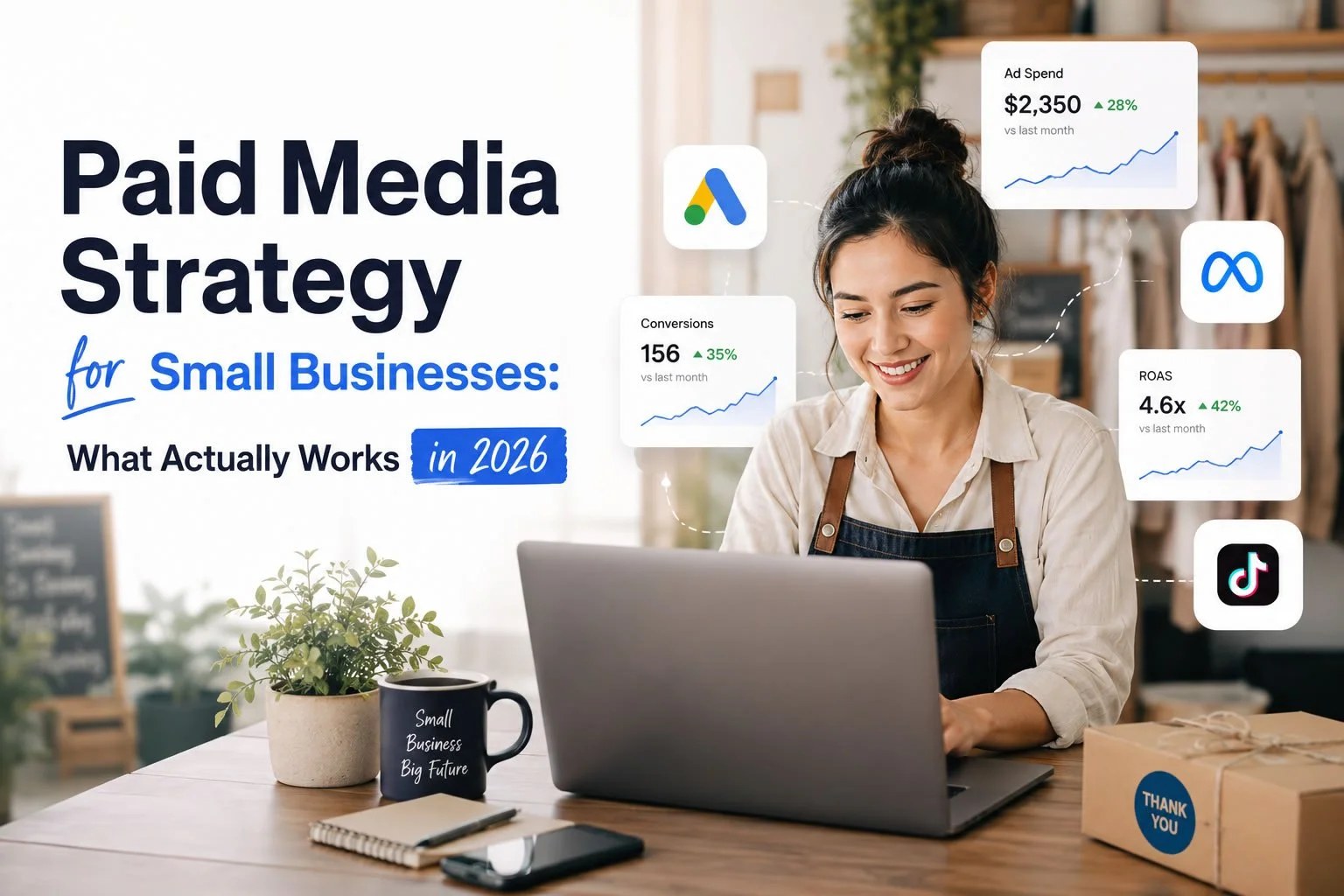
Paid media strategy for small businesses in 2026 means running intentional paid social campaigns on Meta or LinkedIn with a specific offer, a defined audience, and a clear conversion goal. It is not boosting posts. It is not running awareness campaigns on a $200 budget. Bernie Fussenegger at B2The7 has run paid media at national scale and now builds paid programs for Louisville small businesses without agency overhead.
Quick Answer
The businesses getting the best results from paid social in 2026 are keeping things simple. They are using Meta's Advantage+ campaigns, starting with a modest budget of $10 to $30 a day, trying different ads to see what people actually respond to, and only increasing spend on the ones that produce results. Most importantly, they are measuring real conversions like leads and sales instead of getting excited about impressions or clicks alone.
I supported paid media at Papa John's, where we managed millions of dollars in advertising across different channels and markets. Every campaign had to earn its budget. If it wasn't driving results, we changed it or shut it down. That's where I learned that paid media isn't all that complicated. The hard part is getting the basics right, because when you don't, it's easy to spend a lot of money without much to show for it.
And small businesses get the basics wrong in very predictable ways.
Most of the small businesses in Louisville I talk to have tried paid social before. They boosted a post. They got likes. Nobody bought anything. They decided it did not work and moved on. That is not a paid media failure. That is not even paid media. That is a feature Meta offers to collect money from people who do not know the difference.
Here is the honest version of what paid media strategy actually looks like for a small business in 2026.
What You Will Learn
The real difference between boosting a post and running a paid media campaign
When paid social makes sense for a small business and when it does not
What the right campaign structure looks like in Meta in 2026 without overcomplicating it
How much you actually need to spend to get useful data and what to do with it
What works for local businesses specifically versus what works for e-commerce brands
Whether to start with Google Ads or Meta Ads, and why the answer is usually Meta
Boosting a Post Is Not Advertising
Let me get this out of the way first because it saves a lot of wasted money.
The blue Boost Post button on Facebook and Instagram is a product that Meta designed for people who want to feel like they are advertising without understanding how advertising works. When you boost a post, Meta optimizes for reach and engagement, not for sales, leads, or any action that moves your business forward. You get impressions. You get likes. You get comments from accounts that are not your customers. And you spend money on all of it.
Boosting is not a paid media failure. It is not even paid media.
If you've only boosted posts, Meta Ads Manager will feel different the first time you use it. Before you spend a dollar, you have to decide what success looks like. Are you trying to get leads? Sell a product? Get someone to schedule an appointment? Once you know that, you either tell Meta who you want to reach or let it find people who are likely to take that action. Then you add conversion tracking so you can see what people actually do after they click your ad.
I've watched businesses use the exact same ad as both a boosted post and a campaign in Ads Manager, and the results weren't even close. The boosted post picked up likes, comments, and a little extra reach. The campaign generated leads because it was built for that from the beginning. Ads Manager takes a few more minutes to set up, but when the campaign is over, you know what you got for your money instead of hoping the engagement turned into business.
When Paid Social Makes Sense for a Small Business
I am going to be direct about this because most paid media articles want you to run ads regardless of whether it makes sense for your situation.
Paid social makes sense if you have a specific offer, a defined audience, and a clear conversion goal. A seasonal promotion, a new service launch, a specific event, or a product that has a deadline. Something where you can say, "I want this person to do this specific thing by this specific date."
Paid social does not make sense if you are trying to build general awareness for a business that does not yet have a working offer. It does not make sense as a substitute for having content or a website that converts. And it does not make sense on a budget below about $300 a month, because below that threshold, you cannot generate enough data to make meaningful decisions about what is working and what is not.
It also does not replace the organic presence and search visibility that SEO and content build over time. The Louisville visibility article on this site covers why search visibility has to come first for most small businesses, and paid social layers on top of it, not instead of it. The same is true of organic social. If you have not built a consistent posting rhythm yet, start with the social media strategy for Louisville small businesses before you put a dollar behind an ad.
The Right Campaign Structure in 2026
Meta's algorithm has gotten genuinely good at finding your audience if you give it the right information. The old playbook of stacking interest-based targeting into narrow audience segments to find exactly the right person is mostly obsolete. Hyper-narrow targeting limits how much the algorithm can learn, driving costs up and performance down.
What actually works now:
If you're a small business, Meta's Advantage+ is usually the best place to start. Instead of spending hours trying to build the perfect audience, you tell Meta what you're trying to accomplish, upload your ad, set a budget, and let it do the heavy lifting. It automatically tests different audiences, placements, and combinations to find what performs best. For most small businesses that don't have someone managing ads every day, it's a simpler approach and, more often than not, it delivers better results than trying to manage everything by hand.
One of the biggest shifts over the past few years is how much the creative matters. You don't have to spend hours building a super-specific audience if the ad itself is strong. A good headline, a clear message, and visuals that catch someone's attention will do a lot of the work. Meta is pretty good at finding the right people these days. Your job is to give them something that's worth stopping for.
If your goal is leads or sales, use the corresponding campaign objective. Traffic campaigns get you website visits from people who may have no intention of buying. Conversion campaigns optimize for the action that matters, and they cost more per click but deliver a far better visitor-to-buyer ratio.
The Meta Pixel and Conversions API need to be set up correctly before you run any campaign. Without tracking, you are flying blind. You cannot tell which ad produced a lead or sale. You cannot scale what you do not know works. This is a 30-minute technical setup that most businesses skip, only to wonder why their ads are not profitable.
What to Spend and What to Expect
The honest answer on budget is that $10 to $30 per day per ad set is a reasonable starting point. That is $300 to $900 per month for a single campaign. Below $300 a month, you cannot generate enough data in a reasonable time period to make optimization decisions.
What to expect in the first two to four weeks is a learning phase. Meta's algorithm needs time and conversion events to figure out who to show your ads to. Performance during the learning phase is not predictive. Do not make major changes during this window. Let it run.
After the learning phase, you should start to see which creative is performing, what your cost per lead or sale looks like, and whether your offer is resonating with the audience. If your cost per lead is 10x what you expected, the problem is usually the offer or the creative, not the platform.
For local service businesses specifically, the local targeting on Meta is genuinely powerful. You can target people within a specific radius of Louisville, at specific income levels, with specific interest signals. A well-targeted local campaign on a $500 monthly budget regularly outperforms a national campaign on five times that, because the audience is specific and the message can be localized.
Google Ads vs. Meta Ads for a Small Business
This comes up a lot, and the honest answer is they do different things.
Google Ads captures demand that already exists. Someone types in "digital marketing consultant Louisville" and sees your ad. That person is actively looking. The conversion rate is high. The cost per click is also higher because every other business in your category is competing for the same intent.
Meta Ads are different because you're putting your message in front of people who weren't actively looking for you. They might be scrolling through Facebook or Instagram when your ad catches their attention. If the creative stands out and the offer makes sense, they'll click. That's one reason clicks are often less expensive than search ads. The tradeoff is that it usually takes a little longer to turn that click into a customer because you introduced the idea instead of responding to someone who was already searching for it.
For most small businesses just starting with paid media, Meta makes sense to start with first because the lower cost per click gives you more data per dollar. For businesses with a clear, specific offer and a local service area, the combination of local targeting and a concrete call to action on Meta is often the highest-ROI starting point.
Paid media works best as part of a broader strategy that includes SEO, content, and email. The email marketing article on this site explains why email is the highest-ROI channel for retention once paid media generates the initial lead. The two work together, not separately. That is also the thinking behind how B2The7 approaches omni-channel campaigns, where paid, organic, and email reinforce a single message instead of competing for the same budget.
Paid Media Strategy Without Agency Overhead
B2The7 builds paid media strategies for small businesses based on your specific offer, audience, and budget. No agency overhead. One senior strategist who has run paid programs at national scale.
Work With Bernie See the Marketing SuiteFrequently Asked Questions
A paid media strategy for a small business means running intentional paid advertising campaigns on platforms like Meta (Facebook and Instagram), Google, or LinkedIn, with a specific offer, a defined audience, a clear conversion goal, and conversion tracking set up to measure results. It is different from boosting posts, which optimizes for reach and engagement rather than sales or leads. A real paid media strategy is tied to a measurable business outcome, not just impressions or clicks.
If you're serious about running paid ads, it's hard to learn much on a budget below about $300 a month. There just isn't enough activity to know whether an ad is working, whether the audience is right, or whether you simply need more time. A good starting point is around $10 to $30 a day for each ad set. Once you have enough data, you can make smart decisions instead of guessing. If your offer isn't connecting or you're not tracking conversions, spending more money usually just means you'll lose it faster.
Yes, especially for local service businesses. Meta's local targeting allows you to reach people within a specific radius of your location, filter by income, interests, and behaviors, and retarget visitors to your website. A well-structured local campaign with a specific offer and clear call to action on a $500 monthly budget regularly outperforms much larger broad-audience campaigns. The key is having the right objective, proper conversion tracking, and a creative that is actually compelling to a local audience.
Advantage+ is Meta's AI-driven campaign structure that automatically handles audience targeting, placement allocation, and budget distribution. For most small businesses without a dedicated media buyer, it is the right starting point. It consistently outperforms manually built narrow audiences on smaller budgets because it gives Meta's algorithm the flexibility to find the best-performing combination of audience and placement. Use it for sales and lead-generation objectives rather than for awareness campaigns.
For most small businesses starting with paid media, Meta makes sense first. Google Ads captures existing demand, which means high intent but also higher cost per click and more competition. Meta creates demand at a lower cost per click, giving you more data per dollar to learn what works. The exception is when your business has a very specific keyword with clear buying intent and low competition, in which case Google Ads can deliver faster results. Most businesses end up using both eventually.
The Bottom Line
Paid media works when you get the basics right. Start with an offer people actually care about. Know who you're trying to reach. Make sure you're tracking what happens after someone clicks, and build the campaign around a real business goal, like leads, appointments, or sales. Everything else is just noise.
Most small businesses that say paid social does not work tried it without one or more of those fundamentals in place. The platform was not the problem.
If you want help building a paid media strategy for your business that is based on your specific offer, your specific audience, and a budget that makes sense for where you are right now, that is a conversation worth having.
Get the Newsletter
Marketing news and practical strategy for small business owners. No filler. Straight to your inbox.
Get the Newsletter Work With BernieBernie Fussenegger is a Louisville-based digital marketing strategist with senior-level experience at Papa John's, Confluent Health, and other major brands. He works directly with small businesses that need real marketing results without agency overhead. Find him at b2the7.com.