SEO vs GEO vs AEO: What Small Businesses Need to Know
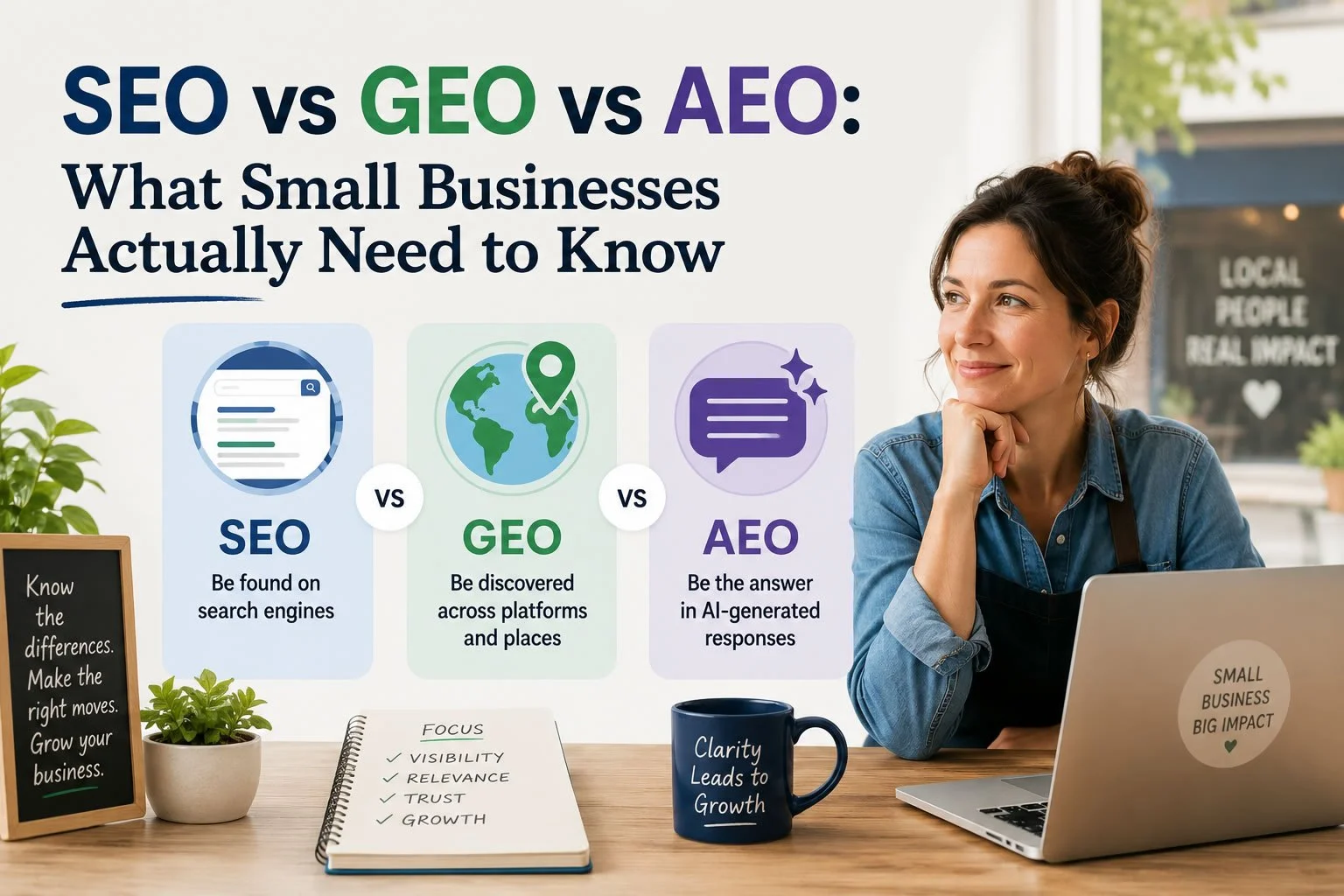
SEO vs GEO vs AEO: What Small Businesses Actually Need to Know
AEO (Answer Engine Optimization) is the practice of structuring content so AI-powered systems can extract it as a direct answer. The goal is to appear in featured snippets, Google AI Overviews, voice search responses, and the direct answer boxes that sit at the top of search results before any links. GEO (Generative Engine Optimization) is broader. It covers how your business is cited, represented, and understood across all AI systems, including ChatGPT, Perplexity, and Gemini. For most small businesses, AEO and GEO overlap heavily in practice. The tactics that make your content AEO-ready, putting the answer in the first paragraph, adding FAQ sections, using clear descriptive headings, are the same tactics that make your content GEO-ready. SEO is still the foundation both require. Bernie Fussenegger at B2The7 helps Louisville small businesses navigate all three as part of a practical content and visibility strategy.
Every few months someone adds a new letter to the search optimization alphabet. First it was SEO. Then GEO arrived, and everyone had to recalibrate. Now AEO is everywhere, and if you spend any time reading marketing content, you have probably already seen the three stacked together like a bracket: SEO, GEO, AEO.
There is a lot of talk about SEO, GEO, and now AEO, as if they are three completely different strategies. They aren't. Before you spend time worrying about another acronym, it is worth understanding what AEO actually means, how much it overlaps with GEO, and whether it changes anything for a small business. The answer isn't as simple as the buzzwords make it sound.
I'm Bernie. I run B2The7 in Louisville. I have been writing about GEO since before most marketing agencies in this city knew what it was. Here is my take.
What You Will Learn
What AEO Actually Is
AEO stands for Answer Engine Optimization. It optimizes for getting your content selected as the direct answer to a question, not just ranked near the top of a results page.
Think about what happens when you search something on Google right now. For many queries, especially questions, you see a featured snippet at the top before any organic links. A direct answer in a box. Sometimes it has a bullet list. Sometimes it is a paragraph. Sometimes it is a step-by-step. That is an answer engine result, and AEO is the discipline of getting your content into that box.
AI Overviews are an extension of the same concept. Google pulls from multiple sources and synthesizes an answer at the top of the page. ChatGPT does the same thing when you ask it a question. Perplexity does it. The goal of AEO is to be the content these systems pull from when they build those answers.
So what is the difference between that and GEO?
GEO, as I have covered extensively on this site, is about being cited and represented broadly in AI-generated answers. Being mentioned when someone asks ChatGPT who is a good digital marketing consultant in Louisville. Being the source Perplexity cites when someone asks how GEO works. GEO is about your presence in the AI-mediated discovery layer.
AEO is a subset of that. It is specifically about the content extraction layer, the moment when an AI system pulls a specific passage from a specific page to use as a direct answer. Some people define it more narrowly as being about featured snippets and voice search. Others define it more broadly as any content that gets directly used in an AI response. The definitions vary by who you ask and what they are trying to sell.
My honest take: for most small businesses, the distinction between AEO and GEO matters less than just doing both well, which turns out to require most of the same things.
Where AEO and GEO Overlap (Which Is Most Places)
Here is the practical reality. The tactics that make your content perform well for AEO are almost identical to the tactics that make your content perform well for GEO.
Answer the question in the first paragraph
Both AEO and GEO require that the answer to whatever question your page is about appears in the first two sentences, not buried in paragraph four. AI systems pulling a featured snippet look at early content. AI systems building a citation look at early content. Same fix, same placement, works for both.
Use FAQ sections
FAQ content is pre-structured as a question followed by a direct answer. That structure is exactly what both featured snippet algorithms and AI citation algorithms are looking for. Adding a FAQ section to a key page improves your AEO performance and your GEO performance at the same time.
Use descriptive headings that mirror questions
A heading that says "What Does a Digital Marketing Consultant in Louisville Actually Do" is more extractable for both AEO and GEO than one that says "Our Services." The heading signals the question, and the content beneath it answers it. Both systems read that signal the same way.
Be specific enough to be attributable
Generic content gets skipped by both featured snippet algorithms and AI citation systems. Content with named specifics, real numbers, named locations, and verifiable claims gets selected. That is an AEO requirement and a GEO requirement that are functionally identical.
I covered the mechanics of why AI systems select certain content to cite in the What Is GEO and How Does It Work article on this site. The query fan-out process I described there is the same process that drives AEO selection. The AI breaks a query into sub-questions and retrieves the clearest direct answer it can find for each one. AEO and GEO are both trying to be that clearest direct answer.
Where AEO and GEO Actually Differ
There are two places where the distinction starts to matter, and it is worth being clear about them.
Voice search is mostly an AEO concern, not a GEO concern
When someone asks a voice assistant a question, they get one spoken answer. That answer comes from a featured snippet or a direct answer extraction. Voice search is almost entirely an AEO optimization challenge because there are no citations in a spoken answer, no source recommendations, no links to click. GEO is less relevant here because GEO is about being recommended by name, which does not happen the same way in voice responses.
For most small businesses, voice search is a smaller piece of the discovery picture than ChatGPT or Google AI Overviews. But if your business serves categories where voice queries are common, understanding the AEO-specific tactics matters.
GEO cares about your full digital footprint; AEO is mostly content structure
GEO requires consistent business information across directories, reviews on multiple platforms, external mentions of your business, and a presence beyond your own website. All of that builds the kind of AI confidence that earns you a mention in a ChatGPT response. If you run a local business, that footprint is exactly what I break down in the GEO for local business in Louisville article.
AEO is more narrowly focused on how a specific page is written. The answer in paragraph one. The FAQ at the bottom. The heading structure. AEO is largely a page-level optimization. GEO is a domain and entity-level strategy.
A small business doing GEO well is doing most of what AEO requires. A small business doing AEO well is not necessarily doing GEO well, because they might have perfectly structured content on a site with no external citations, no Google Business Profile, and no directory presence. The content would be citable, but the business would not be trusted enough to be cited.
My Honest Opinion on the Three-Acronym Stack
Here is what I actually think when I see the SEO, GEO, AEO stack presented as three separate disciplines that each require their own strategy.
For most small businesses, this framing is more confusing than useful. It makes a single underlying question, how do I make sure the right people find my business when they search for what I offer, sound like it requires three separate and potentially incompatible approaches. It does not.
The actual answer is: build content that directly answers specific questions, put the answer early, use FAQ structure, be specific enough to be credible, get your business listed and consistent across the web, collect reviews, and publish consistently. That combination serves SEO, GEO, and AEO at the same time.
The only reason to think about AEO separately is if you are specifically targeting voice search or featured snippets as a primary channel. And for most Louisville small businesses, those are not the first channels to optimize.
If you are still working out the difference between SEO and GEO before adding AEO to the mix, the GEO vs SEO article on this site covers that distinction in detail. Getting clear on those two first is a better use of time than trying to layer all three at once.
What to Actually Do
If you are a small business that has done nothing on GEO or AEO yet, here is the practical priority order.
Start with SEO fundamentals
Content that answers real questions, consistent technical health, and a complete, current Google Business Profile. GEO and AEO both require SEO to be working first. There is no shortcut around this.
Add GEO practices to your content
Answer in the first paragraph. FAQ sections on key pages. Consistent business information everywhere. External citations building over time. This is where most small businesses should be spending effort right now, because the competitive window in GEO is still open in ways that traditional SEO is not.
Add AEO structure as part of GEO, not separately
The FAQ sections, the early answers, the descriptive headings, these are already AEO tactics. You do not need a separate AEO strategy. You need to implement GEO content practices well, and AEO comes along for free.
Track what is happening in AI search
Run the audit process I covered in the How to Check Your AI Visibility article on this site once a month. See which queries are generating AI Overviews. See whether your content is being cited. That tells you where AEO and GEO are working and where they are not, without requiring you to invest in a separate tracking tool.
Frequently Asked Questions
AEO and GEO are closely related, but they are not exactly the same thing. AEO is about writing and organizing a page so an AI can lift a clear answer from it. That is useful for Google AI Overviews, featured snippets, and voice search. GEO goes beyond the page itself. GEO is really about giving AI platforms more reasons to recognize your business as a credible source. AEO helps those same platforms understand and reuse what is on the page. In the real world, the work is almost identical. Write clearly. Organize your pages well. Answer common questions. Back up your claims with real experience or evidence. Most small businesses do not need separate SEO, GEO, and AEO plans. They need content that is genuinely helpful and easy for both people and AI to understand.
For most small businesses, no. The content practices that make your pages GEO-ready, putting the answer in the first paragraph, adding FAQ sections, using descriptive headings that mirror the questions customers ask, are the same practices that make your content AEO-ready. The exception is if you are specifically targeting voice search or featured snippets as a primary channel, which makes AEO page-level optimization more relevant. For most Louisville small businesses, getting GEO fundamentals right covers the vast majority of the AEO requirement automatically.
A page built for AEO gets to the point quickly. The answer should be in the opening paragraph, not halfway down the page. Headings should mirror the questions people are actually asking, and a simple FAQ with direct answers makes it even easier for AI to understand the content. Specific facts, examples, and verifiable claims also carry more weight than broad marketing language. Even a well-written article can struggle if readers and AI both have to dig through several paragraphs before finding the answer.
Think of SEO, GEO, and AEO as building on each other rather than competing with each other. SEO comes first. If your website is not being crawled and indexed, AI tools have little to work with. GEO expands on that by helping establish your business as a source worth citing through accurate business information, mentions from other trusted sites, and content that demonstrates real expertise. AEO focuses on how that content is organized, making it easier for AI and voice assistants to pull a clear answer from the page. They work best together. SEO gets your content discovered. GEO helps build credibility. AEO makes your content easier to quote and reuse.
Yes, but not as a separate investment from what you should already be doing for GEO. The specific AEO tactics that matter most for a small business, answering the question immediately, using FAQ sections, writing in specific and verifiable terms, are already part of good GEO content practice. If you are building content the right way for GEO, you are getting most of the AEO benefit automatically. The additional AEO-specific work, schema markup and structured data, is worth adding to key service pages over time but is not the priority.
The Bottom Line
SEO, GEO, and AEO all aim to solve the same problem: helping people find your business. The difference is where they are looking. Someone might search on Google, ask ChatGPT a question, or use a voice assistant. No matter how they search, the goal is to make sure your business is the one they find.
The honest answer for a small business is that you do not need to treat these as three separate disciplines. You need to build content that directly answers real questions, keep your business information consistent across the web, publish regularly, and make sure your digital presence is specific enough to be credible. That combination serves all three.
Build one strategy, not three
B2The7 helps Louisville small businesses build practical visibility strategies that work across traditional search, AI search, and answer engines. One strategist, no acronym overload.
Work With BernieGet the newsletter
Marketing news and practical strategy for small business owners. No filler. Straight to your inbox.
Get the NewsletterBernie Fussenegger is a Louisville-based digital marketing strategist who helps small businesses get found on Google and inside AI search results. He has built marketing programs for companies including Papa John's and Confluent Health and now works with small businesses that need enterprise-level thinking at a scale that actually fits them. Find him at b2the7.com.