Marketing Leadership Changes 2026: What SMBs Should Know
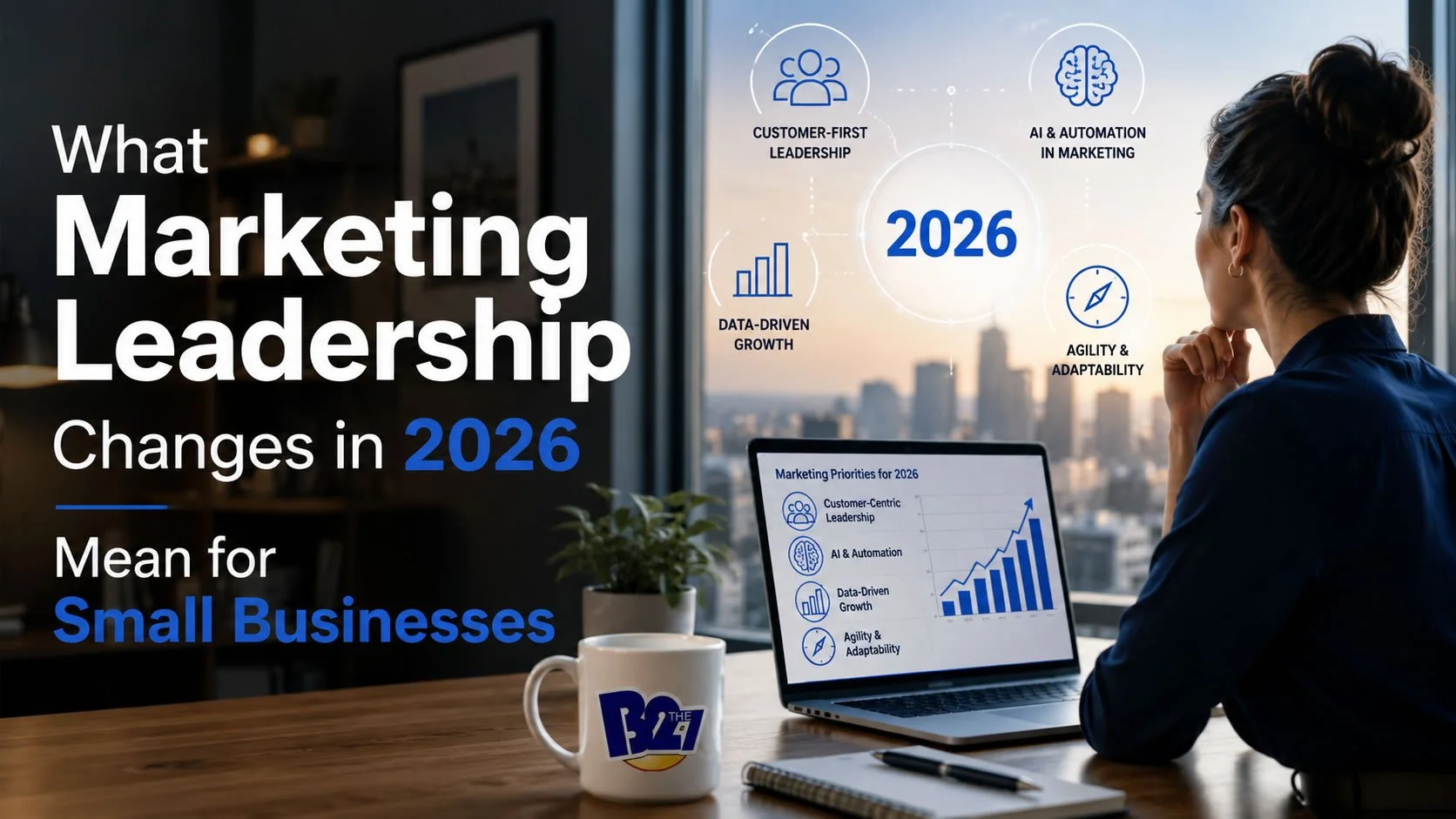
Marketing leadership at major brands is changing faster in 2026 than at any point in the last decade. CMO tenure is near record lows at under four years. AI is restructuring how large companies staff marketing. Agency retainers that used to run for years are being cut or converted to project work. For small businesses watching from the outside, the implications are specific and practical.
Quick Answer
The 2026 marketing leadership shakeup matters to small businesses in two concrete ways. First, agencies losing enterprise retainers are moving down-market and pitching small businesses on packages built for a different kind of client, so be more selective right now, not less. Second, the AI restructuring at large brands is proving that generic marketing does not work, which makes local specificity a real competitive advantage rather than a consolation prize.
What You Will Learn
What the pattern of CMO turnover and agency restructuring in 2026 actually signals about how big brands are rethinking marketing
What happens when a large company dismantles its marketing department and why it rarely ends the way they planned
What the shift to AI-driven marketing decisions means for the agencies and consultants who advise small businesses
Why enterprise-level changes open specific opportunities for small businesses right now
What a small business should take away from all of this, and what it should probably ignore
There has been a lot of CMO turnover in 2026. A lot of agency relationship restructuring. A lot of companies that spent years building large marketing departments deciding that what they built does not work as well as they thought it did.
Most of the coverage of these changes is written for the people making them. For the CMOs evaluating whether to take a severance package. For the agencies trying to figure out what a project-based model looks like versus a retainer. For the brand-side marketing directors defending their headcount.
I want to write the version for the small business owner who does not have a CMO, does not have an agency retainer, and is watching this from the outside wondering whether any of it is relevant to them.
It is. Just not in the way you might expect.
I'm Bernie. I ran marketing at Papa John's. I worked at Confluent Health. I have been inside the enterprise marketing decision-making process and I know what these leadership changes actually signal. Here is the honest interpretation for a small business owner.
What Is Actually Happening With Marketing Leadership
CMO tenure has been declining for years. The average chief marketing officer now stays in a role for under four years, down from over five years a decade ago, and exits tend to come fast when a brand's numbers miss expectations. What changed in 2026 is that the pressure is coming from a new direction.
Average CMO tenure in 2026, down from more than five a decade ago
AI is restructuring the job. Not in a theoretical future sense. In a right now sense. Large brands are discovering that certain marketing functions they used to staff heavily, content production, certain analytics work, routine campaign management, can now be handled faster and cheaper by AI systems. So the question for a CMO is not just how to hit this quarter's numbers. It is how to justify the size and structure of a team in a world where significant parts of what that team does can be automated.
Most CMOs are not winning that argument. Companies are restructuring. Headcount is getting cut. And the agencies that used to benefit from large brand retainers are finding that those retainers are getting renegotiated down or cut entirely in favor of project-based work.
This is not a crisis for marketing. It is a correction. The restructuring is painful for the people inside it, but it is making the function more honest.
The enterprise marketing apparatus that built up over the last twenty years was, in a lot of cases, significantly overstaffed for the outcomes it produced.
What This Means for the Agencies That Advise Small Businesses
Here is where it gets relevant for Louisville small businesses specifically.
The agencies losing large brand retainers do not just disappear. They look for revenue elsewhere. And a lot of them are looking down-market. Agencies that used to only work with brands spending five to ten million a year on marketing are now pitching small businesses for ten to twenty thousand a year. They are using the same pitch they used with the big brands. Strategy, creative, media, reporting. The whole package.
Agency packages aren't necessarily the problem. They're just built for a different kind of client. Larger companies usually have an experienced marketing leader managing the relationship and holding the agency accountable. Most small businesses don't. They sign the contract, trust the process, and a few months later they're looking at charts, dashboards, and reports without knowing whether any of it has brought in more customers.
I covered this dynamic in detail in the consultant versus agency article on this site. The short version is that the agency model built for enterprise clients does not translate to small business needs. The marketing leadership changes of 2026 are sending more agencies downstream into the small business market, which means small business owners need to be more discerning right now, not less.
What the AI Restructuring Means for Small Business Marketing
Here is the part that I think is genuinely good news for small businesses that are paying attention.
Large brands are cutting headcount partly because AI can do certain marketing tasks faster and cheaper than humans. Content production at scale. Certain analytics workflows. Routine campaign management. They are right that AI handles these things well.
But what AI does not do well is the thing that actually drives results for a small business. Specific knowledge of a specific market. Real relationships with real customers. A genuine point of view that reflects actual experience rather than pattern-matching across training data.
The enterprise marketing restructuring is discovering this the hard way. AI content that could have been written by anyone, because it was. Generic campaigns that hit no one specifically, because they were designed for no one specifically. Reporting that looks comprehensive but does not tell anyone what to actually do differently.
For a small Louisville business, the answer has always been specificity. The Louisville restaurant that knows its neighborhood. The local consultant who has actually run programs at the brands its clients aspire to. The photographer who was physically at Valhalla during the PGA Championship. These are forms of knowledge and credibility that AI cannot synthesize and that large brand marketing budgets are discovering they cannot buy back.
I have made this argument in the context of AI search visibility specifically, in the GEO articles on this site. The same principle applies here. What AI search tools reward is the same thing that good marketing has always required: genuine expertise, genuine specificity, a genuine reason to trust the source.
What the Collapse of Agency Retainers Means
In addition to cutting headcount, a lot of brands are canceling or dramatically reducing agency retainers. This is the second structural change worth paying attention to.
For years, agencies were built around monthly retainers. A business paid the same amount every month, the agency handled an agreed-upon list of services, and the relationship often lasted for years. There was nothing wrong with that model when marketing plans stayed relatively consistent.
Things don't stay the same long enough to justify a "set it and forget it" marketing plan anymore. Budgets shift. Priorities change. New channels pop up while others lose momentum. Companies want to be able to react without feeling tied to a contract that was signed months ago. That's one reason more businesses are choosing flexible project work over the traditional agency retainer.
So they are shifting to project-based engagements. Hire an agency to build a campaign. Pay for specific deliverables. Evaluate based on outcomes. Move on or extend based on what the results actually show.
For small businesses, this is actually how the better marketing relationships have always worked. You hire someone to solve a specific problem. You measure whether the problem got solved. You decide whether to continue based on evidence rather than relationship inertia. It is the same logic behind running a paid media campaign with a specific offer and a defined conversion goal instead of boosting posts and hoping. Define the outcome first, then spend against it.
The enterprise market is finally catching up to what good small business marketing procurement has always looked like. That is not ironic. It is just where the incentive structure is pointing right now.
What to Actually Do With This Information
Three things are worth taking from the marketing leadership changes of 2026.
Be more skeptical of agency pitches right now, not less
More agencies are chasing small business revenue because large brand retainers are drying up. That does not mean those agencies are a good fit for a small business. Ask specifically what they have done for clients with similar budgets, similar markets, and similar goals. Ask for outcomes, not case studies.
Prioritize agility over comprehensiveness
The large brands getting hurt most by the current restructuring are the ones that built elaborate marketing infrastructure designed to be comprehensive rather than fast. A small business with one clear marketing priority and the discipline to execute it well outperforms a larger business running five channels mediocrely at the same time. If you only pick one, email is still the highest-ROI channel you actually own.
Specificity is your actual competitive advantage right now
Everything happening in enterprise marketing in 2026, the AI adoption, the agency model collapse, the CMO turnover, points to the same correction. Generic does not work anymore. Specific works. For a Louisville small business, specific means knowing your market, knowing your customers by name, and creating content and experiences that reflect that knowledge. That is the thing enterprise marketing cannot buy back with a bigger budget.
Frequently Asked Questions
If you've been around marketing for a while, you've probably noticed the shift. Companies aren't building bigger marketing departments anymore. They're looking for smaller teams that can move quickly and bring in specialists when they need them. Long-term agency contracts are getting another look, and every marketing expense has to earn its place. Nobody wants more process. They want faster decisions and measurable results. That's changing who gets hired, who gets promoted, and who keeps the business.
Two ways. First, agencies losing large brand retainers are looking for revenue downstream, which means more agencies are pitching small businesses on services designed for enterprise clients. Small businesses need to be more selective about agency relationships right now, not less. Second, the AI restructuring at large brands is confirming that generic, automated marketing produces mediocre results. That creates an opening for small businesses that lead with genuine specificity and local expertise rather than trying to compete on scale.
CMO tenure is declining primarily because the role is under pressure from two directions at once. Traditional marketing performance is harder to attribute clearly in a fragmented media environment. And AI is changing which marketing functions require senior human judgment versus which can be automated. The result is that CMOs are being asked to justify expensive infrastructure at exactly the moment when the returns on that infrastructure are hardest to prove. For small businesses without a CMO, the takeaway is that the playbook those leaders were executing is under serious scrutiny at the highest levels.
It depends on the specific situation, but be more discerning now than you might have been two years ago. More agencies are competing for small business revenue as large brand retainers dry up. That increases your options but also increases the likelihood of being sold a service package designed for a different kind of client. Focus on outcome evidence rather than portfolio impressiveness. Ask what they have achieved for businesses like yours, not what they have done for their largest clients.
It confirms what good small business marketing strategy has always required. Generic content and campaigns built for no one specifically are being exposed as ineffective at every scale. AI can produce generic content faster and cheaper than humans, which means generic content is now essentially worthless. What AI cannot do is replicate genuine local knowledge, genuine customer relationships, and a genuine point of view built from real experience. Those are the competitive advantages small businesses have always had, and they matter more now than they did before the AI restructuring began.
The Bottom Line
I've been in marketing for more than 25 years, and the questions from business leaders have changed. They used to ask how many campaigns were running or whether the budget had been spent. Now they ask what marketing actually delivered. How many customers came in? What did it cost? What would happen if we stopped doing it? That's a healthier conversation because marketing exists to grow the business, not to stay busy.
That shift creates opportunities for small businesses. You don't need a department full of specialists or a seven-figure budget to compete anymore. You need to know your customers, understand your market, and communicate better than the business down the street. Those have always been advantages for smaller companies. Now they matter even more because customers and search platforms reward businesses that are clear, specific, and credible instead of simply being the biggest.
If you're a business owner trying to figure out where to focus next, that's the conversation I enjoy having. Every business is different, and there isn't a one-size-fits-all playbook.
Let's Talk About Where to Focus
B2The7 helps Louisville small businesses build marketing strategies based on real enterprise experience, without the agency overhead or the generic playbook.
Bernie Fussenegger is a Louisville-based digital marketing strategist with senior-level experience at Papa John's, Confluent Health, and other major brands. He works directly with small businesses that need real marketing results without agency overhead. Find him at b2the7.com.