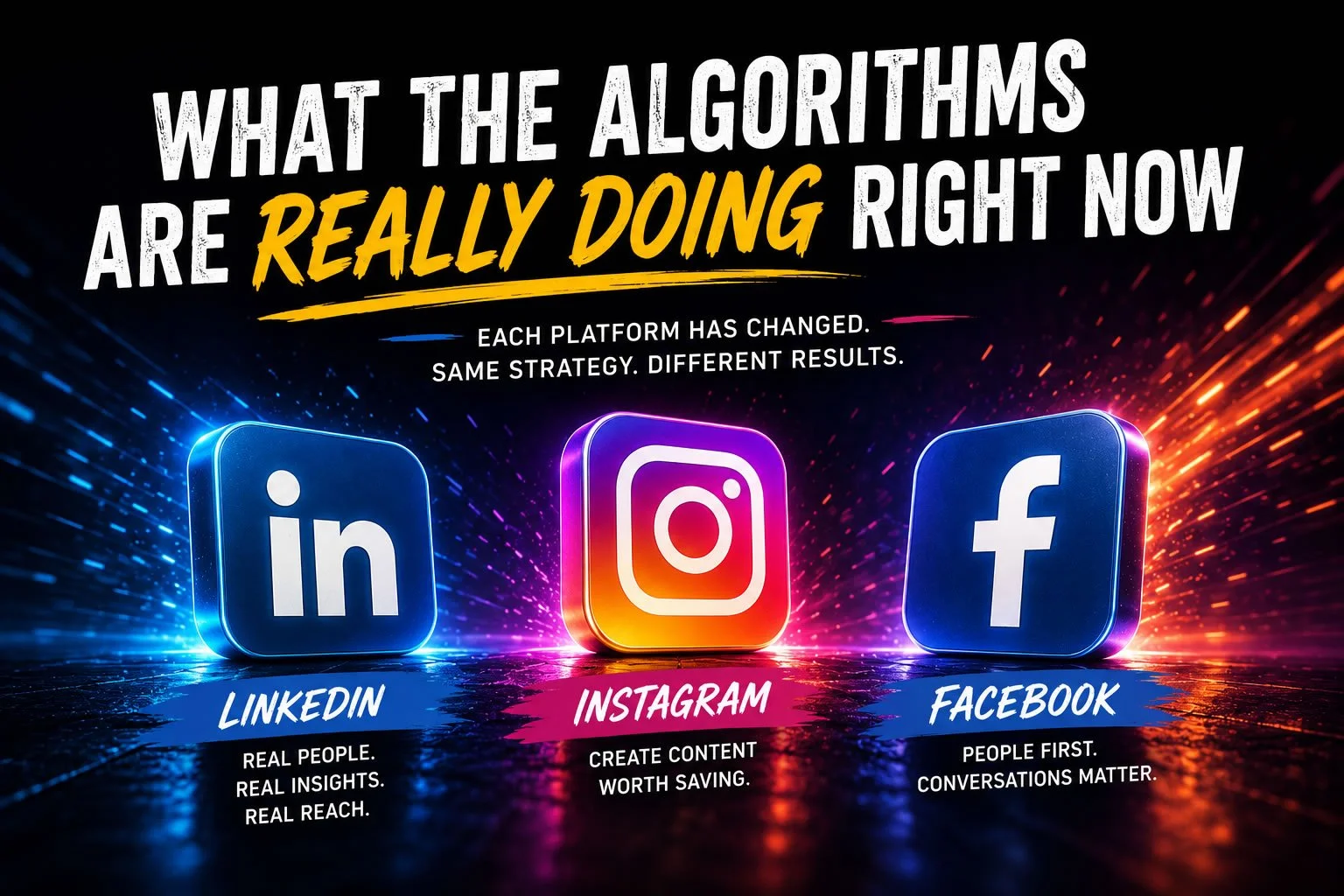
Social media strategy for small businesses in 2025 and 2026 requires understanding that LinkedIn, Instagram, and Facebook each run fundamentally different algorithms that reward fundamentally different content. LinkedIn replaced its core algorithm with an AI system called 360Brew that suppresses generic content and rewards personal profile posts from real practitioners sharing specific expertise. Instagram deprioritized likes and follower count in favor of saves, shares, and watch time on Reels. Facebook organic reach for business pages is under 5% and declining, making groups and personal profiles the primary organic distribution channels. Applying the same content strategy across all three platforms leaves significant reach on the table.
LinkedIn, Instagram, and Facebook now reward different things. LinkedIn's 360Brew AI favors specific, personal-profile posts over company pages. Instagram rewards saves and shares over likes, plus watch time on Reels. Facebook business-page organic reach is nearly dead, so groups, personal profiles, and precise paid promotion carry the load. The one move that works on all three at once: post from the person, not from the brand.
What You Will Learn
What LinkedIn's 360Brew AI algorithm actually does, and why generic posts get suppressed
What Instagram rewards in 2025 and 2026, and how saves and shares changed the game
Why Facebook organic reach for business pages is effectively dead, and what works instead
What content format wins on each platform without running three separate content operations
The single mindset shift that makes all three platforms work better at the same time
I want to start with something that might seem obvious once I say it, but that a surprising number of small businesses have not internalized yet.
LinkedIn is not Facebook. Instagram is not LinkedIn. Facebook is not the same platform it was three years ago. And the content strategy that worked reasonably well across all three of them in 2022 or 2023 is actively working against you on at least one of them right now.
Over the last year and a half, LinkedIn, Instagram, and Facebook have all changed the way they decide what people see. If you're still using the same strategy across every platform, there's a good chance you're putting in the work without getting much back. What works on LinkedIn often falls flat on Instagram, and what gets attention on Facebook may never gain traction anywhere else.
I'm Bernie, and I run B2The7, working with Louisville small businesses on social media. I've watched these changes play out across my own accounts and the businesses I work with. Some tactics that worked a year ago barely move the needle today, while others consistently reach the right people. Here's what each platform is rewarding right now and what I'd stop wasting time on.
LinkedIn: The 360Brew Shift and What It Means
LinkedIn replaced its core recommendation algorithm with an AI system called 360Brew in late 2024. The consequences have been significant, and most people using LinkedIn for business have felt them without fully understanding the cause.
Many users noticed a dip in their LinkedIn performance toward late 2024 and into 2025. Posts that once thrived suddenly faced challenges with reach and engagement, and follower growth stalled. If you've been posting more often, writing longer captions, or upgrading your graphics without the results you expected, that's usually the platform changing under you, not something you're doing wrong.
What 360Brew is specifically designed to do is detect and suppress content that lacks genuine specificity. Content that anyone could have written. Generic advice with no real author behind it. Promotional posts that push a product or service without offering anything useful around it. Repurposed blog summaries that read like AI output.
What 360Brew rewards is the inverse. Personal profile posts from real practitioners sharing specific observations from actual work. A named person talking about a specific client situation, a specific problem they solved, a specific data point they noticed. The more attributable the content is to a real person with real experience, the better it performs.
The practical implication for a small business is that posting from your personal profile outperforms posting from your company page by a wide margin. Personal profiles receive an estimated 65% of LinkedIn's feed distribution. Company pages receive roughly 5%. If you've been putting your LinkedIn energy primarily into the company page, the algorithm is not your friend right now.
I covered the full 360Brew shift and the formats that are outperforming everything else in the LinkedIn trends article on this site. Document posts at 6.6% average engagement. Native video performing consistently. Personal profile posts beating company posts by a 13-to-1 ratio in distribution. The numbers are specific and worth reading if LinkedIn is a channel you're investing in.
Instagram: Saves and Shares Replaced Likes
Instagram's algorithm shift happened more gradually than LinkedIn's, but the outcome is just as significant for small businesses.
Likes were the primary engagement signal for most of Instagram's history. More likes meant more reach. The platform optimized for content that got an immediate emotional response, which skewed heavily toward polished aesthetics, celebrity endorsement, and content that triggered quick approval.
Likes still matter, but they're no longer the best sign that a post is doing well. What really moves the needle now is when someone saves your post to come back to later or shares it with a friend. Those actions tell Instagram the content was actually useful, not just something people glanced at while scrolling. If your posts consistently give people a reason to save or share, they usually reach more people over time.
Watch time on Reels is the third major signal. Instagram prioritizes Reels that hold attention all the way through, which means the hook in the first two seconds matters enormously. A Reel that loses 80% of its viewers in the first three seconds gets suppressed no matter how good the rest of it is.
What this means for a small business: the polished branded content that looks good but offers no specific takeaway does not generate saves. Educational content, how-to content, content that gives someone a specific piece of information they'll want to find again later, that is what gets saved. And it is what now drives distribution on Instagram.
You don't need high production values. You need specific usefulness. A Louisville restaurant that posts a Reel explaining exactly how they make one dish, with enough detail that someone would actually want to try it at home or show their friends, is doing better Instagram marketing than a restaurant posting beautiful food photography with nothing else attached to it.
Facebook: Organic Reach Is Nearly Gone, But Here Is What Works
Facebook business-page organic reach is under 5% for most accounts and trending lower. That means if you have 1,000 followers on your Facebook business page, your average post is being shown to fewer than 50 of them without paid promotion. This is not a new trend, but it has accelerated, and there's no sign it's reversing.
So what actually works on Facebook for a small business without a paid media budget?
Facebook Groups. Groups still have strong organic reach because Facebook treats them as community spaces rather than branded content surfaces. A Louisville small business that participates genuinely in relevant local Facebook groups, offering useful information rather than promotional content, generates more organic reach than the same business posting from its business page.
Personal profiles. Personal profiles on Facebook still have far better reach than business pages. The same dynamic as LinkedIn applies here. A post from a business owner's personal profile about something happening in their business, shared as a personal observation rather than a press release, reaches a much larger fraction of their network than the equivalent post from the business page.
Paid promotion with a specific offer. For reaching cold audiences on Facebook, paid promotion is now effectively required. But it works when the offer is specific and the audience targeting is precise. A boosted post that says "come check us out" is money down the drain. A targeted local campaign for a specific offer to a specific audience in Louisville is a different calculation.
I covered the specifics of paid social for small businesses, including when it makes sense and what the right campaign structure looks like, in the paid media strategy article on this site. The short version: boosting posts is not advertising. Running an Advantage Plus campaign with a conversion objective toward a specific local audience is.
The One Mindset Shift That Makes All Three Work Better
Here's the thing that cuts across all three platforms, and the one shift that makes the most difference for a small business without a dedicated social media team.
Post from the person, not from the brand.
LinkedIn rewards personal profile posts over company page posts. Instagram rewards authentic content with genuine usefulness over polished brand imagery. Facebook organic reach is essentially dead for business pages but alive for personal profiles.
The common thread is that all three platforms are currently rewarding human voices over branded voices. Not because they're trying to punish businesses, but because their users respond to people more than to logos, and their algorithms optimize for what users respond to.
A Louisville small business owner who posts regularly from their personal profile, in their own voice, about specific things happening in their actual work, is performing better on all three platforms at once than an account manager posting polished content from the business page.
This is also the dynamic that connects social media strategy to GEO and AI search visibility. The same specificity and personal voice that LinkedIn's 360Brew rewards, the same genuine expertise that Instagram's save algorithm responds to, is what AI search tools are looking for when they decide whose content to cite. The platforms are all converging on the same signal: does a real person with real experience stand behind this? If you want to see how this plays out from the AI search angle, the what AI search knows about your business article on this site covers the same dynamic.
Frequently Asked Questions
If you've noticed your company page getting less attention on LinkedIn, you're not imagining it. LinkedIn now gives far more visibility to posts from real people than to posts from business pages. That's especially true when someone shares firsthand experience instead of repeating the same advice everyone else is posting. In practice, the owner's personal profile has become one of the most valuable marketing assets a small business has. If you've learned something from doing the work, share it from your own profile. It's much more likely to be seen than the same post published by your company page.
Stop worrying so much about likes. The posts that keep getting shown are the ones people save for later or send to someone else. That usually means they're teaching something, answering a question, or showing something useful. Reels are still the best way to reach new people, especially when they get to the point right away. You don't need fancy editing or expensive equipment. Give people a reason to watch, learn something, or come back to it later.
For business pages, organic reach is under 5% and declining. It is not worth building a strategy around. What does work organically on Facebook is participation in relevant local groups as a real person offering genuine value, and posts from personal profiles rather than business pages. For reaching new audiences, paid promotion with a specific offer and proper targeting is more reliable than any organic business page strategy.
A strong idea can work on all three, but avoid copying and pasting the same post everywhere. Each platform has its own style. LinkedIn favors personal stories and industry insight. Instagram is best for Reels and visuals. Facebook thrives on personal interaction and group discussion. Keep your core message consistent, but adapt how you present it for each platform.
You don't need to post every day to stay visible. For most small businesses, posting two or three times a week on your main platform and replying to comments within a day is enough to keep your account active. Past that, the extra time you spend often doesn't produce much more in return. One thoughtful LinkedIn post from your personal profile, one Instagram Reel that shows real work, and meaningful participation in a relevant Facebook group will usually do more than filling your feeds with polished brand posts people scroll past without saving or sharing.
The Bottom Line
Over the last year and a half, LinkedIn, Instagram, and Facebook have all shifted in the same direction. Content from real people with something useful to say is getting more attention, while polished posts from brand accounts aren't reaching nearly as many people as they once did.
For a small business, that's actually good news. You have something the algorithm wants: direct experience, a real name, a genuine point of view from actual work. The question is whether you're putting it out there in the format each platform responds to, or whether you're still posting from your company page and wondering why the reach isn't there.
If you want help building a social media approach that fits your specific business and the platforms where your customers actually spend time, that's the kind of work I do directly with small businesses in Louisville.
Bernie Fussenegger is a Louisville-based digital marketing strategist with senior-level experience at Papa John's, Confluent Health, and other major brands. He works directly with small businesses that need real marketing results without agency overhead. Find him at b2the7.com.