Content Strategy That Turns Traffic Into Customers
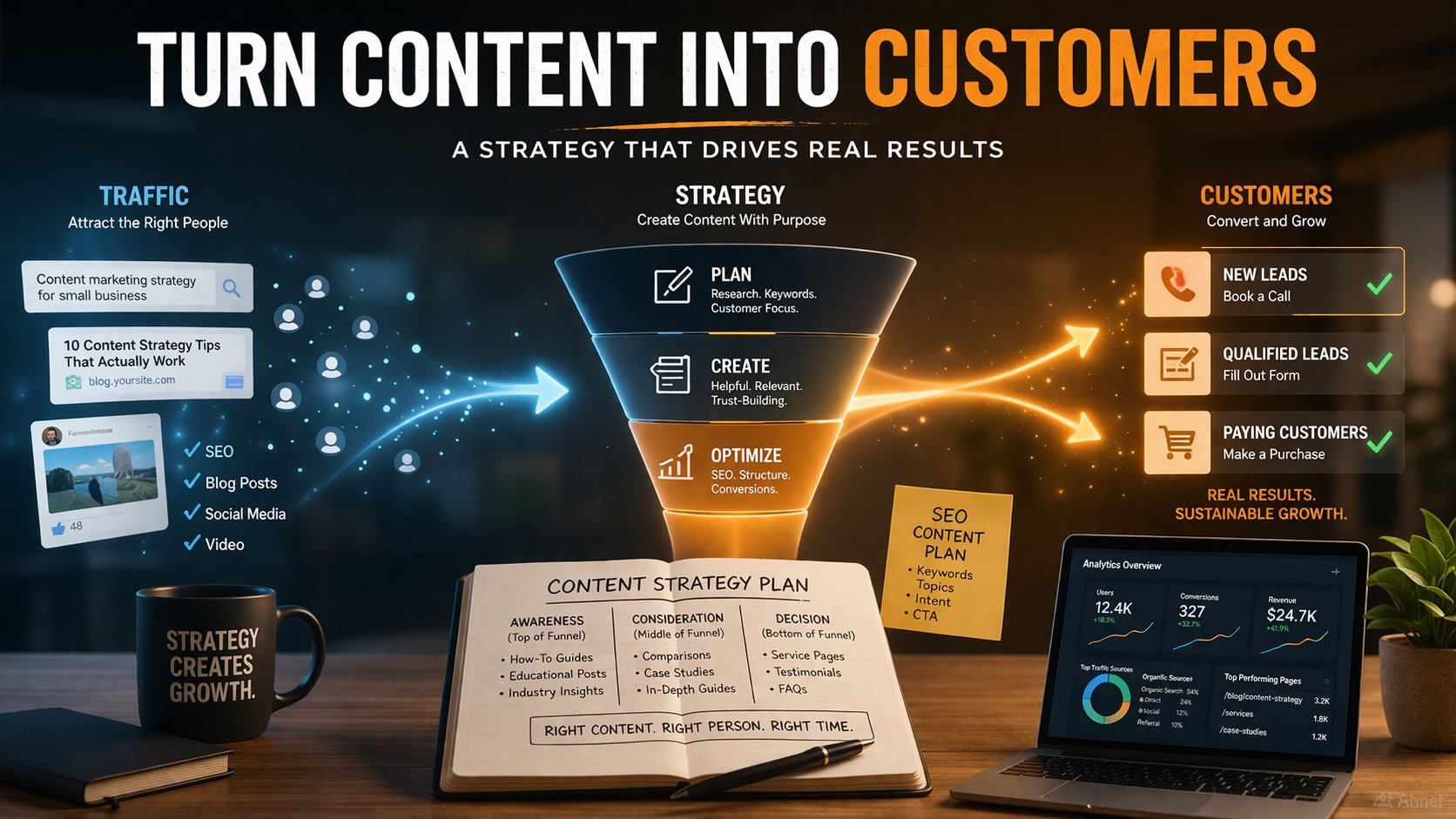
Here is the hard truth most marketing gurus skip right over: getting traffic to your website without a plan to turn that traffic into customers is just an expensive vanity project. You end up with a pretty Google Analytics dashboard and an empty sales pipeline. Sound familiar? Only 29% of B2B marketers rate their content strategy as extremely or very effective, according to the Content Marketing Institute — and that number tells you exactly why most small businesses are stuck. A real content strategy for small business is not about publishing more. It is about publishing smarter, so that every single piece of content you put out there does a job. This guide will walk you through exactly how to build a content marketing strategy that attracts the right people, earns their trust, and converts them into paying customers.
- Why most content strategies fail and what to do differently from day one
- How to define your ideal customer so your content speaks directly to people who are ready to buy
- How to build an SEO content plan around search intent, not just keyword volume
- How to structure your blog strategy like a sales funnel so every post has a purpose
- What E-E-A-T means for your business and how to use it to stand out from the competition
- The SEO checklist every post needs before it goes live
- Which metrics actually tell you if your content is making money (and which ones to stop obsessing over)
A content strategy for small business is a documented plan that connects what you create to what your customer needs at every stage of their buying journey. It combines audience clarity, search intent, an SEO content plan, and a blog strategy built around converting visitors into leads and customers — not just racking up pageviews.
What Is a Content Strategy for Small Business?
A content strategy for small business is a documented plan that defines what you create, who you create it for, where you publish it, and how it moves someone from a first-time visitor to a paying customer. Unlike random posting or blogging for the sake of it, a real strategy connects every piece of content to a specific business outcome, whether that is a phone call, a form fill, a purchase, or a booked consultation.
Why Most Small Businesses Get Content Marketing Strategy Wrong
The biggest mistake is chasing rankings instead of revenue. Business owners see a competitor ranking on page one, and they think, "I just need to write more blogs." So they crank out article after article, wait for Google to notice, and then wonder why their phones are not ringing.
Here is what that approach misses. Traffic without intent is just noise. A blog post that ranks for a general term and attracts people who are nowhere near ready to buy is not helping your business. It is filling your session report and nothing else.
The three most common content mistakes small businesses make:
- Writing about what they think is interesting instead of what their customers are actively searching for
- Publishing without a call to action so readers have nowhere to go after finishing the article
- Skipping the SEO content plan entirely and hoping good writing is enough on its own
Nearly 58.5% of Google searches now end without a single click. Users get their answer on the results page and move on. If your content is not structured to capture intent at every stage of the funnel, you are not even in the game.
Before you write a single word, you need a crystal-clear picture of your customer. Not a fuzzy demographic profile. A real person with real problems and real questions they are typing into Google at 11 PM when nobody is watching.
Ask yourself these questions about your ideal customer:
- What problem are they trying to solve right now?
- What exact words do they use when they search for that solution?
- What objections do they have before they buy?
- What does winning look like for them?
This is not a one-time exercise you do and forget. Your best customers are telling you what they need every single day through their questions, their reviews, their social media comments, and the searches that bring them to your site. Pay attention to that.
Read the one-star reviews of your competitors on Google. The complaints people have about your competitors are the exact promises you should be making and keeping in your content.
Keywords matter, but search intent matters more. Two people can type similar phrases into Google and want completely different things. Someone searching "content marketing strategy" might be a student writing a paper. Someone searching "content marketing strategy for local service business" is probably your customer.
| Intent Type | What They Want | Example Search |
|---|---|---|
| Informational | Learning something new | "What is a content strategy?" |
| Navigational | Finding a specific brand or site | "B2The7 marketing blog" |
| Commercial | Comparing options before buying | "Best content marketing tools" |
| Transactional | Ready to act right now | "Hire content marketing strategist" |
Your SEO content plan should include content targeting all four stages, but your highest-priority content should focus on commercial and transactional intent. That is where buyers live.
When choosing topics, look at what is already ranking on Google for your target keyword. Are the top results blog posts, product pages, or comparison guides? That tells you what Google thinks searchers want. Match that format and then make yours better.
Think of your blog strategy as a three-level system. Every post you write should fit somewhere in this structure.
Posts for people who have a problem but do not yet know you exist. Educational, helpful, built around informational keywords. Think "how to lower small business operating costs."
These readers know what they need and are evaluating their options. Comparison posts, case studies, and how-to guides. You are answering: "Why should I choose you?"
Your money pages. Service pages, testimonials, FAQ content, posts targeting "near me" or "hire" keywords. Make it easy for them to say yes.
Google has a framework for evaluating content quality. They call it E-E-A-T: Experience, Expertise, Authoritativeness, and Trustworthiness. For small businesses, this is actually a competitive advantage because you have real experience that a generic content mill can never replicate.
Here is how to build E-E-A-T into every piece of content you publish:
- Share specific results and numbers. Not "we helped a client grow their business" but "we helped a roofing company in Charlotte book 22 new jobs in 90 days."
- Tell your story. Why did you start this business? What do you know that your competitors do not? Your background is part of your credibility.
- Use real customer quotes and reviews. Social proof is one of the most powerful trust signals you can put in your content.
- Link to credible sources. When you cite a stat or a study, link to it. It shows you did the work.
"Generic content is everywhere. What your customers cannot get anywhere else is your specific point of view backed by your actual experience. That is what separates a blog that gets read from a blog that gets customers."
— B2The7 Digital Growth StrategyWriting great content and then ignoring SEO is like opening a great restaurant in the middle of a field with no road leading to it. Here is the quick checklist that should be part of every post you publish:
- Title tag: Keep it under 60 characters. Include your primary keyword. Make it compelling enough to click.
- Meta description: 150 to 160 characters. Treat it like a mini ad. Include the keyword and a reason to click.
- URL (slug): Short, clean, and keyword-focused. Avoid dates or filler words.
- H2 and H3 headings: Use your primary and secondary keywords naturally. Do not stuff.
- Internal links: Link to other relevant posts on your site. Keeps people reading and helps Google understand your structure.
- Image alt text: Describe what the image shows. Keep it concise. Compress images to under 100KB.
Keyword density is worth watching too. Your primary keyword should appear naturally throughout the post at a density of around 0.5% to 1%. Any less and you might be under-optimized. Any more and it reads as if a robot wrote it.
This is the step most small businesses skip, and it is the one that costs them the most revenue. You worked hard to get someone to read your content. Do not let them leave without telling them what to do next.
- Awareness-stage reader: Offer a free resource like a checklist, guide, or email series. Get their contact information.
- Consideration-stage reader: Invite them to a consultation, a demo, or to read a case study that matches their situation.
- Decision-stage reader: Make it ridiculously easy to book, call, or buy. Remove every possible friction point.
One CTA per post. Not five. Giving someone five options is the same as giving them no options. Pick the one action you most want them to take, and ask for it clearly.
Traffic is a vanity metric if it never converts. Here are the numbers that actually tell you whether your content marketing strategy is working:
- Leads generated per post. Which articles are actually driving form fills, calls, and email sign-ups?
- Conversion rate by traffic source. Organic search visitors often convert at a different rate than social media visitors. Know the difference.
- Time on page. If people are bouncing in 20 seconds, your content is not hitting the mark for that audience.
- Keyword rankings over time. Are you moving up? Holding steady? Dropping? Track your target keywords monthly.
- Revenue influenced by content. Ask every new customer how they found you. Tag content-sourced leads in your CRM.
"If three posts are driving 80% of your leads, write more content like those three. Stop spending energy on what is not converting and redirect it where it counts."
— B2The7 Digital Growth StrategyCommon Questions About Building a Content Marketing Strategy
How long does it take to see results from a content strategy for small business?
How many blog posts should I publish per month?
Do I need to be on every social media platform too?
What is the difference between a content strategy and a blog strategy?
How do I know if my SEO content plan is working?
Stop Chasing Traffic and Start Building a Strategy That Makes Money
Here is the bottom line. A content strategy for small business is not about gaming algorithms or chasing every new SEO trick. It is about understanding your customer deeply, showing up consistently with content that actually helps them, and making it simple for them to take the next step with you.
The businesses winning with content right now are not the ones publishing the most. They are the ones publishing with purpose. Every post has a job to do. Every call to action is intentional. Every metric they track is tied to revenue.
You do not need a massive budget or a full marketing team to pull this off. You need a plan, a commitment to your customer, and the discipline to execute consistently over time.
Start with one post built on the framework above. Measure it. Learn from it. Build the next one better. That is how a real blog strategy gets built, and how small businesses turn content into customers.
Ready to Build a Content Strategy That Actually Brings in Customers?
Our Dedicated Growth Strategists will audit your current content, identify where you are leaving revenue on the table, and build the roadmap that turns your expertise into a customer-generating machine.
Book Your Content Strategy Call →