The Google vs. AI Citation Gap: What Marketers Miss
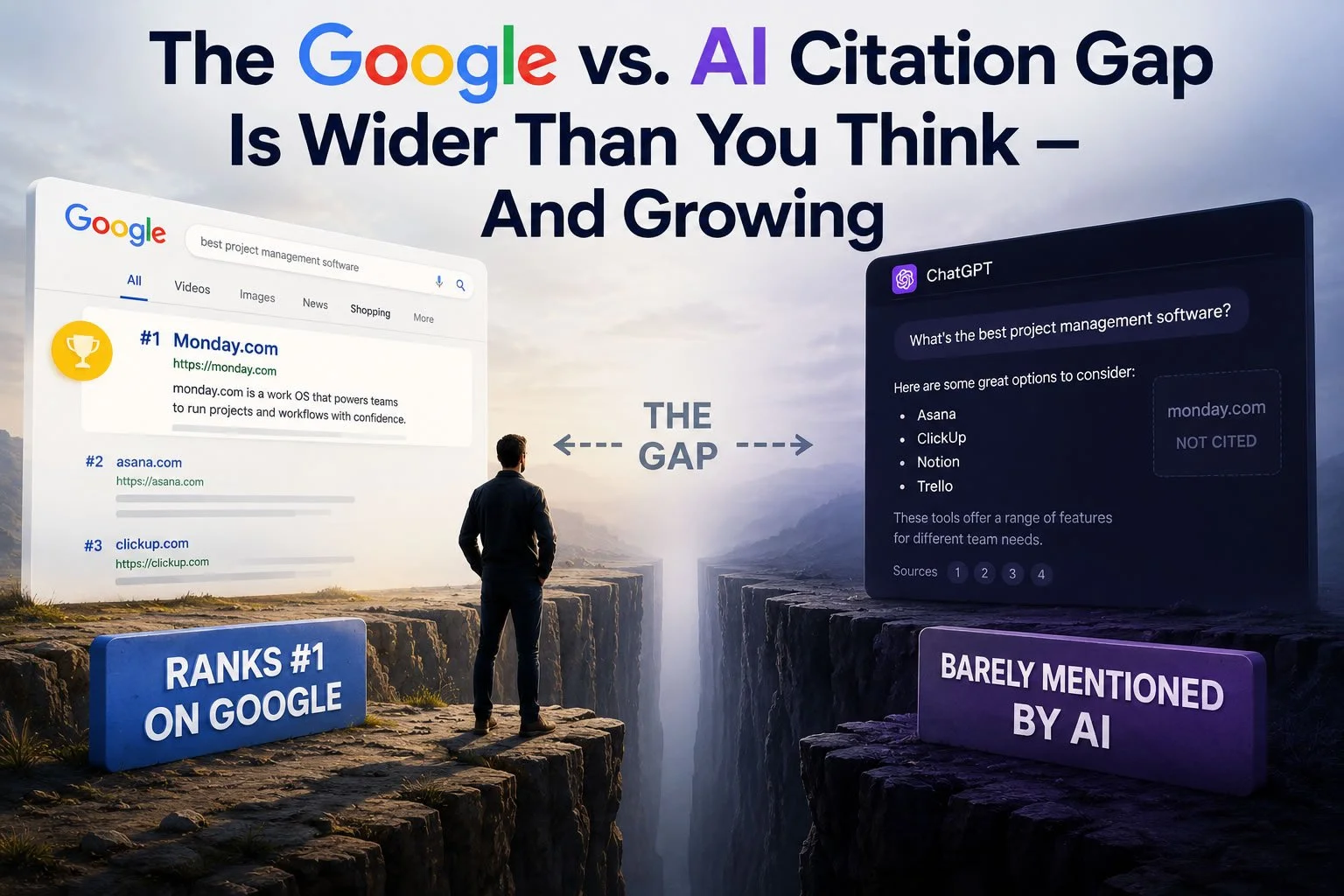
The Google AI citation gap is the growing divide between what Google ranks in traditional search results and what AI systems actually cite when generating answers. As of early 2026, fewer than 38% of AI-cited sources overlap with Google's top 10 results -- and for some platforms, that number drops below 10%. If your entire visibility strategy is built around Google rankings, you are only optimizing for part of the picture.
You worked hard for that Google ranking. Maybe years of content, backlinks, technical audits, and schema updates. You hit page one. Maybe you even hit position one. And now someone asks ChatGPT the exact question your page answers -- and your brand doesn't come up. Not once.
That is not a fluke. That is the gap. And it is getting wider every month.
Here is the thing: most marketing teams are not yet fully reckoning with this. Google and AI systems are not the same thing doing the same job. They are two fundamentally different systems with distinct objectives, selection processes, and ideas about which sources deserve to be cited. Treating them as interchangeable is costing people real visibility with real buyers.
The change happened fast. Back in late 2024, pages mentioned in Google AI Overviews were usually pages already ranking near the top of search results. By early 2026, that overlap had dropped sharply, with some reports putting it at 20% to 40%, depending on the platform and query type. Ranking well in Google no longer guarantees your content will be pulled into AI-generated answers.
What You Will Learn
- Why the Google-to-AI citation overlap has dropped so dramatically, and what is driving it
- How ChatGPT, Gemini, and Perplexity each select sources differently
- The real business cost of the citation gap, not the theoretical one
- What SEO, GEO, and AEO actually mean and how they work together
- What signals AI systems use to decide what to cite
- Five steps you can start taking right now to show up in both places
The Gap Is Real -- Here Is What the Data Actually Says
Let's start with the numbers because they tell the story better than anything else.
A Search Atlas analysis of 18,377 matched queries compared citations from ChatGPT, Gemini, and Perplexity against Google search results. The findings are not encouraging if you've been assuming that your Google performance automatically translates into AI visibility.
ChatGPT
Domain overlap with Google. URL-level overlap stays below 10%. Relies on internal reasoning, not live retrieval.
Gemini
URL overlap with Google. Behavior is inconsistent -- some responses have almost no alignment with search results at all.
Perplexity
Domain overlap with Google -- the highest of the three. Architecturally closest to a search engine because it retrieves live web results.
And here is a stat that stopped me when I first read it: only 13.7% of citations overlap between Google AI Overviews and Google AI Mode. These are two products from the same company, and they're pulling from almost entirely different sources. If Google can't get its own AI products to agree on what's worth citing, that tells you something about how different this selection process really is from traditional search.
The speed of the shift is hard to ignore. In about a year and a half, the overlap between top Google results and AI-generated citations dropped from roughly 75% to somewhere between 17% and 38%. That is a major change in a very short amount of time, and it is already affecting how people find businesses, products, and answers online.
Why AI Systems Pick Different Sources Than Google Does
This is worth understanding because if you know that there's a gap without understanding why, you can't do anything smart about it.
Google ranks pages. It crawls the web, evaluates authority signals such as backlinks and domain strength, assesses relevance through keyword matching and semantic understanding, and produces a ranked list. You click a link. You go to a page. That's the whole model.
AI search tools work differently. When someone asks ChatGPT or Gemini a detailed question, the system is not simply pulling a ranked list of webpages. It builds the response first, then looks for sources that support the answer it generated. That changes how citations get selected and why certain sites appear while others do not, even when those other pages rank well in Google.
What does an AI system actually care about when deciding what to cite? Semantic clarity -- meaning the content directly and clearly addresses what the query is asking. Factual specificity -- data, named sources, verifiable claims. Structural readability -- organized headings, clean formatting, direct answers positioned where they can be found quickly. And source authority, but authority as the AI understands it, which has more to do with your entity's presence across the web than your domain rating in an SEO tool.
So a page can have excellent backlink profiles, strong technical SEO, and a solid Google ranking, and still be effectively invisible to ChatGPT if the content is written in a way that's hard for an AI to parse, extract from, and reference.
And honestly? A lot of pages that rank well were written to rank well -- not to be cited as a source in a synthesized answer. Those are different writing jobs. We're all playing catch-up on that.
The Business Problem Nobody Is Talking About Loudly Enough
Let's get to what this actually costs you.
Your buyers are using AI tools to research vendors. Not all of them, not yet -- but enough that it matters, and the share is growing. They're asking Perplexity to compare their options. They're asking ChatGPT what the best agency for their specific situation looks like. They're asking Gemini to explain the difference between two approaches. These are high-intent queries. The people typing them have a problem and some budget to solve it.
If your business is not appearing in AI-generated answers, there is a good chance potential customers are never seeing you during the research process. At the same time, competitors with simpler, more structured content may be getting mentioned regularly, even if they are not dominating traditional search rankings.
This is where demand gets shaped before anyone clicks anything. Before they visit your site. Before they see your paid ad. Before they find your Google listing. The AI answer is the first impression in a growing number of cases.
BrightEdge has noted that Google AI Overviews now appear on roughly 13% of searches. That number will go up. And the sources cited in those overviews increasingly don't come from the top 10 organic positions. So the funnel you built around traditional search rankings is working with less traffic than you think.
The gap between your Google position and your AI position is where revenue is being lost. Not theoretically. Actually.
SEO, GEO, and AEO: What's Actually Different
These terms get thrown around and sometimes used interchangeably, which doesn't help anyone. Here's how they actually stack up.
| Term | What It Stands For | The Goal | Where It Shows Up |
|---|---|---|---|
| SEO | Search Engine Optimization | Rank in a list of links | Google, Bing organic results |
| GEO | Generative Engine Optimization | Get cited inside an AI-generated answer | ChatGPT, Perplexity, Gemini responses |
| AEO | Answer Engine Optimization | Get pulled into quick-answer features | Google AI Overviews, featured snippets |
The important thing to understand is that these are not competing strategies. They're layered. Strong SEO creates the foundation -- technical accessibility, content quality, credibility signals -- that both traditional and AI systems rely on. GEO and AEO build on that foundation with specific adjustments to how AI systems actually process and select content.
The Princeton research that introduced the term GEO found that AI systems tend to favor clear writing, well-organized information, trusted sources, and consistent facts across the web. Those things already matter in SEO, too -- but AI systems rely on them more heavily and evaluate them a little differently.
SEO gets you ranked. GEO gets you cited. You need both working.
What AI Systems Actually Look For When They Decide What to Cite
This is the part that changes how you write and structure content. Not the theory -- the actual signals.
Direct Answers Early in the Content
Studies have found that 44.2% of all LLM citations come from the first 30% of a piece of content. The intro carries more AI citation weight than the rest of the article combined. If you bury your clearest answer in section four, the AI likely skips it.
Structured, Parseable Formatting
Schema markup, descriptive H2s that answer questions directly, comparison tables, clean hierarchy. AI systems are essentially parsing your content for extractable information. If your formatting makes that easy, you get cited more. If it's hard to parse, you get skipped.
Factual Specificity with Named Sources
Vague claims and unsupported opinions don't get cited. Data does. Named research does. Specific statistics with attribution do. This is not just good writing practice -- it's what differentiates citable content from content AI systems treat as background noise.
Entity Clarity Across the Web
Your brand needs to be clearly associated with specific topics, and that association needs to exist across multiple sources, not just your own site. You can have great content on your site and still be invisible to AI systems because your entity footprint is thin.
Earned Distribution, Not Just Owned Publishing
Distributing content to external publications can increase AI citations by up to 325% compared to publishing only on your own site. Getting your content, your data, and your perspective out into the broader web ecosystem is no longer just a brand-awareness move. It's a core GEO play.
Topical Authority Through Consistency
Scattered, thin coverage across topics doesn't earn citations. Deep, consistent, connected coverage of a specific subject area does. AI systems are looking for sources that clearly own a topic, not sources that merely touch on it.
Five Practical Things to Do Next
You do not need to redo your entire marketing strategy this week. But you probably should stop assuming that strong Google rankings automatically translate into strong visibility everywhere else.
Run Your Own Audit Right Now
Open ChatGPT, Gemini, and Perplexity. Search the same queries your customers would use. See who gets mentioned and who doesn't. Some businesses are going to realize they are basically invisible outside of Google. This is your baseline and it takes about 20 minutes.
Restructure Your Main Service Pages
A lot of companies make people work too hard to find the actual answer. Put the important information earlier. Tighten up the headings. Make the page easier to scan without turning it into robotic SEO copy. Add schema markup if you haven't.
Build Your Presence Beyond Your Own Site
AI tools pull information from industry sites, local listings, interviews, podcasts, review platforms, and news mentions. If your business only exists on its own domain, that is a real problem for AI visibility. Earned media is no longer optional.
Create Content That Answers the Sub-Queries
When an AI answers a complex question, it breaks it into smaller searches. Think about what fragments of your buyers' main questions would look like as separate searches, and make sure you have content that directly addresses each one. This is how you show up in more parts of an AI's reasoning process.
Add AI Visibility to Your Reporting
Start tracking how often your brand appears in AI responses for your target queries. Do it consistently so you can see movement. This is a real metric now -- it belongs next to your rankings, your traffic, and your conversion data. Many buying decisions already start on these platforms before someone ever clicks a website.
Frequently Asked Questions
The Takeaway
You can rank well in Google and still get ignored by AI search tools. That is the part a lot of businesses are missing right now. Traditional SEO still matters, but AI platforms are making their own decisions about which sources to pull from, cite, and trust.
The brands that figure this out in 2026 will have a real edge. Those who wait until the gap is impossible to ignore will be doing a lot more catching up.
If you want to talk through where your content stands and what a GEO strategy actually looks like in practice, we're here for that conversation.