What Competitor Reviews Are Really Telling You
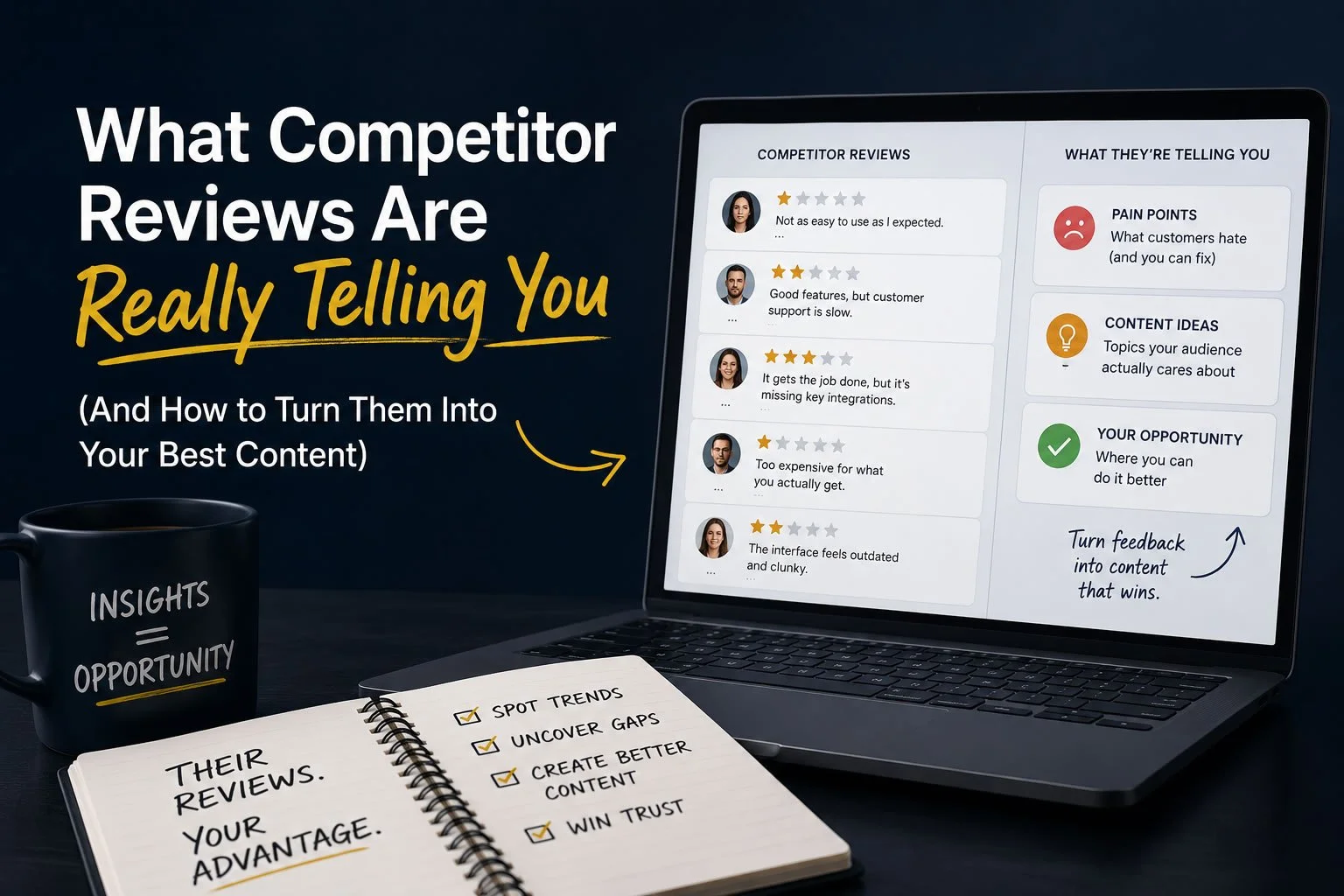
There's a habit I see in many businesses when it comes to competitor reviews. They pull them up, skim the complaints, feel reasonably good about where they stand, and close the tab. No notes. No follow-up.
That habit is leaving money on the table.
Competitor review analysis -- specifically reading your competitors' 1 and 2-star reviews -- is one of the most underused research methods in marketing. When customers leave negative reviews, they're telling you exactly what the market doesn't like, which problems go unsolved, and where the gaps are wide open for a business that actually listens. The businesses that read this data carefully and build content around it don't just look better than their competition. They win the customers who were already frustrated and looking for something different.
This guide covers how to find and read those reviews, what patterns to look for, how to turn complaint data into content that ranks and converts, and how this practice connects to SEO, GEO, and AI search visibility in 2026. Everything here can be started this week with free tools.
Why do competitor 1 and 2-star reviews matter for your marketing?
Because unhappy customers tell you everything your competitors aren't fixing. Their frustrations are your content opportunities. The recurring complaints in low-star reviews show you exactly which problems the market wants solved. They give you a direct roadmap for creating content, messaging, and positioning that speaks to those unmet needs.
The Numbers That Should Make You Pay Attention
The numbers around review impact are worth knowing before diving into strategy. Most marketers have heard some version of them. What makes them useful here is the specificity. The details change how seriously you take what's sitting in your competitors' low-star feedback.
That 9% floor is basically zero. And it's getting harder to clear the bar. Consumer expectations aren't creeping up slowly. They're jumping.
The communication and pricing insight: Roughly 37% of negative reviews trace back to communication problems. Pricing shows up almost five times more in low-star reviews than positive ones, accounting for 20.7% of complaints. But most customers aren't saying the price was too high. The frustration usually comes from surprise fees, quotes changing after the fact, or charges that were never clearly explained upfront.
Around 5% of businesses respond to online reviews. Most customers expect a same-day response when they've left a complaint. That's a wide gap, and it shows up in two places: how your reputation looks to anyone reading those reviews, and in the content opportunity you're missing by not addressing those complaints publicly.
The data in those low-star reviews is free. It's specific. It's already sorted by frustration type. Almost no one in your market is using it.
Why 1 and 2-Star Reviews Are Your Best Research Source
Market research costs money. Focus groups take time. Customer surveys get ignored. But negative reviews? Customers write those without being asked, without being paid, and without filtering themselves. Unhappy customers are roughly 10 times more likely to leave a review without prompting than happy customers. The complaint data is already out there, across Google, Yelp, G2, Trustpilot, and whatever industry-specific platforms your market uses.
The answers that help a brand develop content that actually resonates are buried in those negative reviews. When you read through 50 one-star reviews for a competitor, specific themes start repeating. People aren't randomly unhappy. They're frustrated about the same handful of things, over and over.
Those themes are your content brief.
Real-world proof: One team that mined competitor reviews systematically changed their headline from "enterprise-grade analytics platform" to "analytics that actually get used" -- resulting in a 40% increase in demo requests. They also found that customers loved a feature they barely mentioned, made it their hero feature, and watch rates increased 25%. The answer was sitting in public complaints the whole time.
That's the kind of shift that comes from reading what customers are already saying in public rather than guessing at what the market wants.
Where to Find the Reviews That Matter
No expensive tools required. Here's where to look -- and what each platform is best for:
Starting point for most local and regional businesses. 81% of people check Google reviews before visiting. Filter to 1 and 2-star only and start reading.
About 16% of reviews are 1-star and 6% are 2-star, so roughly 1 in 5 is negative. Solid sample size for any established competitor.
Essential for B2B software and services. Detailed complaints from buyers spending real money with specific opinions about what went wrong.
Houzz, Healthgrades, Avvo: reviewers here did their homework first. Often where the most detailed, unfiltered complaints live.
Don't forget your own reviews. The same patterns showing up in competitor reviews may be in your own 1 and 2-star feedback. If they are, that is not a content opportunity. That is an operational issue that needs fixing first.
How to Read Reviews Like a Strategist
Most business owners read negative reviews looking for reasons the complaint isn't valid. Reading them as a strategist means something different. You're not evaluating individual cases. You're hunting for patterns. Here's the process:
Turning Review Insights Into Content
Keyword research helps, but customer reviews tell you what people are actually frustrated about. You can see the exact issue, how customers described it, and where expectations fell apart. That usually leads to stronger content because it's built around real problems instead of guesses.
If three of your four main competitors have stacks of reviews complaining about poor communication after the sale, and your process is actually organized and responsive, show people what that experience looks like. Walk through the first 30 days. Explain how updates are handled. Buyers who've been burned before read that kind of content carefully. Link it to your service pages for added authority.
Frustrated buyers don't search in marketing language. If reviews keep saying "they never followed up" or "I had no idea what was happening," those aren't just complaints. They're search queries. They belong in your content, headlines, and meta descriptions. This is core to any strong SEO strategy.
"What to look for in a [service] provider" content built around the exact complaint categories you found in competitor reviews is genuinely useful and strategically positioned. It's one of the strongest plays in thought leadership content.
Competitor reviews full of complaints about vague reporting? If you provide detailed monthly reporting, write the case study that proves it. Specific client, specific numbers, specific outcomes. That post directly answers the complaint that's been sending buyers elsewhere.
Every complaint category is a question potential buyers are afraid to ask. Turn those into FAQ content with proper schema markup. It's highly visible in both traditional search and AI-generated answers -- the backbone of a solid GEO strategy.
What Your Own 1 and 2-Star Reviews Are Telling You
Your competitors' reviews are an opportunity. Your own low-star reviews are a mirror.
53% of customers expect businesses to respond to negative reviews within a week. 87% of businesses don't respond at all. That gap is a problem on two levels. It damages your reputation, and it means the feedback sits unaddressed while the same pattern keeps repeating.
Read your own 1 and 2-star reviews using the same framework you'd use for a competitor. Look for patterns. Identify what wasn't solved. Note the language. Then do something about it.
If the same complaint appears more than twice, it's not a one-off. It's a process, communication, or expectation problem. Fixing it is more valuable than any content you could write, because no amount of good content overrides a consistent pattern of bad experiences.
The trust recovery insight: What most customers want after a negative experience is a quick fix. Prompt resolution was rated the most influential factor in regaining trust -- more important than refunds or discounts. Businesses that fix something and then write about how they fixed it build more credibility than any promotional copy, because it's rooted in something real.
Review Mining and AI Search Visibility
There's a layer to this strategy that most marketers haven't connected yet, and it goes directly to how AI systems like Google AI Overviews, ChatGPT search, and Perplexity surface local and service business recommendations.
When someone asks an AI tool "Who is the best [service] provider in [city]?" that answer is pulled from review data, structured content, and signals about a brand's credibility. Content built around the specific language and complaints in reviews creates direct alignment between what buyers ask and what your content answers. That's the core principle of Generative Engine Optimization (GEO).
Schema markup on FAQ content built from review insights compounds this further. If communication and follow-through are the top complaints in your market, and you've built FAQ content answering "how do you keep clients updated" and "what happens after the project starts," that content -- when properly structured -- becomes a real candidate for AI citation.
Customer complaints and search queries tend to use similar language because they come from the same headspace. Someone writing a one-star review saying "I had no idea what was going on with my project" isn't far from the person searching "how to know if your agency is doing anything." When your content reflects that phrasing, you appear in searches that are worth being in.
A Practical Workflow to Get Started This Week
No competitive intelligence platform required. This process works with free tools and a few focused hours:
Do this every quarter. Staff changes, new ownership, growth spurts, budget cuts -- any of these can change a competitor's complaint profile within a few months. A review pattern that wasn't there in January can be obvious by April. The businesses whose marketing always seems to hit the right notes aren't necessarily smarter. They're paying attention to what's already being said.
FAQ: Using Competitor Reviews for Content Strategy
The Most Valuable Research Your Competitors Are Doing for You
Every 1-star review your competitor has ever received is a gift. Not because it makes them look bad. It tells you something a real customer wanted, didn't get, and walked away still wanting.
Those unmet needs are your market. That language is your copy. Those patterns are your content strategy.
The businesses pulling ahead right now aren't the ones with the biggest ad budgets. They're the ones paying attention to what the market is already saying out loud, and building something that actually answers it.
A lot of what we do at B2The7 starts with this kind of read. Not a keyword spreadsheet or a trend report. A look at what real buyers are saying about their real experiences, and then a plan for how to use that. If your competitive landscape is something you haven't looked at lately, it's worth the conversation. There's usually more useful material sitting in those reviews than anyone expects to find.
Ready to Turn Competitor Complaints Into Your Content Strategy?
B2The7 helps brands mine competitive intelligence, build content that ranks, and position themselves where frustrated buyers are already looking. Let's see what's sitting in your market.