LLMs for B2B and B2C: Strategies That Win in 2026
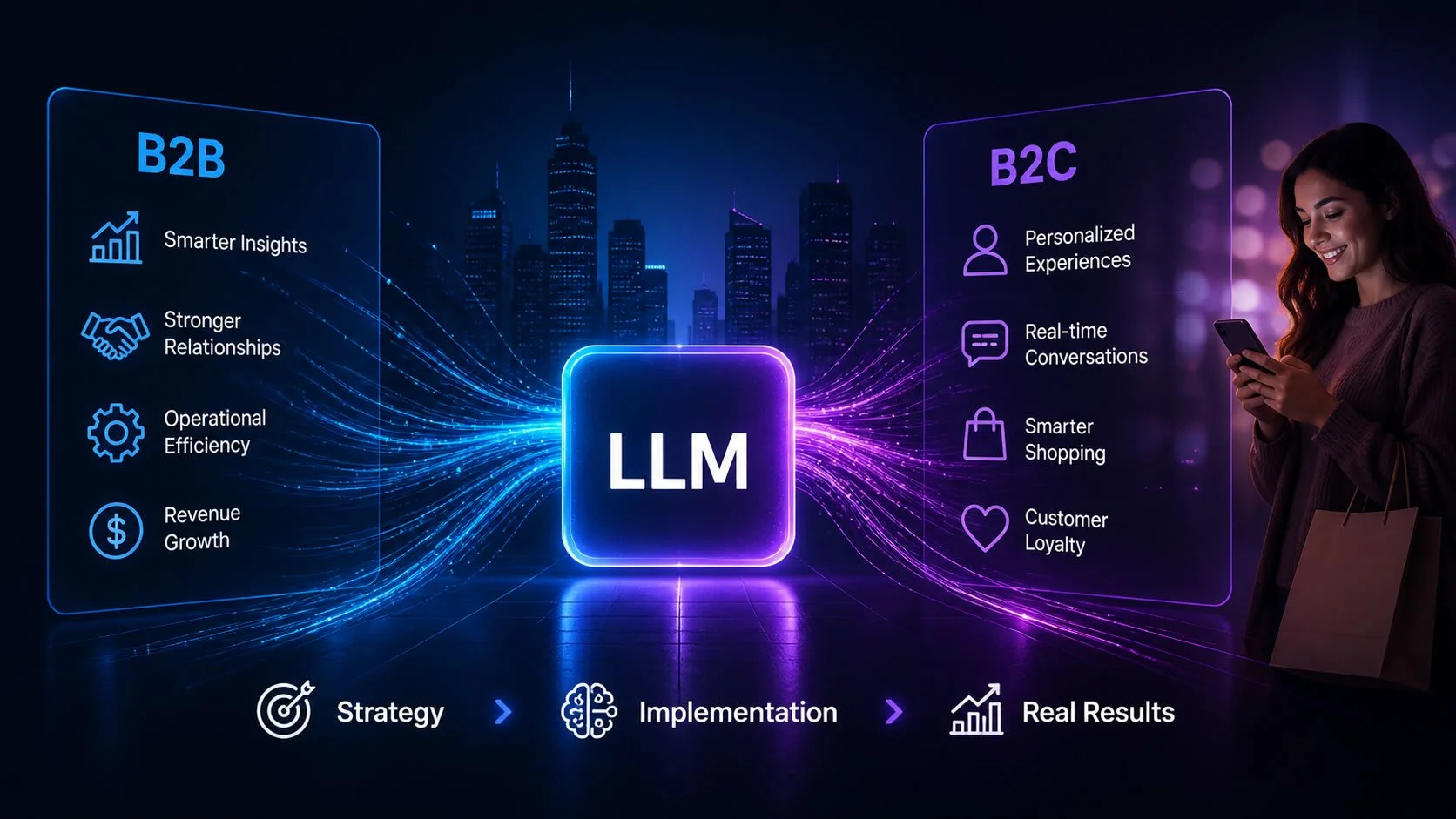
Every week, another brand announces they are using AI. But there is a real difference between dropping AI tools into your workflow and building a strategy around large language models that actually drives revenue. Most businesses -- B2B and B2C alike -- are still figuring out which side of that line they are on.
LLMs for B2B and B2C aren't interchangeable -- and treating them that way is expensive. The buyers think differently, buy differently, and respond to content that is completely different. Trying to run one unified LLM strategy across both usually means you've optimized for neither.
This guide breaks it all down -- how LLMs work in both environments, which models are leading in 2026, the key strategic differences, and what LLM optimization looks like when it's built to rank and convert.
- Why B2B and B2C LLM strategies are fundamentally different -- and where brands go wrong treating them the same
- What the 2025 buyer data actually says about how LLMs are already influencing purchase decisions
- A breakdown of the models leading in 2026 -- and a straight answer on which fits which situation
- The B2B eCommerce shifts already underway that most content strategies haven't caught up to yet
- What LLM optimization actually involves and where traditional SEO falls short on its own
What Is an LLM and Why Should Marketers Care?
A large language model is an AI system trained on billions of words of text -- articles, books, websites, code, conversations -- until it can generate, summarize, translate, and analyze language at a level increasingly hard to distinguish from a skilled human writer. ChatGPT, Claude, Gemini, and Llama are all LLMs. So is the AI writing assistant your team may already be using inside HubSpot, Salesforce, or Microsoft 365.
For marketers, LLMs matter on two fronts, and you need to understand both.
First, they're production tools. LLMs help your team produce more content, faster -- blog posts, sales emails, product descriptions, ad copy, RFP responses. Done right, they amplify what your team can do without replacing the judgment and voice that make your brand worth paying attention to. That's at the core of how we approach content development strategy at B2The7.
Second, and more importantly, they're the engine behind AI search. When someone types a question into ChatGPT, Perplexity, or Google with AI Overviews turned on, an LLM decides what answer to generate -- and whose content to cite. That second part is where most marketing teams have a blind spot. You can be producing great content and still be invisible in AI-generated answers because your content isn't structured the way LLMs expect to find it.
That's the real reason this topic matters in 2026. LLMs aren't just changing how you create content. They're changing how your buyers find you.
This post is structured for AI search visibility. It answers direct questions in clear, concise language, uses structured formatting that LLMs can parse and cite, and covers the full topic scope that AI models look for when generating answers about large language models in B2B and B2C marketing.
What's the difference between LLMs in B2B and B2C? In B2B, LLMs are doing the heavy lifting on long sales cycles -- generating technical content, personalizing outreach at the account level, and helping sales teams respond faster to RFPs. In B2C, the job is speed and relevance at scale -- product recommendations, chatbots, personalized email copy, ad creative. Same underlying technology, but the strategy, the metrics, and what success looks like are miles apart.
LLMs in B2B: Turning Complex Buying Journeys Into Competitive Advantage
B2B buying is slow by nature. The average deal involves 6 to 10 stakeholders, takes three to six months to close, and requires content depth that most marketing teams can't sustain consistently. That's exactly where LLMs in B2B are making the biggest impact -- and the numbers now back it up.
6sense ran a global study of nearly 4,000 B2B buyers in 2025, and the number that stood out most was this: 94% said they used an LLM at some point during a software purchase journey. That's no longer a niche behavior. Two years ago, that number was effectively zero. The buyers in your pipeline right now are already using AI to research you, compare you to competitors, and decide whether you make the shortlist.
About 80% of enterprise tech buyers now use AI tools as much as or more than traditional search when evaluating vendors. If your content isn't optimized for these platforms, you're missing visibility at exactly the moment decisions are being made.
What are B2B teams actually doing with LLMs? A few things are coming up consistently:
- White papers, case studies, technical documentation -- content that used to sit on a two-week production timeline is getting done in a day. 30% of enterprise content is now created or enhanced by generative AI, up from under 5% two years ago. That gap keeps widening.
- Generic prospecting is getting replaced by outreach that's actually trained on CRM data and company context. The teams doing this well aren't just saving time -- they're seeing better conversion on sequences that used to perform at the same flat rate for everyone.
- Keeping ABM campaigns fresh across multiple account segments used to require rebuilding them constantly. LLMs handle the messaging adjustment by industry, company size, and role, so teams can scale without adding headcount to do it.
- RFP responses are a clear, practical example. What used to take days of back-and-forth across three or four departments can now be handled by pulling from an internal knowledge base, with a person refining the final version. Hours, not days.
Key insight: LLM use in the B2B buying journey doesn't peak at the start -- it peaks in the middle. Buyers are using LLMs after they've already identified a shortlist, to compare offerings side-by-side, synthesize vendor documentation, model costs, and draft RFP language. That distinction should shape your entire digital content strategy.
Look at what's already happening in the market. Salesforce built LLMs into its Einstein AI layer to generate personalized sales recommendations and draft follow-up emails directly from CRM activity -- cutting the time reps spend on admin. HubSpot's AI content assistant has become a real part of how B2B marketing teams build campaigns, not a side experiment. IBM is using LLMs to knock out proposal drafts that used to eat days of coordination time across multiple departments.
Large enterprises now account for 78% of total enterprise LLM market share, concentrated in organizations with complex operations, large datasets, and multi-department workflows. If you're a mid-market B2B brand not yet building LLM workflows into sales and marketing, you are already competing against organizations that have a significant head start.
There's also a bigger picture worth keeping in mind. LLMs touch 40% of global working hours and in certain roles can automate 60 to 70% of daily tasks. In B2B, the roles sitting in that range are sales, marketing, and content -- exactly the functions your revenue flows through.
LLMs in B2C: Personalization at Scale and the Expectation That Comes With It
B2C buyers move fast. The window between discovering a product and making a purchase can be minutes. With platforms like Amazon, Netflix, and Spotify setting the standard through AI-driven personalization, consumers now expect experiences that are genuinely relevant -- not segment-level guesses dressed up as personalization.
LLMs in B2C are closing that gap for brands that aren't Amazon. And the scale of adoption tells you the window to gain competitive advantage is narrowing fast.
Retail and eCommerce currently represent the largest industry segment in the LLM market at 27.5% -- more than any other vertical. That's not coincidence. It's the direct result of consumer-facing brands discovering what personalization at scale actually does to revenue.
The revenue case is hard to argue with: LLM-driven personalization is pushing customer engagement up by as much as 40%, and retailers running AI recommendation engines are reporting 10 to 30% higher revenue than those that aren't. Put that number in front of any executive team and the conversation about whether to invest shifts pretty quickly.
So where is this actually showing up in B2C? A few areas are seeing the most traction:
- Recommendation engines have gotten genuinely smart. LLMs trained on behavioral data aren't just surfacing basic suggestions -- they're making real-time calls on what each shopper is most likely to want next. 80% of customers say they prefer buying from retailers with personalized search, and platforms running AI-powered search are reporting up to 25% higher satisfaction scores.
- Industry forecasts suggest automated chat tools could handle up to 85% of retail service interactions -- returns, sizing questions, complaint resolution -- with potential savings reaching $11 billion each year. For individual brands, that means lower service costs and always-on support without overnight staffing.
- Email and SMS that actually feel personal. LLMs are generating copy that adjusts offers, messaging, and CTAs at the individual level based on purchase history and browsing behavior -- not just segment-level assumptions. This connects directly to strong lifecycle and retention marketing strategy.
- Automating product descriptions is cutting human content workload by 60% in some retail operations, with a 20 to 30% improvement in efficiency as a result.
- Creative testing on paid social channels is advancing rapidly. LLM-assisted ad copy generation lets marketing teams test more variations without burning out the people responsible for producing them.
Sephora uses a digital assistant that guides customers through product selection based on skin type and past purchases -- it feels less like a chatbot and more like talking to someone who actually paid attention. Stitch Fix takes a similar approach, tailoring styling notes and recommendations to each customer's stated profile. Instacart's Ask Instacart feature lets shoppers ask plain-language questions and get real product answers in real time. H&M uses conversational tools to handle returns and offer style guidance across multiple markets simultaneously -- at a volume no human service team could sustain.
More than 75% of eCommerce companies plan to integrate LLMs, with focus on customer service, personalized marketing, and inventory management. If you're in the 25% that hasn't moved yet, you're not in a wait-and-see position -- you're already behind most of your competitive set.
McKinsey's data is clear: 71% of shoppers expect personalized interactions every time, and 76% get frustrated when it doesn't happen. For brands not operating at Amazon scale, LLMs are what make meeting that expectation operationally realistic.
One thing worth being straight about -- brand voice is a real risk when you scale content with LLMs. When everything starts sounding the same, customers notice. The brands getting this right have built intentional prompt architecture and real human review into the process. Speed without guardrails just means you're producing mediocre content faster.
Top LLMs and Models for 2026: Which One Fits Your Business?
The LLM landscape has consolidated. There are clear leaders in 2026, and the choice between them isn't about raw capability -- it comes down to fit, integration, cost, and use case.
- GPT-4o / OpenAI -- still the default for most marketing and content work. Long-form writing, tone matching, structured output -- it handles all of it well. 92% of Fortune 100 companies now use ChatGPT in some form, and Azure OpenAI integrations have made it the standard enterprise choice for B2B teams.
- Claude 3.5 / Anthropic -- consistently mentioned when teams are prioritizing content that doesn't read like it came out of a machine. Long-context tasks and nuanced reasoning are where it stands out. Enterprise AI assistant market share went from 18% in 2024 to 29% in 2025, and in regulated industries it tends to be the first choice because accuracy and tone both matter.
- Gemini 1.5 Pro / Google -- the obvious pick if your team lives in Google Workspace. Natively integrated, handles multimodal tasks well, and if Google AI Overview visibility is a priority for your SEO strategy, this is the model to have in your stack. 400 million monthly active users by May 2025.
- Llama 3 / Meta (open-source) -- built for teams that can't send data to a third-party cloud. On-premise deployment, full customization, no data governance headaches. The go-to for regulated industries and B2B organizations with strict security requirements.
- Mistral / Cohere -- built for specific jobs rather than general use. Retrieval-augmented generation, enterprise search, task-specific automation -- efficient and at a lower cost than the bigger models. If you've scoped your use case tightly and need to keep spend under control, these are the ones to evaluate.
Model selection isn't really a capability conversation -- most of these are capable enough. It's a fit conversation. Does it connect cleanly to your existing stack? Do your data governance requirements allow cloud-based inference or do you need on-premise? Are you solving one specific problem or looking for something that handles a range of tasks? Answer those three questions first and the model choice usually becomes clear.
Key Strategic Differences: B2B vs. B2C LLM Implementation
This is where I see brands lose time and budget. A model is selected, deployed, and someone decides the strategy that works for the B2C side should translate cleanly to B2B. It doesn't. A quarter later, the team is auditing results that don't make sense -- and usually the root cause is that two completely different buying environments got treated as variations of the same problem.
| B2B | B2C | |
|---|---|---|
| Buyer journey | Long, multi-stakeholder, research-driven | Short, individual, emotion-influenced |
| Content depth | Technical, detailed, role-specific | Concise, engaging, benefit-focused |
| Personalization | Account-level and role-level | Individual behavioral and preference-based |
| Primary LLM use | Content generation, sales enablement, ABM | Recommendations, chatbots, campaign copy |
| Success metric | Pipeline influence, deal velocity | Conversion rate, repeat purchase, LTV |
| Risk tolerance | Low -- errors damage credibility | Moderate -- speed often outweighs perfection |
The biggest mistake in B2B is using LLMs to generate generic content faster. Faster generic content is still generic -- and B2B buyers are sophisticated enough to spot it. The strategic win in B2B is using LLMs to produce highly specific, deeply relevant content that reflects a real understanding of the buyer's industry, role, and problem. That's what a proper strategic marketing plan accounts for.
B2C has its own version of this problem: over-automation. Customers pick up on generic faster than most marketers expect. When every email sounds the same and every chat interaction feels scripted, people stop engaging -- and sometimes stop buying. Speed only helps when the output still sounds like your brand. When it doesn't, you trade loyalty for efficiency, and that's usually a bad deal.
How AI Is Reshaping B2B: B2B eCommerce Trends in 2026
B2B eCommerce is going through a significant shift, and LLMs are at the center of it. A few trends are worth watching closely.
Self-serve buying is accelerating. Gartner research shows that 75% of B2B buyers now prefer a rep-free purchase experience for routine purchases. LLMs are making that possible by powering intelligent product configurators, instant quoting tools, and 24/7 chat-based support that can handle complex product questions without a sales rep involved.
The way buyers find vendors has changed. A procurement manager searching for a software solution or service partner today is far more likely to get an AI-generated answer than a ranked list of links. That answer is pulling from content that LLMs can retrieve and cite -- and if your B2B content isn't structured that way, you're not in the conversation. This is exactly why Generative Engine Optimization (GEO) has become a non-negotiable part of any serious digital strategy.
Personalized B2B content portals are replacing static resource libraries. LLMs allow companies to serve dynamic content experiences where a CFO sees financial ROI content and a technical lead sees integration documentation -- from the same page, based on role and behavior.
Predictive content recommendations in B2B are maturing. Rather than manually segmenting email lists, B2B marketers are using LLM-powered systems that analyze engagement patterns and automatically surface the next best piece of content for each account.
What's really happening here is a convergence. B2B buyers now expect a consumer-grade experience -- fast answers, personalized content, and self-serve options. But the underlying complexity of B2B decisions hasn't gone anywhere. LLMs are what make it possible to deliver both at the same time.
LLM Optimization That Ranks: How to Get Your Content Into AI-Generated Answers
Getting found in traditional search isn't enough anymore. As AI Overviews, ChatGPT search, Perplexity, and Claude's web access become primary research tools for buyers in both B2B and B2C, your content strategy has to account for how LLMs retrieve, parse, and cite information.
LLM optimization -- sometimes called GEO (Generative Engine Optimization) -- is not a replacement for traditional SEO. It layers on top of it. Over 50% of web content is now generated or influenced by AI, and 69% of Google searches end without a click to any website. If you're only optimizing for clicks, you're optimizing for a shrinking pool.
So what does it actually take to show up in AI-generated answers? Six things keep coming up:
- Put the answer first. LLMs favor content that answers the question right away, before building context. Don't bury the point three paragraphs down. The Quick Answer block at the top of this post is a direct example of that approach in practice.
- Don't assume platforms will infer context. Be clear about what something is, who it's for, and what problem it solves. If that definition isn't in your content, it won't get picked up or used.
- Schema markup is not optional anymore. FAQ, HowTo, Article -- structured data gives platforms a clear roadmap to your content. Skip it, and you make it harder to get cited even if your content is the best answer available.
- Vague content doesn't get pulled into AI answers. The sources cited include specific numbers, named frameworks, and concrete claims. If your content reads as if it could apply to anyone, it'll be treated like it applies to no one.
- Build topical authority across multiple posts, not just one. A cluster of posts covering the same topic from multiple angles signals to AI systems that this source genuinely understands the space. That's what gets you cited consistently rather than occasionally. It's the same principle behind a strong content development strategy.
- Write FAQ sections using the same language people actually type into search. The phrasing matters -- it's often exactly what platforms look for when pulling answers. Match it, and you're far more likely to show up.
Budget doesn't determine who wins in AI-generated search results. Structure does. Specificity does. A consistent body of content that signals genuine expertise does. A well-funded brand with generic, vaguely optimized content is going to lose to a smaller brand that took the time to build content LLMs can actually work with.
FAQ: LLMs for B2B and B2C
The Competitive Gap Is Widening -- Which Side Are You On?
LLMs for B2B and B2C aren't a future consideration anymore. They're an active competitive factor right now -- shaping how brands create content, how sales teams operate, how buyers find vendors, and how AI search systems decide whose content gets cited.
What the businesses pulling ahead right now have in common isn't budget or headcount. It's that they made a decision to treat LLM strategy like any other serious marketing function -- not a side experiment, not something to revisit next quarter. They built it deliberately. They tested it. They kept improving it. The content they publish is structured so AI systems can find it and cite it. Their teams are moving faster without the output getting generic. And the gap between what their buyers expect and what their marketing actually delivers keeps getting smaller.
Ready to Build Your LLM Strategy?
B2The7 helps brands at every stage of this shift -- from auditing your current content for AI search visibility to building the full LLM content strategy that drives pipeline. If you're ready to stop watching this from the sidelines, let's talk.