Micro-Community Marketing That Beats Ad Spend
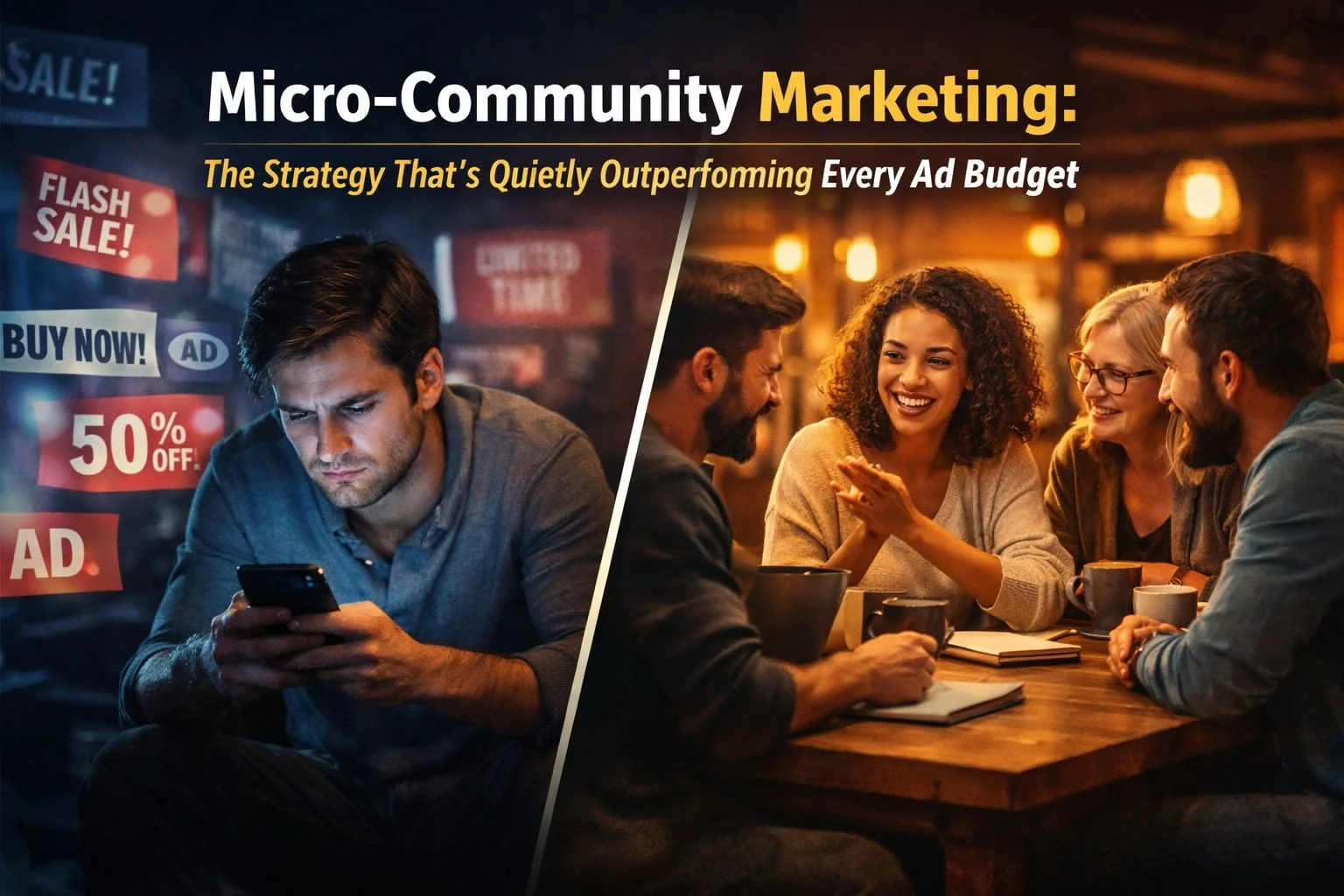
Micro-community marketing is about building small groups around a shared interest or need, then staying active in those groups so trust builds over time. Those groups can drive awareness, recommendations, and real revenue. Data from Kantar shows brands using this approach are seeing higher returns, and close to 40% of people trust recommendations from these groups like they would a personal referral. This guide breaks down how to build and grow a community that can turn into a steady source of business.
- What micro-community marketing actually is and why it works differently from influencer marketing or social media management
- Why mass marketing keeps losing ground and what the numbers say about where trust and conversions are moving
- Which platforms to use, with Discord, Reddit, Slack, and niche forums broken down by audience and use case
- How to build a micro-community strategy from the ground up, using the four-step framework B2The7 applies with growth-focused brands
- Why peer-to-peer marketing converts better than paid ads and how to tap into it without losing authenticity
- How to measure community ROI, with the metrics that connect community activity to actual revenue
- How B2The7 approaches community-led growth and what separates a real community program from one that looks good but doesn't produce results
Micro-community marketing is about bringing together a small group of people who share a common interest or need, staying involved with them, and letting that group build awareness, trust, and real buying action over time. Rather than broadcasting to millions, brands go deep with hundreds or thousands of highly relevant people in spaces like Discord servers, private Slack groups, Reddit communities, and niche forums. The result is stronger engagement, better peer advocacy, and conversion rates that broad-reach campaigns can't match.
Why Your Biggest Marketing Problem Isn't Budget. It's Trust.
This isn't a fluke. It's the market self-correcting. For the past decade, marketers chased scale: bigger audiences, wider reach, more impressions. But reach without trust is just noise, and consumers stopped listening.
What they haven't stopped doing is listening to each other. Recommendations inside tight-knit groups still feel like a message from someone who knows you. Niche community marketing gives brands a way into that dynamic without having to manufacture it.
- CPMs on Meta and TikTok are now often over $12, up sharply in the past few years
- Organic reach for brand pages keeps dropping quarter after quarter
- 74% of brands are putting real budget into community and creator programs in 2026
- People are spending more time in smaller groups where they feel like they belong
The brands winning with micro-community marketing right now aren't spending more. They're spending smarter. They're building owned trust assets that grow in value over time, rather than renting attention that disappears the moment the campaign budget runs out.
What Makes a Micro-Community Different From a Regular Audience
Most brands confuse having followers with having a community. Those are two very different things.
An audience is passive. People read a post, maybe click, then move on. In a micro-community, people interact. They talk to each other, share advice, call out bad experiences, and recommend brands that have helped them.
"A group of fifty creates repeated interaction, clearer norms, and faster trust than a crowd of fifty thousand ever will."
Community-led growth works because it goes both ways. People are not just paying attention to the brand, they are paying attention to each other. That shifts it from a one-way message to real interaction, and that is what helps it grow.
What High-Performing Micro-Communities Have in Common
Where Micro-Community Marketing Is Happening Right Now
One of the most common mistakes brands make when getting into micro-community marketing is hunting for a single platform that does everything. Different communities live on different platforms, and the right one depends entirely on who you're trying to reach.
| Platform | Best For | Avg. Daily Time | Key Advantage |
|---|---|---|---|
| Discord | Consumer brands, creator programs, developer products | 94 minutes | No CPM inflation, organic growth, voice & video native |
| Brands willing to earn trust inside existing communities | High intent | 116M daily users across 100,000+ active subreddits | |
| Slack | B2B brands targeting professional decision-makers | Work hours | Invite-only, curated, high-value peer conversations |
| Circle / Geneva | Niche creators, courses, vertical communities | Variable | Purpose-built community tools, clean member experience |
| Substack | Thought leadership, B2B, content-forward brands | Variable | Built-in audience, comments, peer discussion threads |
How to Build a Micro-Community Marketing Strategy That Actually Works
A micro-community strategy isn't about launching a Discord server, posting a few times, and checking it off the list. It takes the same discipline as any other channel that produces real results. Here's the framework B2The7 uses with growth-focused brands.
Step 1 Define the Member Promise Before You Build AnythingThe most common reason branded communities fail is that they were built around what the brand wanted, not what the member needed. Before you create a single channel or send a single invite, answer these three questions:
- Who is this community specifically for? Think in terms of role, stage, and problem, not just "our customers."
- What will members consistently get here that they can't find anywhere else?
- What does good participation look like, and how will you model it from day one?
The answers drive everything else: platform choice, content calendar, moderation approach, and how you'll grow.
Step 2 Start Smaller Than You Think You ShouldMost people try to start big and invite everyone. That usually doesn't work. A quiet group, even if it's large, won't go anywhere. A smaller group that stays active will. Start with 30 to 80 people who fit: early customers, power users, loyal buyers, or advocates. Let it settle there for a bit. Then grow step by step. Ask each member to bring in one person who fits. One strong referral beats a pile of random signups.
Step 3 Build Recurring Rituals, Not One-Off CampaignsThe difference between a community-driven brand marketing program that lasts and one that fades out is whether there are regular, predictable things members look forward to.
- Weekly threads on what people are working on or where they are stuck
- Set times where your team is available to answer questions
- Bring in guests the group actually wants to hear from
- Call out members who contribute something worth recognizing
- Give your most active people early access or previews
Drop the vanity metrics. Look at what actually ties to the business.
- Acquisition: how people get in and whether they complete onboarding
- Engagement: who shows up each week and who actually takes part
- Health: whether the group feels active, steady, and positive
- Business impact: retention, referrals, and revenue you can connect back to it
Check retention at 7, 30, and 90 days. If people join and then go quiet, the issue is how they were brought in or what they expected, not the community itself.
Why Micro-Community Marketing Outperforms Influencer Campaigns
Working with creators in the 1,000 to 100,000 follower range produces 60% higher engagement rates than macro-influencer campaigns and converts better than paid search in a lot of categories. Long-term creator partnerships deliver 2.5 times the ROI of one-off activations.
But influencer campaigns end. Community doesn't.
When you build a community with a clear purpose, it becomes something you own. It keeps bringing in feedback, referrals, and repeat customers without having to keep spending on ads. When you pair creator partnerships with an existing community, you get a compounding effect: the creator brings in new members, the community turns them into advocates, and those advocates bring in the next group.
Brands using knowledge-sharing micro-community platforms are achieving 25% higher marketing ROI, according to Kantar LIFT data. Layer long-term creator partnerships on top of that community, and the conversion economics reach a level that paid-only programs can't replicate.
The Trust Economy: Why Peer-to-Peer Marketing Converts Better Than Ads
Around 40% of people trust recommendations from smaller communities just as much as a personal referral. That is a buying signal, not just an engagement metric.
There are a few reasons for this. Feeds are crowded with the same kind of content, so brand posts don't get much attention. People scroll past ads without thinking, especially when they feel too polished. There is also more content than ever, which makes real voices easier to notice. At the same time, people are spending more time in smaller groups that match their interests.
Trust is built in these smaller groups. Brands that get involved early and show up the right way put themselves in a strong position that others will struggle to match.
Authentic Brand Engagement: What It Actually Looks Like
Show Up as a Member First, Not a Marketer
Brands that do well in micro-communities don't walk in as advertisers. They walk in as contributors. On Reddit, spend time there. Answer questions and share useful input. Don't jump in just to promote something. On Discord, stay in the conversation. Don't just post updates and disappear.
Communities pick up on self-serving intent fast. The quickest way to lose trust is to make every interaction feel like part of a campaign. The quickest way to earn it is to help people solve real problems without asking for anything back.
Close the Loop When Members Give You Feedback
One of the strongest trust signals a brand can send inside a community is following through on what members suggest and making it public. When a piece of feedback leads to a real product change, acknowledge it and credit the person who raised it. When something can't happen, explain why. Communities that feel heard become your most vocal advocates. Communities that feel ignored go somewhere else.
Lead with Value Before You Ever Ask for Anything
A strong niche audience engagement program follows a simple standard: the community should be genuinely useful to members even when the brand isn't promoting anything. Build programming that members would keep coming back to, even if the brand were never mentioned.
Micro-Community Marketing for B2B: Where Big Deals Get Started
A lot of people assume micro-community marketing is a consumer play. It isn't.
In B2B, community-led growth is reshaping how enterprise deals get done. Private Slack groups, selective LinkedIn communities, and curated Substacks are where decision-makers share vendor recommendations, discuss implementation challenges, and form opinions about vendors based on what they've heard from peers. Being genuinely present and useful in those conversations, as an expert rather than a salesperson, is one of the best ways to get into the consideration set before a formal sales process ever starts.
Prospects who know you from the community come into the sales conversation with a head start. Trust is already there.
Community members raise their hand by showing up. The leads that come in are usually a better match than cold outreach.
Customers who feel part of something stick around longer and refer more often than those who are just on a list.
How B2The7 Approaches Micro-Community Strategy for Clients
At B2The7, we don't treat micro-community marketing as an experiment or a nice-to-have. We treat it like any other channel that has to produce results, with clear expectations and real accountability, just like paid media, SEO, and content.
What we do comes down to four things that separate a working community from one that looks good on a slide.
We nail down the member promise, the niche positioning, and the measurable outcomes before a single channel gets created or a single person gets invited.
We build recurring engagement formats that generate momentum without depending on constant brand effort or one-off campaign pushes.
We connect community intelligence back to marketing, product, and customer success so value flows in both directions.
We measure community impact on CAC, retention, referrals, and revenue the same way we measure every other channel.
"The brands that will own the next phase of digital marketing aren't the ones spending the most on paid reach. They're the ones building the most trusted communities around the most specific interests."
— B2The7 Digital Growth StrategyCommon Questions About Micro-Community Marketing
Stop Renting Attention. Start Owning Trust.
Here's what it comes down to. The brands winning with micro-community marketing right now aren't the ones with the biggest budgets. They're the ones who showed up in the right communities early, built real credibility, and let trust do the work that paid campaigns can't.
A 25% lift in marketing ROI. Consumer trust on par with personal referrals. Engagement two to five times higher than what macro campaigns produce. These are real outcomes from brands already running niche community marketing programs, not projections.
You don't need a massive budget to pull this off. You need a plan, a genuine commitment to the people you're building for, and the consistency to follow through.
B2The7 has the experience, expertise, and track record to help your brand build micro-communities that produce real commercial outcomes. Not community theater. A channel that actually performs.
Ready to Build a Micro-Community Strategy That Brings in Customers?
Our Dedicated Growth Strategists will review your current community presence, identify where you're leaving revenue on the table, and map out the steps to turn peer trust into a reliable customer-acquisition channel.
Book Your Micro-Community Strategy Call →📱 Get Weekly Marketing Trend Alerts — Sign up for the Trend Brief and stay ahead of what's moving in marketing, social, and tech.