Cannes Lions 2026: AI Hype Is Over for Small Biz
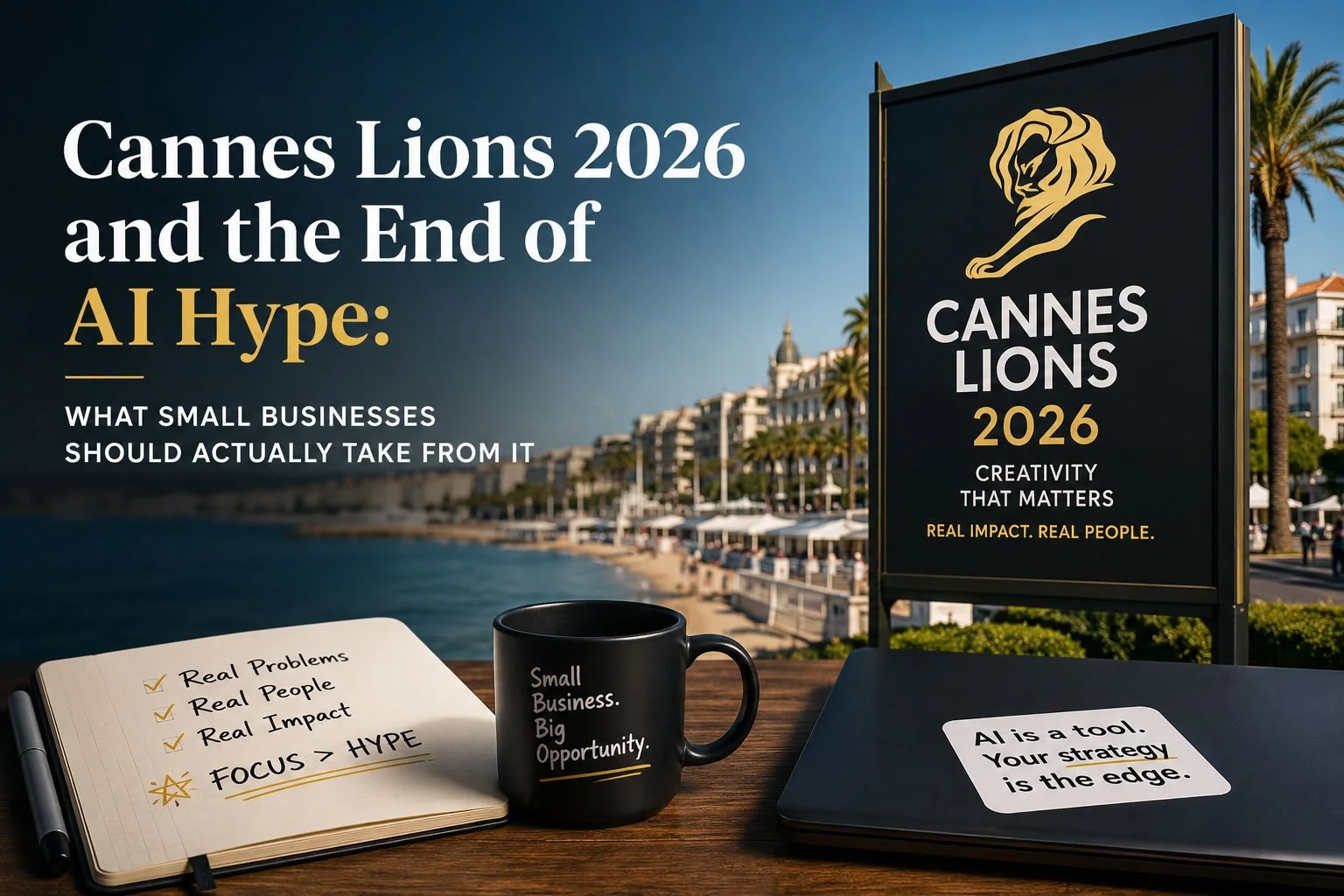
Cannes Lions 2026 runs June 22 through 26, and the dominant story heading into the advertising industry's biggest festival is that the AI hype era is officially over. Jury leaders are signaling a shift away from rewarding novelty toward demanding proof that AI driven work actually produced a result.
If you are trying to make sense of ai marketing trends 2026 small business owners actually need to pay attention to, this is the one. Using AI in your marketing is no longer impressive on its own. What matters is whether it produced something measurable.
Quick Answer: Cannes Lions 2026 runs June 22 to 26 in France, and the industry's biggest theme this year is that AI hype is over. Marketers are now judged on measurable results, not on whether they used AI. For small businesses, that shift favors real experience over flashy AI tools.
What You Will Learn
- What is actually happening at Cannes Lions 2026, and why the AI conversation has shifted
- Why proof of results is replacing novelty as the standard the industry judges itself by
- What this means if you have felt pressure to use more AI in your own marketing without knowing if it helps
- A simple way to evaluate whether an AI tool or tactic is actually worth using for your business
- Why this is actually good news for small businesses specifically
Cannes Lions happens this week. June 22 through 26. If you do not work in advertising, you have probably never paid attention to it, and that is fine. But the conversation happening there this year is actually relevant to you, even if you're running a small business in Louisville with no agency and no media budget.
Here is the headline version. For the last two years, the entire advertising industry has been obsessed with AI. Every agency pitch, every conference talk, every brand campaign seemed to lead with some version of look what we did with AI. This year, the industry itself is saying that it is over.
And I think that matters more for small businesses than for the agencies talking about it.
What Is Actually Happening at Cannes This Year
One industry writer described it directly. The fascination with AI remains, but the mood around it has clearly changed. After two years of AI-generated ads, synthetic spokespeople, and automated content flooding every feed, marketers are finally asking a less glamorous question. Did any of this actually work?
That is a real shift. Cannes Lions has, for the last couple of cycles, basically rewarded ambition with AI. Using it boldly was the story. This year, jury leaders are openly saying they expect a reckoning with authenticity and that simply using an AI tool will no longer be considered award-winning in itself. The festival even introduced a new award category, the Creative Brand Lion, specifically designed to recognize the systems and discipline behind breakthrough work, not just the flashy output.
In plain language, the industry that spent two years telling everyone AI was the future is now telling itself that using AI is no longer an achievement. The achievement is using it well enough to produce something that actually moved a business forward.
Why This Matters If You Are Not an Agency
If you run a small business, you have probably felt some version of pressure over the last two years to do more with AI. Use it for your content. Use it for your ads. Use it for your social posts. A lot of that pressure came from exactly the kind of industry hype now being walked back at the biggest stage in advertising.
And here is the thing. A lot of small businesses spent real time and money trying to keep up with that pressure without ever being sure it was making a difference. AI-generated content that all started to sound the same. Automated ad creative nobody could distinguish from a competitor's. Synthetic everything, with no clear sense of whether any of it converted better than the version that came before.
The industry is now admitting, at its own biggest event, that much of that was hype. Not because AI does not work. It can work extremely well. But because using it was treated as the win, instead of treating the result as the win.
The Shift in One Line
Did you use AI in your marketing? If yes, that was the story.
Did using AI actually produce a measurably better result than not using it? If you cannot answer that, the tool did not do its job, regardless of how advanced it sounds.
A Simple Way to Evaluate Whether AI Is Actually Helping You
Here is a practical filter, and it is the same one the industry is now applying to itself.
Before you use an AI tool for a piece of content, an ad, or a campaign, ask what specific result you expect from it. Not generally, specifically. More clicks. More calls. More time on the page. A specific number you can check afterward.
Then actually check it afterward. Did the AI-assisted version perform better than what you would have done without it? If you genuinely do not know, that is worth sitting with. It may be that the tool helped, and you haven't measured it. It may mean it didn't move anything, and you have been using it because others were.
This is not an argument against AI tools. I use them. Most small businesses doing this well use them somewhere in their workflow. The argument is against using them because their use itself feels impressive, rather than because they produced something that actually worked.
Why This Is Good News for Small Businesses Specifically
Here is the part that should actually be encouraging.
For the last two years, a small business without a big AI budget or a flashy automated content pipeline could reasonably feel behind. Every marketing conversation seemed to assume you needed sophisticated AI tooling to compete. That pressure is exactly what the industry's biggest stage is now backing away from.
What actually wins now, by the industry's own admission, is proof and authenticity over flash. That favors a small business with a real story, real client experience, and real specificity over a business with a more impressive-sounding AI stack and nothing distinct to say. I have made this argument before about how AI search visibility actually works for small businesses, and the same logic applies here. Specificity and real experience beat generic sophistication, whether you are trying to get cited by an AI search tool or trying to win attention in a crowded market.
That is genuinely good news if you have been worried that not having an enterprise AI marketing stack puts you at a disadvantage. The industry just told you, at its biggest annual event, that the stack was never the point.
What to Actually Do With This
Do not chase AI tools because they are trending. Use the ones that solve a specific problem you actually have, and measure whether they helped.
Lean into the things that are harder to fake. Real client stories. Specific experience. A point of view that comes from actually doing the work, not from a prompt. That is precisely the territory the advertising industry is now saying matters more, after two years of testing the opposite approach at scale and finding the results underwhelming.
If you want a gut check on whether something in your marketing is genuinely effective or feels current, that is a conversation worth having before you spend more time or money on it.
Frequently Asked Questions
Cannes Lions is the advertising industry's largest annual festival, held in France, where brands and agencies showcase and award the best creative marketing work of the year. It runs June 22 through 26 in 2026. Because it gathers the most influential voices in marketing, the themes that dominate the festival often signal where the broader industry is heading, including for small businesses that never attend but are affected by the same trends.
After roughly two years of heavy AI experimentation in advertising, including AI-generated ads and synthetic content, industry leaders are now asking whether any of it actually produced better results. Jury leaders at Cannes Lions 2026 have indicated that using AI alone will no longer be considered impressive. The shift is toward judging work by measurable outcomes and authenticity rather than by the novelty of the technology used.
No. It means AI tools should be evaluated by whether they produce a measurable improvement, not by whether using them feels current or sophisticated. A small business can absolutely use AI tools effectively. The shift is about expecting results rather than assuming the tool is valuable just because it is advanced.
Set a specific, measurable goal before using the tool, such as more clicks, more calls, or higher engagement on a specific type of content. Track whether the AI-assisted version actually performs better than what you would have produced without it. If you cannot answer that question after using a tool for a while, it is worth reconsidering whether it is actually contributing or just adding complexity without a clear benefit.
Because the trait the industry is now prioritizing, real specificity and authentic experience over polished AI-generated output, is something small businesses are often better positioned to deliver than larger competitors with bigger AI budgets. A business with genuine client stories and a clear point of view has an advantage in this environment that an impressive but generic AI-driven campaign does not automatically provide.
The Bottom Line
The advertising industry spent two years telling everyone that using AI was the story. This week, at its own biggest stage, it is admitting that it was the hype phase, and what actually matters is whether any of it worked.
For a small business, that is a relief, not a threat. You do not need the most advanced AI stack to compete. You need a clear sense of what you are trying to accomplish, a willingness to actually check whether your tools are helping, and the kind of specific, real experience that no amount of AI polish can fake.
If you want help thinking through which parts of your marketing are actually working and which ones feel current, that is exactly the kind of conversation I have with small business clients. Reach out at b2the7.com.